
Direct Answer: California’s updated CPRA rules now require mandatory annual cybersecurity audits for many businesses and compress breach notification deadlines to 30 days. Monterey County SMBs need to act before something goes wrong.
Most business owners in Salinas and across Monterey County didn’t get into their industry to become cybersecurity experts. A produce distribution company in the Salinas Valley, a law firm near Old Town, a nonprofit serving farmworker families — none of them have time to track every shift in California’s data privacy law. But California’s rules changed significantly as of January 1, 2026, and the gap between what most local businesses are doing and what the law now requires is wider than most people realize.
The California Privacy Rights Act (CPRA) updated enforcement framework isn’t just about consumer data rights anymore. It now carries mandatory annual cybersecurity audits, compressed breach notification deadlines, and per-record fines that can stack up fast. For a business with a few thousand customer records in a CRM, the math gets uncomfortable quickly.
This article breaks down the two changes that matter most for Monterey County businesses — the audit requirements and the breach notification clock — and explains what being unprepared actually costs.
Who Actually Has to Comply with California’s New Cybersecurity Audit Rules
The CPRA audit requirement applies to businesses that meet at least one of these thresholds:
- Annual gross revenue exceeding $26.6 million
- Personal information collected from more than 100,000 California consumers per year
- More than 50% of annual revenue derived from selling or sharing consumer personal information
A lot of Monterey County business owners read that list and assume they’re off the hook. But the thresholds are easier to hit than they look, especially once you account for how data actually moves through modern business operations.
An ag-tech company in Salinas running a CRM, a vendor portal, and employee HR software may be pulling data from thousands of California residents across all three platforms. A medical billing office in Monterey that processes patient records for multiple practices could cross the 100,000-record threshold without ever thinking of itself as a data company.
The CPRA’s audit framework covers 18 distinct technical and organizational components — including access controls, patch management, incident response documentation, and vendor risk management. Passing a future audit isn’t a one-time effort. It requires maintaining current, accurate documentation on an ongoing basis, starting now.

The 30-Day Breach Clock — And Why It Moves Faster Than You Think
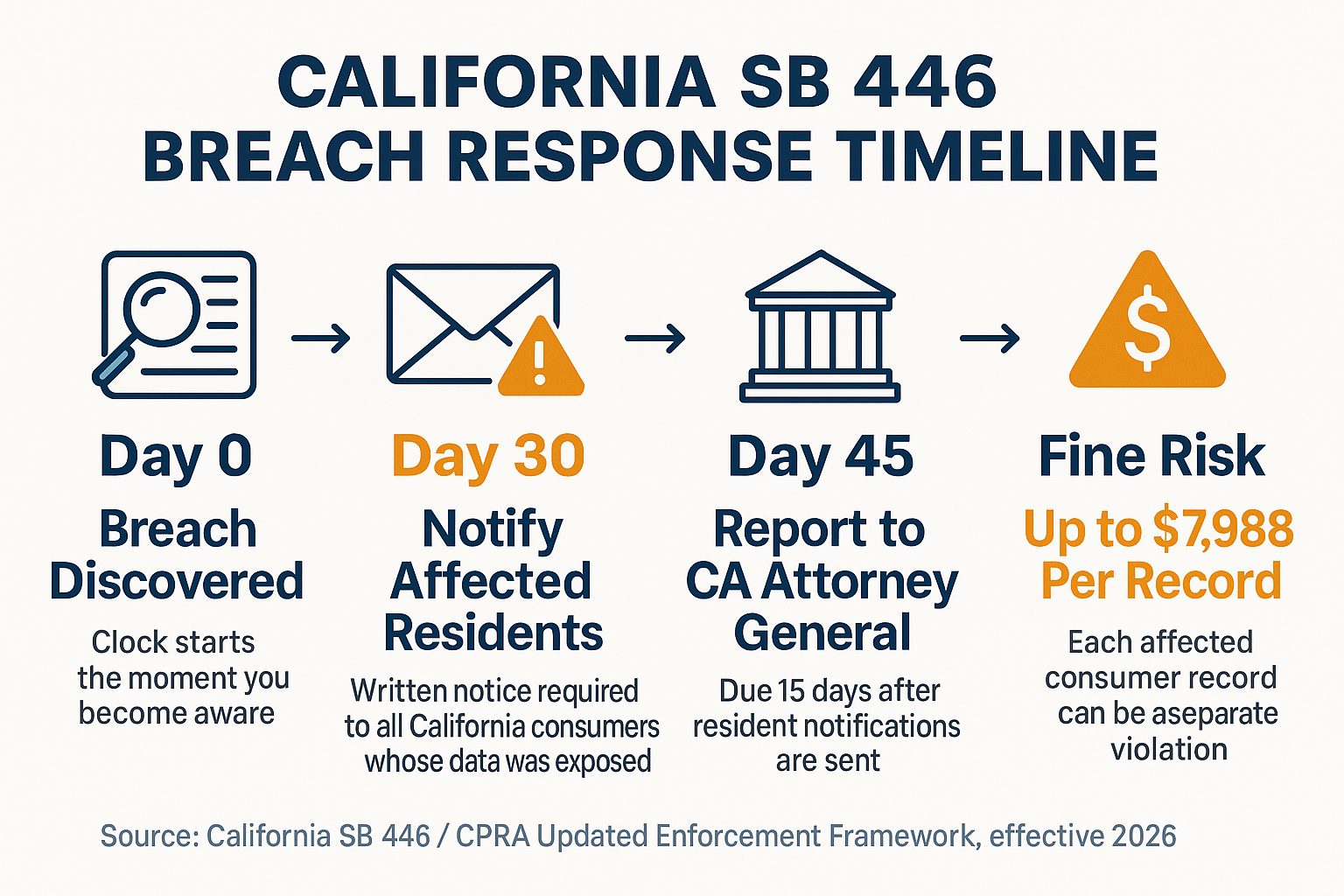
California’s SB 446 tightened breach notification timelines significantly. If your business experiences a data breach, here’s what the law now requires:
- Notify all affected California residents within 30 calendar days of discovering the breach
- Submit a report to the California Attorney General within 15 days after sending those notifications
- That’s a total window of roughly 45 days from discovery to AG filing
For a business that discovers a breach on a Friday afternoon — which is when most incidents surface — the clock is already running before anyone has identified the full scope of what happened.
Fines for non-compliance can reach $7,988 per violation, and each affected consumer record can count as a separate violation. A breach affecting 500 customer records could generate fines exceeding $4 million if notifications aren’t handled correctly and on time.
The problem for most Salinas-area businesses isn’t that they don’t care — it’s that they’ve never written an incident response plan, never practiced it, and wouldn’t know who to call at 6 p.m. on a Sunday when something breaks. As we’ve covered before, California’s new breach clock is one of the most operationally demanding changes in the state’s updated privacy framework — and most small businesses are not ready for it.
The 30-day window sounds reasonable until you’re actually in it. Identifying the scope of a breach, notifying affected individuals, and coordinating with legal counsel all take time. Without a documented and practiced incident response plan, that timeline can slip — and the fines multiply with every day of delay.
California Breach Notification Timeline at a Glance
This timeline shows every deadline a California business must hit after discovering a data breach under the updated SB 446 rules.
Why Small Businesses Are the Preferred Target Right Now
There’s a common assumption that attackers focus their energy on large enterprises — banks, hospital networks, national retailers. That assumption is wrong, and it’s expensive to hold.
SMBs accounted for over 70% of data breaches in 2025, according to recent industry data. The reason isn’t that small businesses have more valuable data. It’s that attackers now use automation to hit hundreds of smaller organizations simultaneously, rather than spending resources on a single hardened enterprise target.
A 10-person accounting firm in Monterey. A 40-person ag-tech company on the east side of Salinas. A regional nonprofit with offices in Watsonville and Hollister. These are viable, scalable targets — not collateral damage from attacks aimed elsewhere.
And the compliance exposure compounds the problem. A small business hit by ransomware doesn’t just face recovery costs. If personal data was accessed, they’re now inside that 30-day notification window with breach response they’ve never planned for. Why small businesses are now ransomware’s favorite target goes deeper on the mechanics of how this targeting works — it’s worth understanding before it becomes personal.
The businesses that handle this best aren’t necessarily the ones with the biggest IT budgets. They’re the ones that have proactive monitoring in place and documented processes before an incident happens.
CPRA Cybersecurity Audit: What the 18-Component Framework Actually Covers
California’s audit framework isn’t a single checklist item — it spans technical controls, operational policies, and vendor relationships. Here’s a summary of the major categories businesses need to address.
| Audit Category | What It Requires | Common Gap for SMBs |
|---|---|---|
| Access Controls | Documented user permissions, role-based access, MFA enforcement | Shared logins, no MFA, stale accounts from former employees |
| Patch Management | Regular, documented patching schedule for all systems and software | Updates applied reactively or not at all on older machines |
| Incident Response | Written, tested incident response plan with defined roles | No written plan; no one knows who calls whom when something happens |
| Vendor Risk Management | Third-party vendors assessed for security practices and contractual obligations | Software vendors and cloud tools never reviewed for data handling |
| Data Inventory | Accurate record of what personal data is collected, stored, and processed | No one has mapped where customer data actually lives across all platforms |
| Employee Training | Documented, recurring security awareness training for all staff | One-time onboarding mention of passwords, nothing formal since |
What Getting Audit-Ready Actually Looks Like for a Monterey County Business
The phrase “annual cybersecurity audit” sounds like something reserved for Fortune 500 legal departments. In practice, for a 30-person business in Salinas or a regional nonprofit based in Monterey, it means building and maintaining a set of documented controls that demonstrate your organization manages risk responsibly.
The businesses we see struggling most aren’t doing nothing — they have antivirus software, they use cloud email, they think they’re covered. The problem is the gap between informal good habits and the kind of audit-ready documentation California’s updated rules now demand.
A few things that need to exist before a business can credibly claim compliance readiness:
- A current data inventory — what personal information you hold, where it lives, and who can access it
- A written and tested incident response plan with named roles and defined timelines
- Vendor assessments for every third-party tool that touches personal data — CRMs, payroll platforms, cloud storage
- Access control documentation showing who has what permissions, and a process for revoking access when employees leave
- Ongoing employee security training with records to prove it happened
For businesses that don’t have dedicated IT staff — which describes most organizations in Monterey County under 150 employees — building and maintaining this infrastructure is genuinely hard to do alone. Many local organizations have looked into how small businesses in Monterey are handling IT without an in-house team as a starting point for understanding their options.
Frequently Asked Questions About California’s Cybersecurity Rules for Salinas Businesses
My business is small — do these rules actually apply to me?
Possibly. The thresholds feel large — $26.6 million in annual revenue or 100,000 California consumers — but they’re easier to hit than they appear. A business that collects data through a customer portal, a loyalty program, a vendor system, and employee HR software may be aggregating data from tens of thousands of records without realizing it. If you’re uncertain, a data inventory is the right first step.
What happens if we miss the 30-day breach notification deadline?
Fines under the CPRA enforcement framework can reach $7,988 per violation, and each affected consumer record can count separately. A breach affecting even a few hundred records can generate fines that dwarf the cost of whatever caused the incident. Missing the deadline also invites scrutiny of your overall compliance posture — which rarely helps.
We’ve never had a breach. Do we still need an incident response plan?
Yes. California’s audit framework requires that the plan be written and documented before a breach happens — not assembled during one. The 30-day notification clock doesn’t care that this is your first incident. Having a plan also tends to reduce the actual damage when something does happen, because the decisions have already been made.
How is this different from HIPAA or other compliance frameworks we already follow?
HIPAA, PCI-DSS, and similar frameworks each govern specific industries or data types. California’s CPRA audit requirements apply broadly to any business collecting personal information from California consumers above the threshold — regardless of industry. If you’re already HIPAA-compliant, you likely have some of the right building blocks, but the CPRA framework covers additional components like vendor risk management and data inventory documentation that HIPAA doesn’t address the same way.
What’s the first thing we should do if we’re not sure where we stand?
Start with a gap assessment — an honest look at which of the 18 audit components your business currently meets, which are partially in place, and which don’t exist yet. That gap list becomes your compliance roadmap. Many Monterey County businesses that believe they’re in decent shape discover significant gaps once they map their current practices against the full framework.
Want to Know Where Your Business Actually Stands?
Adaptive Information Systems works specifically with small to mid-sized businesses across Monterey County and the Salinas Valley — the same organizations navigating California’s updated cybersecurity requirements without dedicated in-house IT staff. If you’re not sure whether your current setup meets the 2026 CPRA audit framework, or if you’ve never had a documented incident response plan, that’s a reasonable place to start a conversation. Reach out to the team at (831) 644-0300 or visit adaptiveis.net to learn more.