
Direct Answer: California’s new CCPA cybersecurity audit rule requires covered businesses to conduct annual independent security audits and file a written certification with the state. Whether your business qualifies depends on revenue and data volume, not just company size.
A new California privacy law that took effect January 1, 2026 quietly added a requirement that most Monterey Bay Area business owners haven’t heard about yet: an annual cybersecurity audit conducted by an independent professional, with a written certification filed with the state. If your business handles consumer or employee data, and almost every business does, it’s worth taking a few minutes to understand whether you’re in scope.
The rule comes out of the California Consumer Privacy Act (CCPA) and is the first of its kind among U.S. state data privacy laws. A lot of local business owners, from law firms in Salinas to agricultural operations in the Salinas Valley, assume they’re too small to be covered. That assumption may be wrong. The thresholds are specific, and they’re not limited to corporations.
This article breaks down what the law actually requires, how to read the scope rules honestly, and what the audit process looks like in practice. No scare tactics, just a clear explanation of where things stand.
What the Law Actually Requires
Under the new CCPA cybersecurity audit regulations, covered businesses must complete an annual audit of their security program performed by an objective, independent professional, not a self-assessment, not an internal review. The auditor evaluates the business’s security controls against a framework of up to 18 technical and organizational components, which can include:
- Multifactor authentication practices
- Encryption of data at rest and in transit
- Account and access controls
- Vulnerability scanning and patch management
- Incident response policies and procedures
- Employee security training programs
The auditor doesn’t automatically review all 18 components for every business. They determine which apply based on the size and nature of the business’s data processing. Then they document any gaps and produce a remediation plan.
Businesses must retain that full documentation for five years. And here’s the part that matters most for enforcement: the California Privacy Protection Agency (CPPA) can demand your records within 30 days during an investigation. If you can’t produce them, that gap itself becomes a compliance problem. The Ropes & Gray analysis of the CCPA cybersecurity audit rule confirms the effective date, the 18-component framework, the five-year retention requirement, and the CPPA’s 30-day enforcement authority.

Who Is Actually In Scope
The rule covers businesses that meet the CCPA’s definition of a “covered business” and that engage in “significant risk” processing activities as defined by the regulations. The scope is tied to specific numeric thresholds, revenue and data volume, not vague descriptions of company size.
For Monterey Bay Area businesses evaluating whether they qualify, the honest starting point is to look at your annual gross revenue and the volume of California consumer records your organization processes each year. Financial services firms, legal practices, healthcare-adjacent organizations, nonprofits handling donor or client data, and agricultural operations with employee records or vendor networks are all categories where the answer may be closer to “yes” than many owners expect.
The CPPA’s enforcement division characterized 2026 as “a new era of privacy enforcement” at its September 2025 board meeting. That’s not marketing language, it signals that the agency intends to treat this audit requirement as a real enforcement priority, not a formality.
Understanding where your documentation currently stands is the practical first step. If you don’t know what your incident response policy says, or whether you have one at all, that’s the answer. For more on how California’s privacy enforcement framework is evolving, California’s New Breach Clock: What the 30-Day Rule Means for You covers the companion notification rules that affect the same businesses.
CCPA Cybersecurity Audit, Compliance Deadlines by Revenue
Deadlines are staggered by annual gross revenue. Smaller businesses have more time before their first filing deadline, but the audit period begins accumulating now.
| Annual Gross Revenue | First Audit Filing Deadline | Audit Period Covered |
|---|---|---|
| Above $100 million | April 1, 2028 | 2027 calendar year |
| $50 million – $100 million | April 1, 2029 | 2028 calendar year |
| Below $50 million (if in scope) | April 1, 2030 | January 1, 2029 forward |
Why the Phased Timeline Is Misleading for Smaller Businesses
The staggered deadlines are real, and if your revenue falls below $50 million, your first filing isn’t due until April 1, 2030. That sounds like a comfortable runway. But two things make the wait riskier than it looks.
First, the audit period for smaller businesses runs from January 1, 2029 forward, which means documentation gaps that exist today become part of the history your auditor will need to account for. Security controls that weren’t in place, incidents that weren’t properly logged, vendors that received personal data without a documented agreement, those are harder and more expensive to address retroactively than they are now.
Second, the audit requirement runs alongside a companion rule that also took effect January 1, 2026: privacy risk assessments before undertaking certain data processing activities. For professional services firms, nonprofits, and service businesses across Monterey and Salinas, that means doing a practical review of which vendors receive personal data, how employee and client records are stored, and whether the business has a written incident response plan at all.
A law firm evaluating a new managed IT provider, as several Monterey Bay Area practices have done recently, is asking exactly the right questions. What California’s New Cybersecurity Rules Mean for Salinas Businesses covers additional context specific to this region.
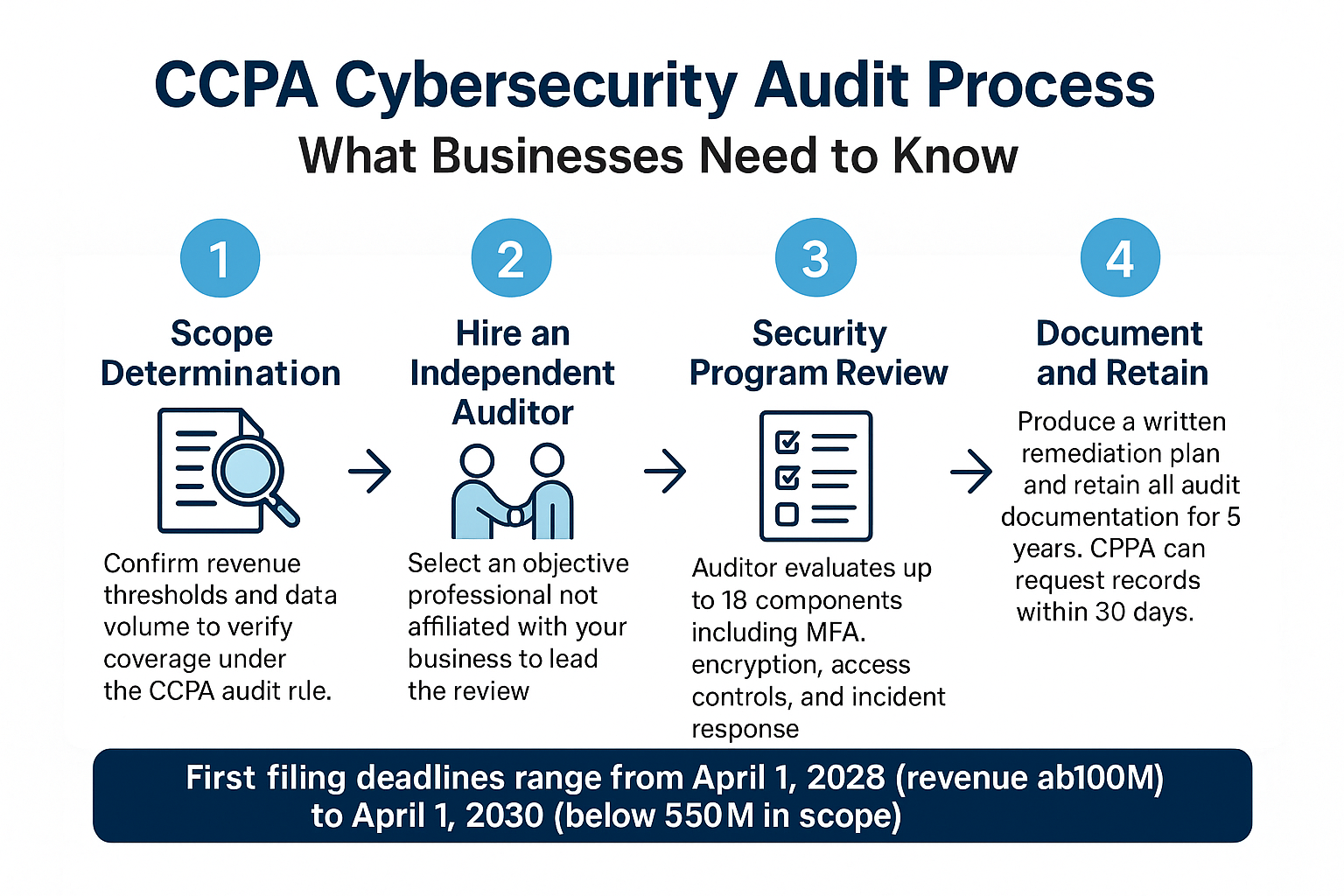
The CCPA Cybersecurity Audit Process at a Glance
This infographic outlines the four stages of the CCPA cybersecurity audit process and what businesses need to have in place at each step.
What the Penalties Look Like in Practice
The CCPA’s penalty structure is worth understanding clearly before deciding whether to take the audit requirement seriously.
Current enforcement figures set penalties at:
- Up to $2,663 per violation for standard violations
- Up to $7,988 per intentional violation
- Each affected consumer and each day of non-compliance can be treated as a separate violation
For a Salinas-area financial services firm or legal practice that processes records for hundreds of clients, the math gets uncomfortable quickly. A data incident combined with a documented failure to maintain a compliant security program could produce penalties that dwarf the cost of the audit itself.
This isn’t meant to be alarming, most businesses that take reasonable steps to understand their current security posture will find they’re closer to compliance than they think. But why small businesses are now ransomware’s favorite target explains why regulators have increased focus on smaller organizations, not just enterprises.
Frequently Asked Questions About the CCPA Cybersecurity Audit Rule
Does the audit requirement apply to small businesses with fewer than 50 employees?
Possibly. The rule is tied to revenue thresholds and data volume, not headcount. A 20-person professional services firm that processes significant consumer data could be in scope, while a larger company with a different data profile might not be. The only way to know is to look at the specific criteria, don’t assume you’re too small without checking.
Can we do the audit ourselves using internal staff?
No. The regulation specifically requires an independent, objective professional. That means someone outside your organization who has no financial or operational stake in the outcome. Internal IT staff or a current vendor don’t qualify.
What happens if we’re in scope but miss the filing deadline?
The CPPA has enforcement authority and can initiate investigations. Missing the filing deadline, or being unable to produce documentation within 30 days of a request, can result in the per-violation penalties described above. The longer a business remains non-compliant, the more exposure accumulates, since each day can be treated as a separate violation.
We already have cybersecurity tools in place. Does that mean we’re compliant?
Having tools is a good start, but the audit looks at your documented security program, not just what software you’re running. An auditor will want to see written policies, evidence that controls are actively managed, and a documented incident response plan. Many businesses have reasonable security practices but haven’t formalized the documentation the regulation requires.
Does the audit rule interact with other California compliance requirements?
Yes. The cybersecurity audit requirement runs alongside the companion privacy risk assessment rule that also took effect January 1, 2026. Businesses required to conduct risk assessments before certain data processing activities will find significant overlap between the two frameworks. Addressing them together is more efficient than treating them separately. Our article on California’s new cybersecurity rules for Salinas businesses covers how these requirements connect.
Our business handles agricultural data and employee records for seasonal workers. Are we covered?
Agricultural operations in the Salinas Valley that process large volumes of employee or vendor records, including seasonal workforce data, should evaluate their scope carefully. California’s agricultural sector is one of the largest private employers in Monterey County, and the data volumes involved in managing seasonal labor can push businesses closer to coverage thresholds than owners realize.
Ready to Understand Where Your Business Actually Stands?
If you’re a business owner or operations manager in Monterey County and you’re not sure whether your organization is in scope for the CCPA cybersecurity audit rule, or you know you’re in scope and aren’t sure where your documentation gaps are, Adaptive Information Systems works with businesses across Salinas, Monterey, Watsonville, and the broader Central Coast to assess and strengthen security programs before problems surface. You can reach the team directly at (831) 644-0300 or visit adaptiveis.net to start the conversation.