
For business owners in Salinas and Monterey County, the real cost of ignoring IT security in 2025 isn't just a tech problem—it's a direct threat to your money, your reputation, and your future. Many local business owners still believe a dangerous myth: that they're "too small to be a target." As we'll see, that mistake can cost you everything you've worked for. This guide will show you the true price of that gamble and give you practical steps to protect your business.
Why Salinas Businesses Can No Longer Gamble on IT Security
If you run a business in Monterey County, you know the value of hard work. Whether you’re managing a farm in the Salinas Valley, a hotel in Carmel, or a restaurant in Pacific Grove, you’ve built something valuable. But in 2025, a single cyberattack can put all that work at risk in an instant.
The conversation around cybersecurity has changed. It's no longer a question of if an attack will happen, but what it will cost you when it does. A lot of business owners think basic protections like antivirus software are enough. But that overlooks the deeper, more dangerous threats that are becoming common right here in our community.
Beyond the Basics: What Other IT Providers Get Wrong
Many IT providers focus on simple fixes, but they often miss the bigger picture that truly affects your bottom line. They might talk about passwords and software updates but fail to address the real-world risks your business faces every day.
Modern threats go far beyond simple viruses. We’re seeing a rise in clever attacks that target your employees and exploit the very tools you use to run your business. Some of the most common yet overlooked weak spots include:
- Social Engineering: These are tricky phishing emails that fool your staff into giving away passwords. They aren't generic spam anymore; they're targeted and look very real.
- Hybrid Work Weak Spots: When your team works from home, their unsecured networks and personal devices (often called BYOD or "Bring Your Own Device") create new, unguarded backdoors for attackers to walk right through.
- Compliance Gaps: For many local industries like healthcare or agriculture, there are strict rules for protecting data. Failing to meet regulations like HIPAA or PCI DSS can lead to huge fines on top of the costs of cleaning up a breach.
A recent report highlights a dangerous blind spot: 26% of small businesses still believe they are "too small" to be targeted by cybercriminals. This misconception leaves them wide open to attacks that are often automated and don't care about the size of your business.
The Dangers of Believing You Are "Too Small"
This belief that your business is "too small to matter" to hackers is a critical, and potentially fatal, mistake. Cybercriminals often see small and mid-sized businesses as perfect targets because they assume your security is weaker. You may not have a full-time IT department, making your business an easy win for their automated attacks.
At Adaptive Information Systems, we see firsthand how this plays out for local businesses. The risks are unique to our region. Agricultural tech companies in Salinas, for instance, hold incredibly valuable data, while hospitality businesses in Monterey process thousands of credit card payments daily. Ignoring these specific risks is no longer an option.
We help businesses understand the cyber threats no one warns small businesses about and build practical, affordable defenses. It's time to stop reacting to problems and start preventing them.
The Immediate Financial Toll of a Security Breach
When a security breach hits, the first costs you’ll face are direct, immediate, and often painful. It’s a lot like a pipe bursting in your office. You aren't just calling a plumber. You’re suddenly paying for emergency cleanup crews, replacing damaged equipment, and losing productive hours while your team can't work.
This initial financial shock is a huge part of the real cost of ignoring IT security in 2025. For a local business in Seaside or Carmel, these aren’t just numbers on a page—they're real expenses that can completely wreck your budget for the year.
The diagram below shows how a single security threat can create a domino effect, hurting both your finances and your hard-earned reputation.
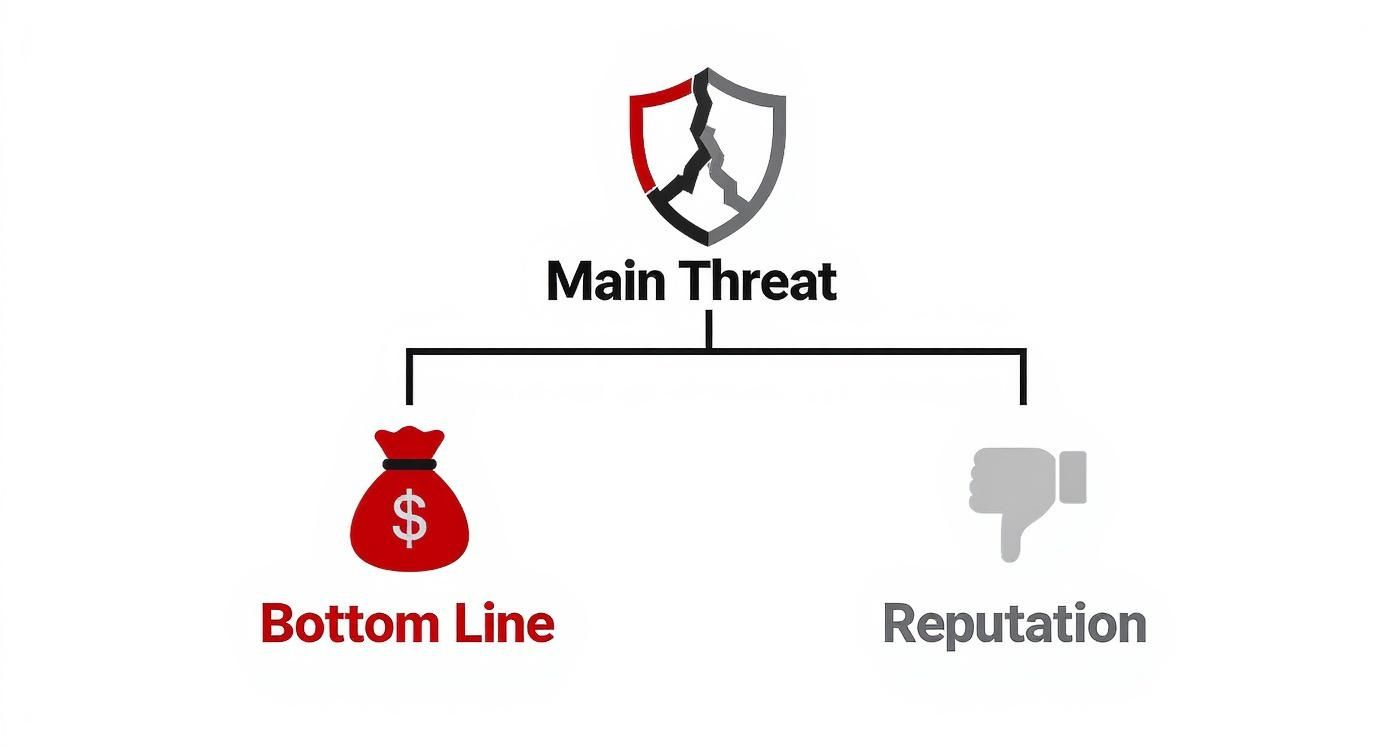
As you can see, a security failure splits into two damaging paths. One hits your bank account directly, while the other chips away at the trust you've built with your customers and community.
Dissecting the Upfront Costs
So, what does this initial bill actually look like? The moment a breach is discovered, a costly chain of events kicks off. You have to move fast, and every single action comes with a price.
The expenses start piling up almost immediately and usually fall into several key categories:
- Forensic Investigation: You'll need to hire specialists to figure out exactly how the attackers got in, what data they stole, and how much damage was done. This isn't optional—it's required to fix the problem and for any legal reporting you'll have to do.
- System Remediation and Repair: This is the heavy lifting. It includes everything from cleaning infected computers and restoring data from backups to completely rebuilding parts of your network to make sure the threat is gone.
- Legal and Compliance Fees: If any customer data was stolen, you’ll need a lawyer to help you navigate data breach notification laws. One wrong move here can lead to even bigger problems.
- Regulatory Fines: Depending on your industry, like healthcare (HIPAA) or finance, you could face severe penalties for failing to protect sensitive information. These fines can easily cost tens or even hundreds of thousands of dollars.
The table below breaks down the typical out-of-pocket expenses a small or mid-sized business can expect right after a security incident. These are the costs that hit your books first and hardest.
Direct Financial Costs of a Security Breach for an SMB
| Expense Category | Description | Typical Cost Range for an SMB |
|---|---|---|
| Forensic Investigators | Specialists hired to analyze the breach and figure out what happened. | $15,000 – $50,000+ |
| IT Remediation & Repair | Labor and hardware costs to clean systems, restore data, and fix weak spots. | $10,000 – $75,000+ |
| Legal Counsel | Lawyers specializing in data privacy to guide your response. | $5,000 – $25,000 |
| Customer Notification | Costs for printing, postage, and call centers to inform affected people. | $2,500 – $15,000 |
| Regulatory Fines | Penalties from agencies (e.g., for HIPAA or credit card data violations). | $10,000 – $250,000+ |
| Credit Monitoring Services | Offering identity theft protection to affected customers to help rebuild trust. | $1,000 – $10,000 |
These figures show just how quickly the bill can grow, turning a single cyberattack into a major financial crisis for a small business.
Why Proactive Security Pays for Itself
Ignoring cybersecurity in 2025 isn't a gamble; it's a guaranteed loss. Research shows the average cost of a data breach in the United States continues to climb, highlighting the severe financial risk businesses face right here at home.
The numbers are huge. The U.S. average has hit $10.22 million, making it the most expensive country for a data breach. What’s even scarier is that 51% of these costs hit your business within the first year, right when you're most vulnerable. This includes everything from legal fees and fines to the immediate costs of notifying customers.
A single ransomware attack can bring your entire operation to a dead stop. You're not just dealing with the pressure of a ransom demand; every minute your systems are down is a minute you aren't serving customers or making money.
These upfront costs are just the beginning. They don't even touch on the long-term damage to your reputation or the operational downtime that follows. For a closer look at one of the most common threats facing businesses today, check out our guide on how to prevent ransomware attacks.
Understanding this initial financial pain makes it clear why a proactive, layered security strategy is no longer optional—it's essential for survival.
The Hidden Costs That Cripple Businesses Long-Term
The initial bill for cleaning up a security breach is just the start. The real damage comes from the expenses that stick around, like aftershocks that can shake your business for months, if not years. These hidden costs almost always end up being larger than the immediate financial hit, making a full recovery a steep, uphill climb.
Think of it this way: the direct cost of a breach is the emergency room bill after an accident. The hidden costs are the months of physical therapy, lost income, and higher insurance premiums that follow. This is where the true price of ignoring IT security in 2025 really hits home.

The Crippling Cost of Operational Downtime
One of the most immediate and painful results is operational downtime. When ransomware locks your files or a hacker shuts down your systems, your business simply stops. Your team can't pull customer records, process orders, or send invoices. Every single minute you're offline is a minute you're losing money and productivity.
For most businesses, this isn't a small problem; it's a disaster. According to recent data, the average cost of a data breach in 2023 was a shocking $4.45 million, a number that includes huge losses from business interruption. You can learn more about how these disruptions impact your bottom line by exploring the hidden costs of IT downtime.
Damage to Your Brand and Reputation
In a tight-knit community like ours in the Monterey Bay Area, your reputation is everything. A data breach doesn't just damage your network; it shatters the trust you've spent years building with your customers and partners.
Picture a popular Pacific Grove restaurant being forced to shut down for a week because its payment system was hacked and customer credit card data was stolen. The lost sales are bad enough, but the real damage is the long-term loss of trust. Will locals feel safe using their cards there again? Will tourists hear the story and decide to eat somewhere else?
After a breach, customer trust disappears quickly. News travels fast, and once your business gets labeled as "unsafe," winning back public confidence is an exhausting battle that can take years.
This damage to your reputation leads to very real, very painful results:
- Customer Churn: Your loyal clients may quietly take their business to competitors they feel are more secure.
- Difficulty Attracting New Business: Potential customers will think twice before working with a company that has a history of security failures.
- Negative Word-of-Mouth: Your standing in the community can be permanently damaged, impacting everything from local partnerships to your ability to hire good people.
Skyrocketing Insurance Premiums
Another nasty surprise waiting for many business owners is the hit to their cyber insurance. After a security incident, you can bet your premiums will skyrocket—if you can even get coverage at all.
Insurance companies see a breached business as a high-risk client. At your next renewal, they'll either raise your rates a lot or, in some cases, simply refuse to renew your policy. This leaves you even more exposed to future attacks, forcing you to carry all the financial risk yourself.
Finally, there’s the quiet theft of your secret business information. For many businesses, your competitive edge is in your data—customer lists, special formulas, or unique product designs. When a breach happens, this priceless information can be stolen and sold, causing permanent harm to your future growth. These are the silent costs that can slowly bleed a business dry long after the initial attack is over.
For a lot of businesses here in Monterey County—especially if you're in healthcare, finance, or even retail—data security isn't just a good idea. It's the law.
When a security breach happens, it's more than a tech headache; it's a legal landmine. The moment sensitive data gets out, a countdown starts. That clock ticks down to a whole mess of regulatory demands, government reporting, and some very painful audits.
Ignoring those duties simply isn't an option. The fines are often severe enough to cripple a healthy local business. This is exactly why a proactive, compliance-focused security strategy is so important. You're building a defense not just against hackers, but against the punishing legal storm that follows an attack.
Navigating the Alphabet Soup of Compliance
You've probably heard acronyms like HIPAA or PCI DSS, but what do they actually mean for your business? Think of them as rulebooks for protecting consumer data. If you don't follow them, you're putting your business directly in the sights of regulators.
Here’s a quick, simple breakdown of what's at stake:
- HIPAA (Health Insurance Portability and Accountability Act): If you handle any patient health information—from a dental office in Marina to a medical billing service in Salinas—this is your world. A single violation can trigger fines from $100 to $50,000, which can add up to a massive $1.5 million per year.
- PCI DSS (Payment Card Industry Data Security Standard): Any business that takes credit cards has to follow these rules. If you don't, you could be looking at fines from $5,000 to $100,000 per month until the problems are fixed.
- CCPA (California Consumer Privacy Act): This law gives Californians control over their personal data. If a breach exposes unencrypted information, the penalties can hit $7,500 per violation. For a breach that affects just 100 customers, that’s a potential $750,000 fine.
These aren't just imaginary numbers. Government agencies are actively enforcing these rules, and they don’t make exceptions for small businesses.
The Real-World Consequences of Non-Compliance
A data breach transforms from a private crisis into a public legal battle almost overnight. The process is both exhausting and expensive. First, you have to notify every single person whose data might have been exposed. Then come the government investigations and required audits to figure out if your security measures were good enough.
A failed audit due to outdated software or weak security can do more than just trigger fines. We’ve seen businesses lose major contracts because their security didn't meet a potential partner's standards, costing them hundreds of thousands in future sales.
This is where having a clear, documented security plan becomes your best defense. It shows you took your legal duties seriously from the start. To get a handle on where you stand, it's a good idea to review a helpful small business compliance checklist.
Protecting your business means understanding that the real cost of ignoring IT security in 2025 is baked into these massive legal and financial penalties. At Adaptive Information Systems, we help Salinas businesses build security plans that not only stop hackers but also satisfy regulators. It's about making sure your business stays on the right side of the law, protecting both your customers and your future.
The Opportunity Cost: What You Lose by Standing Still
So far, we’ve covered the painful, clear costs that show up after a security breach—the direct cleanup bills, the hidden operational expenses, and the legal nightmares. But there’s another, more subtle cost we need to talk about: the opportunity cost.
This isn't about the money you have to spend when things go wrong. It’s about the money you fail to make and the growth you give up by treating security as a low priority.
It’s easy to think of cybersecurity as just another expense. The smarter way to see it is as a business advantage. When your security is an obvious weak point, you aren't just open to attacks. You're quietly closing doors to bigger and better opportunities before you even get a chance to walk through them.
When Weak Security Gets You Disqualified from Growth
Imagine this: your Salinas-based ag-tech company is about to land a huge contract with a national distributor. It's the kind of deal that could double your revenue. But during their normal review process, they ask for proof of your cybersecurity measures. Your basic, off-the-shelf setup doesn't even come close to meeting their strict vendor requirements.
Just like that, the deal is dead.
This exact situation happens all the time. Larger clients and partners, especially those in finance, healthcare, and government, have incredibly high security standards. They simply cannot afford to partner with a vendor who could become the weak link in their own security.
A strong security posture isn't just a defensive shield. It’s a key that unlocks access to bigger, more profitable markets. It sends a clear signal that you are a reliable, professional, and trustworthy partner.
The Innovation You Sacrifice for Damage Control
Perhaps the biggest opportunity cost of all is the theft of your time, energy, and focus. Every single moment you and your best people spend dealing with a preventable security problem is a moment stolen directly from growth and innovation.
Instead of planning your next marketing campaign or improving a new service, you're stuck in damage control. Your key employees are tied up in meetings with investigators, on the phone calming down upset customers, and desperately trying to fix a broken system.
When all your resources are being poured into cleaning up a mess, your business isn't moving forward. It’s stuck in neutral or, even worse, sliding backward as your competitors grab the opportunities you're now too distracted to even see.
Think about what your team could achieve if they weren't bogged down by security headaches:
- Developing New Products: The hours spent fixing a security hole could have been used to build that new feature your customers have been asking for.
- Expanding Your Market: The budget you spent on breach cleanup could have funded an expansion into a new area like Marina or Seaside.
- Improving Customer Experience: The intense focus on restoring systems could have gone toward creating a better, more efficient service for your clients.
Understanding the real return on investment of cybersecurity helps show why this is a business decision, not just a technical one. Investing in strong, proactive security is really an investment in your own future. It builds the stable foundation you need to stop reacting to problems and start focusing on what you do best—growing your business.
Your Proactive Security Plan for 2025

Understanding the risks is one thing, but turning that knowledge into action is what will actually protect your business. This is your practical, no-nonsense game plan for 2025. We're skipping the generic advice like "use strong passwords" and jumping straight to the strategies that make a real difference for businesses here in Salinas and across Monterey Bay.
The goal is simple: turn cybersecurity from a confusing headache into a real business advantage. It's all about building a smart, layered defense that lets you get back to what you do best—serving your customers and growing your company.
Start with the Human Firewall
Your employees are your greatest asset, but if they're untrained, they can also be your biggest security risk. Modern cyberattacks are clever. They often target people, not just computers, using social engineering to trick someone into giving away the keys.
This is exactly why regular security awareness training isn't just a good idea—it's essential. It's the most effective defense you can build against phishing, which remains the number one way ransomware gets into a business. A well-trained team becomes a powerful human firewall, spotting and flagging suspicious emails before they can do any damage.
Here's what good training actually looks like:
- Phishing Simulations: Send out safe, fake phishing emails to your team regularly. It's the best way to test their awareness in a real-world way without any risk, helping them learn to spot red flags firsthand.
- Clear Reporting Procedures: Make it incredibly easy for an employee to report a suspicious email. Creating a "when in doubt, report it" culture is one of the strongest security moves you can make.
- Focus on Real-World Threats: Ditch the generic examples. Tailor your training to the kinds of scams your industry actually sees, whether it's fake invoices for your hospitality business or fake wire transfer requests at a financial firm.
Implement High-Impact Technical Controls
While training your team is critical, you need strong technical tools backing them up. These are the practical tools that block attacks automatically and drastically shrink your chances of getting hit. Think of them as the digital locks, alarm systems, and security cameras for your business data.
A modern security strategy goes way beyond basic antivirus software. It involves layers of protection that work together to secure your data from every possible angle. If you're a business owner in Marina or the surrounding area, these three areas are where you should focus your investment first.
With 80% of small businesses planning to increase their cybersecurity budgets, the question isn't if you should invest, but where to invest for the biggest impact. Focusing on these proven, foundational security measures always delivers the best return.
Three non-negotiable security layers for 2025 include:
- Multi-Factor Authentication (MFA): This is the single most effective security step you can take. MFA requires a second form of verification—like a code sent to a phone—before letting someone log in. This one simple step can block over 99.9% of account hacking attacks.
- Network Segmentation: Don't let your entire business run on one big, flat network. Segmentation is like building firewalls inside your building; it divides your network into smaller, isolated zones. If an attacker gets into one area, they can't easily move over to access your most critical data, like financial records or customer files.
- Proactive Patch Management: Outdated software is a hacker's favorite way in. A proactive patch management plan makes sure that all your systems, from servers to employee laptops, are always updated with the latest security fixes. It's the digital equivalent of locking your doors and windows to known threats.
Partner with a Local Expert
For most small and mid-sized business owners, trying to manage all of this in-house just isn't realistic. Only about 30% of small businesses handle their own security, and for good reason. It demands special knowledge, constant attention, and a huge time commitment you probably don't have.
This is where partnering with a trusted local provider like Adaptive Information Systems makes all the difference. We bring big-company security tools and expertise to your business at a price that makes sense for you. We can help you build and manage a strong security plan, starting with a full look at where your risks are today. A great place to start is by learning about our cybersecurity risk assessment template to see what a truly thorough review involves.
Let’s work together to protect everything you’ve built.
Got Questions About IT Security Costs? We've Got Answers.
We've walked through the financial, operational, and reputational disasters that can come from weak security. Now, let’s answer some of the most common—and most important—questions we hear from business owners right here in Monterey County about the real cost of ignoring IT security in 2025.
"My Business Is Small. Am I Really a Target for Cybercriminals?"
Yes, you are. In fact, hackers often see small businesses as easy targets because they assume you have fewer security resources. It’s nothing personal; they use automated tools to constantly scan the internet for any weakness, and your business size doesn't make you invisible.
Worse yet, if you're a supplier or partner to a larger company, you can become an attractive backdoor for an attack on them. The myth that you're "too small to be a target" is one of the most dangerous and expensive assumptions a business owner can make.
"Isn't Antivirus Software Enough to Protect My Company?"
While you absolutely need it, relying only on antivirus software today is like locking your front door but leaving all the windows wide open. Today's biggest threats, like clever phishing emails and ransomware, are designed to sneak right past traditional antivirus programs.
Think of antivirus as the lock on your front door. You still need locks on the windows, a security alarm, and a clear process for who gets a key. A complete, modern defense includes firewalls, multi-factor authentication (MFA), regular employee training, and proactive system monitoring.
"How Can I Possibly Afford Expert IT Security on a Small Business Budget?"
This is a completely valid concern, and it’s why partnering with a local IT expert like Adaptive makes so much sense for businesses our size. Instead of taking on the huge cost of hiring an in-house cybersecurity specialist, you get access to an entire team of experts for a predictable, flat monthly fee.
This model makes top-tier protection affordable. We handle the constant monitoring, critical updates, and strategic planning, which frees you up to focus on running your business. You get enterprise-level IT security at a price that works for your budget.
If you're a business owner in Salinas or the surrounding area, now’s the time to re-evaluate your cybersecurity strategy. Reach out to Adaptive Information Systems for expert, affordable support tailored to your specific needs. Let’s protect what you’ve built — together.
Adaptive Information Systems
380 Main St, Salinas CA 93901 | 831-644-0300 | hello@adaptiveis.net