The single biggest myth threatening businesses in Salinas and across Monterey County is the belief that you're too small to be a target. Many owners think hackers only go after big corporations, but the opposite is true. Hackers see small businesses as easy targets because their digital security is often weaker. For any modern company, a cyberattack is a matter of ‘when,’ not ‘if.’ Let's bust the myths that put your business at risk and show you what you really need to know.
Your Salinas Business Is a Bigger Target Than You Think
As a business owner in Salinas, you’re busy. You're focused on managing your team, serving customers, and growing your company. It’s easy to think that cybersecurity is a problem for big tech companies in Silicon Valley, not for a local shop, a hospitality business in Monterey, or an agricultural supplier here in the valley.
But this is a dangerous and costly assumption.
Cybercriminals don’t pick their targets one by one. They use automated programs that constantly scan the internet for any weakness they can find. To them, your business is just as visible as a huge corporation. Think of it like a thief walking down a street checking car doors. They aren't looking for the fanciest car—they're looking for the one that's unlocked. Too often, small businesses leave their digital doors wide open.
Why Small Businesses Are So Appealing to Hackers
From a cybercriminal's point of view, the logic is simple. Why spend months trying to break into a corporate fortress when thousands of smaller businesses have their gates unguarded? Many small companies have limited IT resources and a "set it and forget it" mindset, which creates the perfect opportunity for an attack.
Here’s why your business is on their radar:
- You Have Valuable Data: Don't underestimate what your information is worth. Customer lists, employee details, and financial records are all valuable on the dark web.
- You're a Gateway: Hackers often use smaller, less secure businesses as a stepping stone to attack their larger partners. A breach at your company could be the entry point to your entire supply chain.
- You're More Likely to Pay: Without a dedicated IT team or a recovery plan, you’re more likely to pay a ransomware demand just to get your business back online quickly. Hackers know this.
The numbers tell a scary story. A recent Q4 2025 report found that 26% of small and mid-sized business (SMB) owners still believe they are “too small” to be targeted. This is terrifying when you consider that 79% of those same businesses have been hit by a cyberattack in the last five years.
"The 'it won't happen to me' mindset is the biggest vulnerability any business has. Today, proactive security isn't just for big companies; it's essential for survival, no matter your size."
The Real-World Impact on Local Businesses
For a small business right here in our community—whether you're in hospitality in Carmel or agriculture in the Salinas Valley—the effects of a breach can be devastating. It's not just about losing money to a ransomware payment.
Downtime can bring your entire operation to a halt, leading to lost sales and unhappy customers. The costs of recovering data, notifying clients, and repairing your reputation can easily add up to tens of thousands of dollars. Understanding what you're up against is the first step, and for practical advice, this essential guide to network security for small businesses is a great starting point.
The world of cyber threats changes constantly. What worked to protect a business a few years ago is no longer enough. To learn more about today's challenges, you can read about how cyber threats are evolving and why some common advice is now dangerously out of date.
At Adaptive Information Systems, we help local SMBs get past these myths. We provide clear, affordable IT support that protects your business and your future. Don’t let a common misconception put everything you've worked for at risk.
Why 'Do-It-Yourself' IT Is Costing You More Than You Realize

As a small business owner, you wear many hats. You’re the CEO, the head of sales, and the marketing director all at once. But when you add "IT guy" to the list, you’re taking on a role with hidden costs and big risks.
The idea that DIY IT saves money is one of the most damaging myths out there. Think of it this way: would you try to do the electrical wiring for your new office just to save a few bucks? Of course not. The risk of a fire is too high. Your business technology works the same way—one small mistake can lead to a disaster.
The Hidden Costs of Managing Your Own Tech
When you or an employee who isn't an IT expert handles your technology, you aren’t really saving money. You're trading it for costs that are harder to see on a balance sheet. These "soft costs" add up fast and can hurt your productivity.
The real price of DIY IT shows up in a few key places:
- Lost Productivity: Every hour you or a team member spends trying to fix a printer, wrestle with software, or deal with a virus is an hour not spent on customers or growing the business.
- Increased Downtime: Without an expert, a small glitch can quickly turn into a system-wide crash, bringing your entire business to a halt.
- Security Gaps: Proactive security is a full-time job. A DIY approach often misses critical security patches, leaving you wide open to the attacks we just talked about.
- Data Loss Risk: Improperly set up backups (or no backups at all) can mean losing everything—financial records, customer lists, and all of your critical data.
Your Time Is Your Most Valuable Asset
Think about the last tech problem you had. How many hours did you lose searching online forums or sitting on hold with a support line? Now, multiply that time by what your hour is worth. The cost becomes painfully clear.
Your expertise is in running your business, whether that’s in hospitality in Monterey or education in Seaside. Our expertise is in managing the technology that supports it. Every moment you’re pulled away from your core strengths is a direct cost to your company.
A professional IT partner acts as your dedicated tech department for a predictable monthly fee—often for less than what you’d pay a part-time employee. We handle the monitoring, updates, security, and troubleshooting so you can get back to focusing on what you do best.
Deciding on the right path can be tricky. That’s why we created a guide to help you figure out if you should hire or outsource your IT.
By switching from a reactive, DIY approach to a proactive, managed one, you’re not just buying tech support. You’re investing in stability, security, and peace of mind. It's a key step in busting the biggest tech myths and setting your business up for success.
The Truth About Cloud Technology for Your Business
When you hear "the cloud," what do you think of? For many business owners, it sounds like something expensive and complicated, built only for giant companies. It can feel completely out of reach for a local business.
That’s one of the biggest myths we hear, and it’s time to set the record straight. The cloud is actually one of the most powerful and affordable tools a small business can use.
Here's a better way to think about it: instead of building your own expensive warehouse to store all your data (and paying for security, maintenance, and insurance), the cloud is like renting a super-secure, professionally managed storage unit. You get all the top-level benefits without the high upfront cost and constant headaches.
What the Cloud Really Means for Your Business
For businesses right here in Carmel and Pacific Grove, the cloud isn't some far-off idea. It offers real benefits that help you run a leaner, more competitive company. It’s all about making your daily work simpler, safer, and more flexible.
So, what does that actually look like day-to-day?
- Work From Anywhere, Securely: Your team can access everything they need—files, applications, you name it—from the office, from home, or while on the go.
- Updates on Autopilot: Forget about manual software updates and security patches. They’re handled automatically in the background, so you’re always using the latest, most secure versions.
- Bulletproof Data Backup: Your most important business data is backed up automatically to a secure, offsite location. This protects you from almost anything—hardware failure, theft, or a local disaster.
- Ditch the Server Closet: You no longer need a noisy, power-hungry server humming away in a closet. The cloud provider takes care of all that for you.
The cloud levels the playing field. It gives your small business access to the same powerful technology and strong security that, until recently, was only available to companies with huge IT departments.
Making Technology an Asset, Not a Hassle
Here’s something that might surprise you: you’re probably already using cloud technology every day. If your business uses email like Gmail or tools like Microsoft 365, you're already in the cloud. These aren't just minor upgrades; they are the foundation of modern business efficiency.
Take Microsoft 365. It gives your team the power to edit documents together in real-time, share calendars instantly, and join video meetings from anywhere, all for a predictable monthly fee. This isn't a luxury anymore—it's how you stay competitive.
The goal is to stop worrying about physical hardware and start thinking about how technology can help you grow. Making the move to the cloud might seem like a huge project, but it doesn't have to be painful. For anyone thinking about it, you can learn about smart methods to streamline cloud migration to make the switch a smooth one.
At Adaptive, our job is to make the cloud simple for local businesses. We'll show you affordable, secure solutions that can completely change how you operate, boost your team's productivity, and give you peace of mind that your data is always safe.
Seeing Technology as a Growth Investment, Not a Cost
It’s easy to look at technology as just another expense—a necessary evil you have to pay for. But that mindset is one of the biggest myths holding small businesses back. Smart technology isn't a cost; it's one of the best investments you can make in your company's future.
When you change your perspective, you stop asking, "How much does this cost?" and start asking, "What return will this give me?" The answers can completely change how you run your business. That modern VoIP phone system isn't just another bill; it's the tool that makes sure you never miss an important client call. New software isn't just a subscription fee; it's what automates tedious tasks, freeing up your team for more important work.
This infographic shows how other businesses are already making this shift and investing in growth.
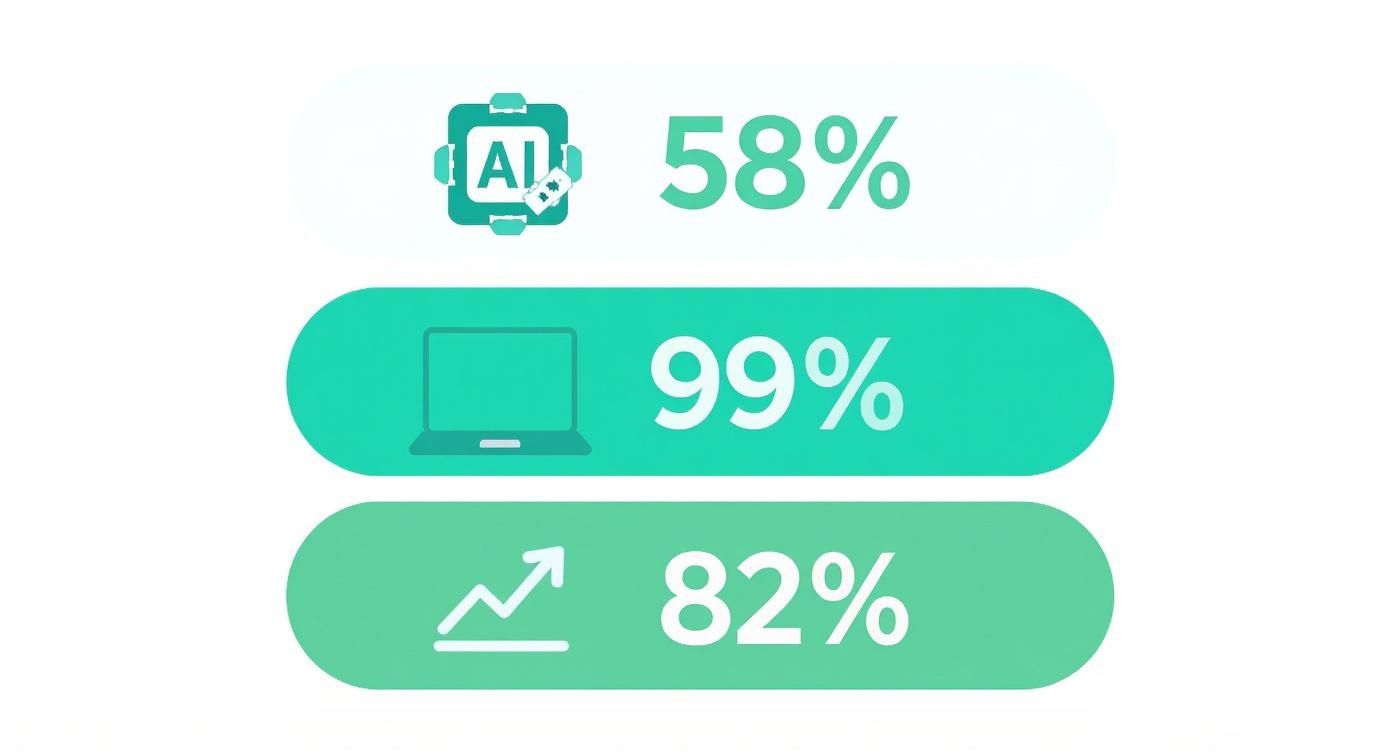
The numbers don't lie. Small businesses aren't just adopting new tech; they're using it to hire more people and grow faster. So much for the idea that tech just replaces jobs.
From Expense Sheet to Growth Engine
Thinking of tech as an investment means focusing on the value it creates. Every dollar you spend on the right tools should come back to you, whether through more sales, better productivity, or stronger security that prevents a costly disaster. This is how a local business can operate with the efficiency of a much larger competitor.
Consider a few real-world examples:
- Better Customer Engagement: Modern tools can completely change how you connect with your customers. For example, learning how SMS blast software for unlocking growth can boost your marketing with real results is a perfect example of tech driving growth.
- Improved Efficiency: The right software can automate everything from invoicing to inventory. This cuts down on human error and frees up hours every week for more strategic work.
- Stronger Security: Investing in proactive security isn’t just about avoiding a data breach. It’s about protecting your reputation and making sure your business can keep running no matter what.
A simple change in perspective from "cost" to "investment" reframes the entire conversation. It's not about spending money; it's about putting your money to work for you.
Tech Myth vs. Investment Reality
| Common Myth (Tech as a Cost) | Investment Reality (Tech as a Growth Driver) |
|---|---|
| "How can I cut my IT budget?" | "Which tools will give me the best return?" |
| "It's just another operational expense." | "This will automate 10 hours of manual work a week." |
| "We'll upgrade when the old system breaks." | "Proactive upgrades prevent expensive downtime." |
| "New tech is too expensive for us." | "Subscription models make powerful tools affordable." |
This table shows the key difference between a reactive, cost-cutting approach and a proactive, growth-focused one. The second is where successful businesses thrive.
Busting the "New Tech Is Too Expensive" Myth
One of the biggest hurdles for small businesses is the fear of high upfront costs. A decade ago, that was a real concern. But today, the game has completely changed. You no longer need to buy expensive servers or clunky software.
The modern tech world runs on affordable, subscription-based models. This gives your business access to the same powerful, enterprise-level tools that large corporations use, all for a predictable and manageable monthly fee. It’s a total game-changer for tight budgets.
A major myth is that advanced tools like artificial intelligence are only for big companies. The reality? AI use by U.S. small businesses has jumped from 23% to 58% in just two years. This is part of a larger trend where 99% of small businesses use at least one technology platform to stay competitive.
And here’s the kicker: 82% of small businesses that brought in AI actually increased their staff. This proves that technology is a powerful tool for creating jobs and expanding your business.
At Adaptive, we specialize in finding these high-value, budget-friendly solutions for businesses just like yours. We help you find the right technology that fits your budget and helps you reach your growth goals.
Shifting From Reactive Fixes to Proactive Support

Does this sound familiar? You only think about IT when a computer dies, the internet goes out, or an error message pops up. If so, you're stuck in the "break-fix" cycle—a surprisingly expensive and outdated way to handle your business technology.
Relying on break-fix support is like only going to the doctor when you’re already in the emergency room. A much better approach is to get regular check-ups to catch small problems before they become serious. Proactive IT support applies that same idea to your business.
Instead of waiting for a crisis, a proactive approach is all about keeping your technology healthy from day one. It’s focused on stopping problems before they can shut down your business, saving you from the stress and high costs of emergency repairs.
The Power of a Proactive Mindset
Switching from reactive to proactive IT completely changes the game. Your IT partner is no longer just someone you call when things go wrong. They become part of your team, making sure your technology helps your business move forward, not holds it back.
This forward-thinking strategy involves a few key things:
- Continuous Monitoring: We keep a watchful eye on your systems 24/7, spotting and fixing small issues before they can cause major downtime.
- Regular Maintenance: Just like changing the oil in your car, we perform routine updates and tune-ups to keep your network and computers running at their best.
- Strategic Planning: We work with you to plan your technology needs for the future, ensuring your IT can support your business as it grows.
The goal of proactive support isn't just to fix things faster. It's to create a stable, secure, and reliable technology environment where fewer things break in the first place.
This approach dramatically reduces emergencies, strengthens your security against cyber threats, and ensures your technology is always an asset. To get a better sense of how it all works, check out our guide on what managed IT support really means for your business.
Debunking the Affordability Myth
Many business owners think proactive IT support is a luxury they can't afford. But the idea that small businesses are priced out of modern technology just isn't true anymore.
Recent data shows that 57% of small businesses have adopted new technologies in the last two years. While big corporations might be adopting things like AI more quickly, it's clear that technology is within reach for smaller companies, too. In fact, many businesses find that a predictable, proactive IT plan is much more budget-friendly than the unpredictable costs of emergency break-fix services.
Proactive vs. Reactive Support: A Quick Comparison
The difference becomes crystal clear when you put the two models side-by-side.
| Reactive "Break-Fix" Model | Proactive Managed Support Model |
|---|---|
| Focus: Fixing problems after they happen | Focus: Preventing problems before they start |
| Cost: Unpredictable, often high emergency fees | Cost: Predictable, flat monthly fee |
| Downtime: Frequent and disruptive | Downtime: Minimized through constant monitoring |
| Relationship: Transactional (you call, we fix) | Relationship: Partnership (we help you grow) |
A reactive approach leaves you constantly dealing with unexpected costs and frustrating problems. A proactive strategy, on the other hand, delivers stability, security, and peace of mind. By moving past the myth that you only need IT when something is broken, you can build a much stronger and more resilient business.
Why Tech Is a Powerful Tool, Not a Magic Solution
Let's bust one final, important myth. Too many business owners see technology as a magic wand that can instantly solve all their problems. But the truth is that technology, no matter how advanced, is just a tool. It’s an amplifier, not a replacement for a solid business plan.
Even the best software can't fix a broken business model, patch up poor customer service, or create a strong company culture. Technology works best when it supports and improves processes that are already working. If your current workflow is a tangled mess, automating it will only help you make the same mistakes faster.
Technology Amplifies What's Already There
Think of technology like a megaphone. If you have a clear, valuable message, the megaphone helps you share it with a wider audience. But if your message is weak or confusing, the megaphone just blasts that confusion for everyone to hear.
This same idea applies to your daily operations.
- Good Processes Become Great: A clear sales process, boosted by the right software, becomes a powerhouse for growth.
- Bad Processes Get Worse: An unreliable inventory system that you digitize without fixing the real issues will only make errors bigger, leading to stockouts or overages.
Technology is great at making efficient operations even better, but it's terrible at fixing broken ones. It has a way of highlighting your strengths and exposing your weaknesses.
Strategy First, Tools Second
One of the most common mistakes we see is businesses buying a tool to solve a problem they haven't fully defined yet. You absolutely need a clear strategy before you invest in a solution. A true IT partner gets this. They don't just sell you software; they take the time to understand your real-world goals first.
The most successful businesses don’t just buy technology; they align it with their core goals. The key is to find a tool that fits your strategy, not to change your strategy to fit a new tool.
This is where a local partner like Adaptive Information Systems makes a real difference. We go beyond just installing systems. We work with you to make sure the technology you choose directly supports your business goals, whether that’s boosting productivity in your Seaside office or securing data for your agricultural operations in the Salinas Valley.
It's a common myth that tech can solve all the challenges a small business faces. While technology is critical, small businesses still deal with big economic hurdles. Small businesses make up 99.9% of all U.S. companies, yet they face barriers like inflation and complex regulations. Technology can certainly help—8-in-10 owners say it helps them handle these issues—but it isn't a silver bullet. You can read more about the challenges small businesses face and see how tech fits into the bigger picture.
Ultimately, technology is a powerful tool. When you pair it with a smart strategy and solid business practices, it can give you a serious competitive advantage. Our job is to help you make that connection, turning your IT from a simple expense into an engine for success.
Turn Tech Confusion into a Competitive Advantage
We’ve just busted some of the most common tech myths that hold small businesses back. To move forward, you need to make decisions with confidence, knowing that old ideas about security, cost, and IT support are risks you can't afford to take.
Relying on tech myths to guide your business is like trying to navigate the backroads of Monterey County with a map from 1985—you simply won’t get where you need to go.
The good news? You don’t have to figure this all out alone. You have a local, approachable expert ready to help.
Your Local Partner in Smart Technology
This is where Adaptive Information Systems comes in. We’re not some faceless national company; we are part of the Salinas community, dedicated to helping businesses like yours across Monterey County make smart IT decisions. Our mission is simple: bring enterprise-level IT to the table at an affordable price for local SMBs.
We believe great IT support is built on a relationship. That’s why we take the time to understand your unique challenges and goals. It’s how we become more than just a vendor—we become a trusted advisor. You can read more on how educational content builds better IT relationships in our related article.
Don’t let common myths put your business at risk. The difference between struggling with technology and using it to grow is having the right partner by your side. A proactive approach turns your IT from a source of stress into your greatest competitive asset.
We specialize in translating complex tech jargon into plain English, helping you see exactly what you need and what you don’t. Whether it’s setting up managed security, VoIP systems, or remote access tools, Adaptive turns misconceptions into smart decisions.
It's time to stop letting myths dictate your business's future. Let’s work together to turn your technology into a powerful engine for productivity, security, and growth.
Don’t let common myths put your business at risk. Talk to Adaptive about how modern IT support can improve productivity, reduce downtime, and keep your data safe—without breaking the budget. Visit https://adaptiveis.net to learn more.
Adaptive Information Systems
380 Main St, Salinas CA 93901 | 831-644-0300 | hello@adaptiveis.net