
Moving your business to the cloud can feel like a huge task, but it doesn't have to be a headache. For businesses here in Salinas and across Monterey County, a smart cloud migration is your ticket to better security, lower costs, and the kind of flexibility that helps you compete. The methods that worked yesterday, however, are not enough for tomorrow. In 2025, the game is all about efficiency, automation, and getting it right the first time with minimal disruption to your operations.
Whether your business is in agriculture, hospitality, or education, you need a plan that is both powerful and practical. At Adaptive Information Systems, we've guided countless local businesses just like yours through successful cloud transitions. We refined our process to bring you enterprise-level IT at a price that makes sense for local SMBs.
This guide shares our proven, 2025-ready framework, refined through successful projects across the Monterey Bay. We will walk you through eight smart methods to streamline cloud migration in 2025, helping you move forward with confidence. You'll learn automation-driven strategies that minimize downtime and get expert guidance on navigating compliance and cybersecurity challenges specific to California-based SMBs.
1. AI-Powered Cloud Assessment and Discovery
The first step in any successful cloud migration is knowing exactly what you have. For many businesses, this initial discovery phase can be a major hurdle, often involving manual spreadsheets and guesswork. AI-powered cloud assessment transforms this process from a manual chore into an intelligent, automated strategy session. This is one of the most effective smart methods to streamline cloud migration in 2025 because it replaces assumptions with data-driven facts.
These tools use machine learning to scan your entire on-premise environment. They automatically map every server, application, and dependency, creating a complete blueprint of your current setup. More importantly, they analyze performance patterns and resource usage to provide smart recommendations.
How It Works in Practice
Imagine you run a hospitality business in Carmel subject to strict data privacy rules. An AI assessment tool doesn't just list your servers. It identifies which applications handle sensitive customer data, analyzes their performance needs, and recommends the most secure and cost-effective cloud setup. It can pinpoint which systems are perfect for a simple "lift-and-shift" and which need to be updated, saving you significant time and money.
Key Insight: AI assessment tools turn the complex puzzle of migration planning into a clear, actionable roadmap. They provide a "right-sized" migration plan from day one, preventing you from overspending on cloud resources.
The following infographic highlights the dramatic efficiency gains reported by businesses using AI for their cloud migration planning.
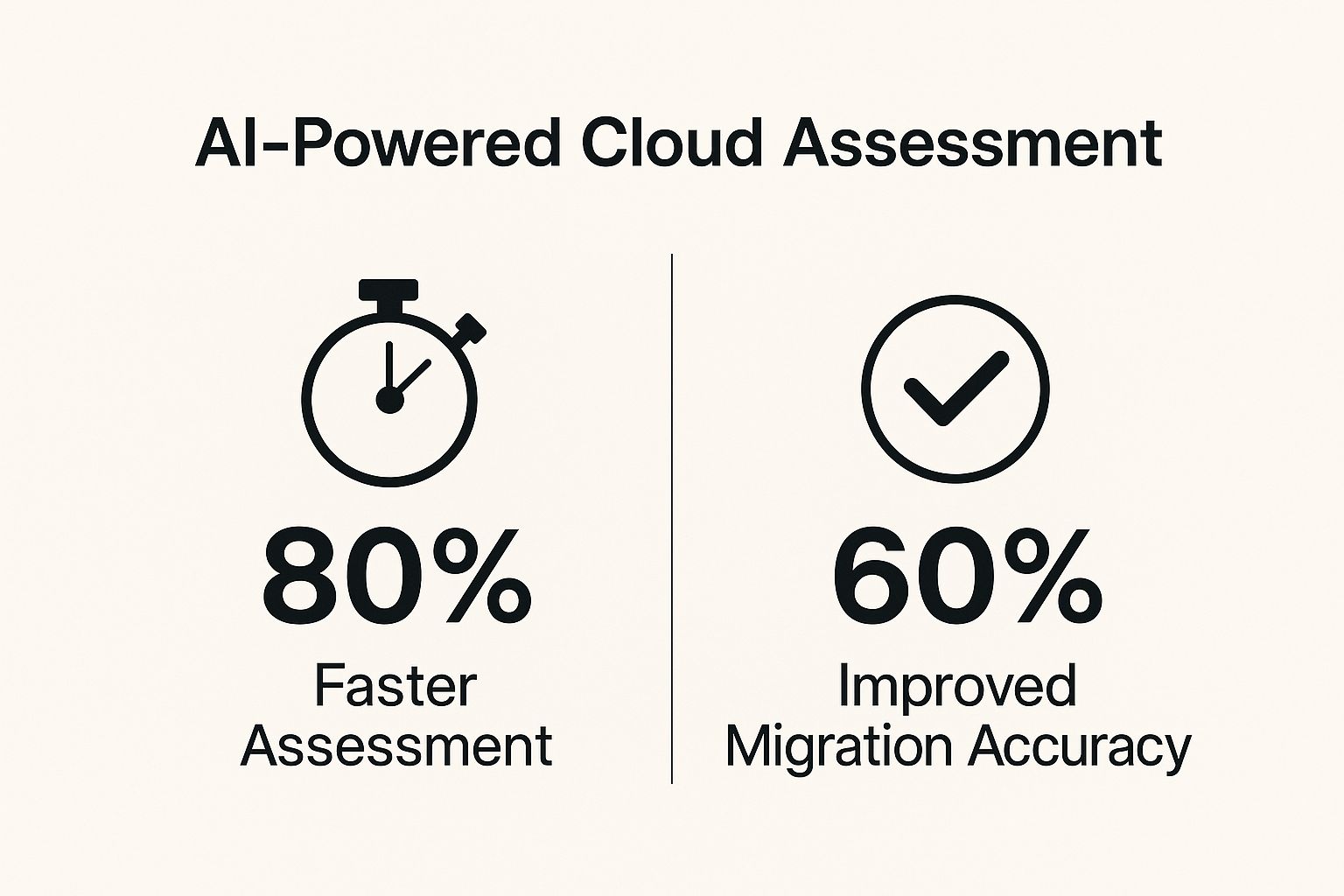
As the data shows, using AI can slash assessment time by up to 80% and significantly improve the accuracy of migration outcomes. For a busy business owner, this means a faster, more reliable, and less disruptive transition to the cloud.
2. Zero-Downtime Migration with Blue-Green Deployment
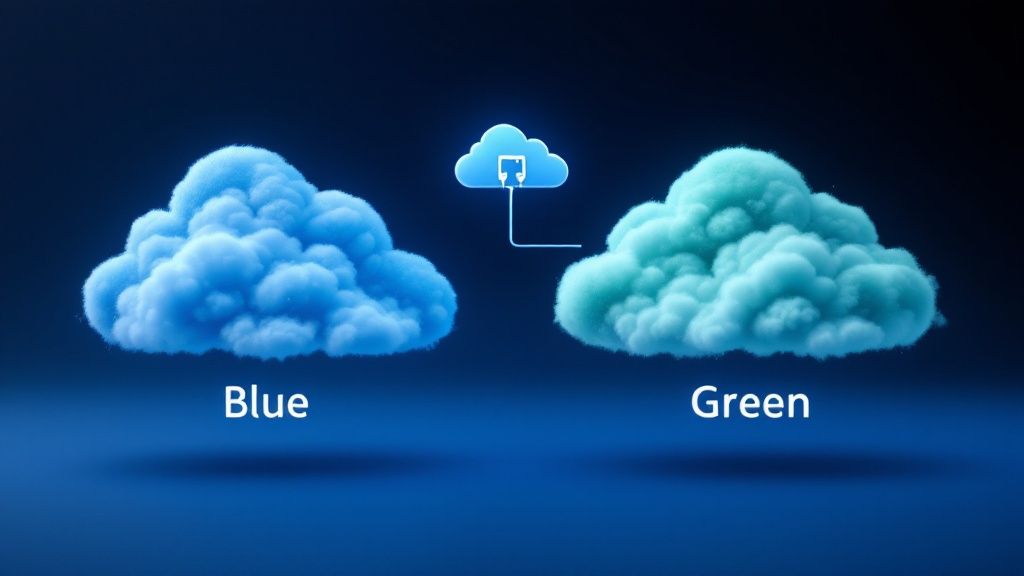
For any business, downtime is not an option. A botched migration can halt your operations and damage customer trust. The blue-green deployment strategy is a powerful way to eliminate this risk, making it one of the top smart methods to streamline cloud migration in 2025. This approach involves running two identical production environments: a "Blue" environment (your current system) and a "Green" one (your new cloud environment).
At any given time, only one environment is live and serving your customers. You can build and thoroughly test your new cloud setup in the Green environment while the Blue environment continues to run your business as usual. Once the Green environment is fully tested and ready, you simply switch the traffic router to point all users to it. The switch is instant, resulting in zero downtime for your customers and employees.
How It Works in Practice
Consider a local financial services firm in Monterey preparing to migrate its client portal to the cloud. Using a blue-green strategy, they would first copy their entire application and database into the new cloud environment (Green). For weeks, their team could perform tough testing and security audits without affecting a single live client on the Blue system. When ready, the IT team flips a switch, and all traffic seamlessly flows to the new, faster, and more secure cloud platform. If any issue arises, they can instantly switch back to the old Blue environment, providing a perfect safety net.
Key Insight: Blue-green deployment transforms a high-stakes migration into a controlled, reversible process. It provides the ultimate safety net by allowing for an instant rollback, ensuring business continuity.
This method gives your business an enterprise-level migration capability without the enterprise-level budget or risk. Our hybrid migration support model combines this kind of scalable tool with our local, hands-on expertise to ensure your move is flawless.
3. Containerization-First Migration Strategy
Instead of moving applications directly from an on-premise server to a cloud server, a containerization-first approach modernizes the application before the move. This involves packaging your applications and all their parts into standardized units called containers. This is one of the most forward-thinking smart methods to streamline cloud migration in 2025 because it separates your software from the hardware, offering amazing flexibility.
This strategy creates a portable "box" for each application that can run consistently anywhere—on a local server in Marina or on any major cloud platform like AWS or Azure. By containerizing first, you simplify the migration, improve scalability, and avoid being locked into a single cloud vendor. You're making your applications agile and future-proof.
How It Works in Practice
Think of a local agricultural tech company in Salinas that needs to migrate a critical logistics application. Instead of a risky "lift-and-shift," they first containerize the application. Using a tool like Kubernetes to manage these containers, they can deploy it seamlessly to the cloud. If they later decide to switch cloud providers for better pricing, the containerized application can be moved with minimal effort. This avoids the dreaded vendor lock-in that can trap California SMBs into expensive contracts.
For a detailed overview of different migration approaches, you can learn more about our cloud migration guide for small businesses.
Key Insight: Containerization turns your applications into portable, self-contained assets. This eliminates compatibility issues and vendor lock-in, giving you the freedom to choose the best cloud environment for your needs.
The following image illustrates how containers bundle an application with its libraries, ensuring it runs uniformly across any environment.
For Monterey Bay businesses, this means greater control and long-term cost savings. By adopting a container-first strategy, you are not just migrating; you are modernizing for the demands of 2025 and beyond.
4. Automated Infrastructure as Code (IaC) Migration
Manually setting up cloud environments is a thing of the past. For businesses in Seaside and Marina, this old-school approach is slow and prone to human error. Automated Infrastructure as Code (IaC) migration solves this by treating your cloud setup like software. Instead of clicking through menus, your entire infrastructure is defined in simple text files.
This is one of the most powerful smart methods to streamline cloud migration in 2025 because it brings automation and repeatability to your cloud foundation. By defining your infrastructure in code using tools like Terraform, you create a reliable and auditable blueprint for your environment. This code can be reviewed, tested, and deployed automatically, saving time and preventing mistakes.
How It Works in Practice
Imagine your growing business needs to quickly create identical testing and production environments in the cloud. Using IaC, you can write a single configuration file that defines all your virtual servers, networks, and databases. With one command, you can deploy a perfect replica of your production environment for testing, and then tear it down just as easily. This ensures consistency and saves you money.
Key Insight: IaC turns your cloud infrastructure into a predictable, version-controlled asset. It allows your team to deploy complex environments with speed and confidence, minimizing risks from manual configuration.
By codifying your setup, you also gain a clear, documented history of every change. This is invaluable for troubleshooting, security audits, and ensuring compliance with California regulations—a key concern for any local SMB. For businesses looking for guidance on complex projects like this, you can learn more about our migration services.
5. Multi-Cloud Migration with Cloud Abstraction Layers
Putting all your digital eggs in one basket is a risky strategy. A multi-cloud approach, using what are called abstraction layers, helps you avoid vendor lock-in and allows you to pick the best services from different providers. For businesses in Salinas or Marina, this means unmatched flexibility. This is one of the most forward-thinking smart methods to streamline cloud migration in 2025 because it builds a future-proof, adaptable infrastructure from the start.
Cloud abstraction layers create a unified management tool over multiple cloud environments (like AWS, Azure, and Google Cloud). You can deploy and manage applications consistently across different clouds without having to re-engineer them for each provider. This gives you the power to optimize for cost, performance, and features all at once.
How It Works in Practice
Consider a hospitality business in Monterey that wants robust data analytics from Google Cloud but prefers Azure's security features for its booking system. Instead of being forced to choose one, a cloud abstraction layer lets them run each part where it performs best. Their IT team can manage both from a single dashboard, applying the same security policies to each. This strategy reduces complexity and makes your business more resilient.
Key Insight: A multi-cloud strategy transforms your infrastructure from a rigid commitment into a flexible portfolio. It empowers you to use the best services from any provider without multiplying your management headaches.
This approach is no longer just for large enterprises. As you explore the different services available, understanding who provides cloud services in Salinas can help you build a tailored multi-cloud strategy. Even a small business can achieve the resilience and innovation of a multi-cloud model.
6. Data-First Migration with Real-Time Synchronization
Traditionally, applications and their data are moved together in a single, high-stakes event. This "big bang" approach often leads to long downtime, which a hotel in Monterey or a farm in Salinas simply cannot afford. A data-first approach flips the script by prioritizing your most critical asset: your data. This is one of the most powerful smart methods to streamline cloud migration in 2025 because it de-risks the entire process.
This strategy involves moving your data to the cloud first while keeping your on-premise applications running. It uses real-time synchronization to ensure that any changes made on-premise are instantly copied to the cloud database. This creates a live, consistent data mirror in the cloud, allowing you to move applications gradually without a disruptive cutover.
How It Works in Practice
Imagine an agricultural tech company in Salinas that needs to move its core database to the cloud for better scalability. Instead of taking the system offline for a weekend, they use a real-time sync tool. The service copies the existing database to the cloud and then streams all new transactions as they happen. The on-premise system continues to operate normally while the team tests and moves applications to the new cloud environment one by one. For advanced data platforms, using Snowflake Snowpipe Streaming with Change Data Capture (CDC) is a modern way to achieve this.
Key Insight: Migrating data first with real-time sync eliminates the pressure of a single cutover window. It allows for a phased, controlled application migration, drastically reducing downtime and business risk.
This approach not only simplifies the migration but also improves your overall business resilience. By maintaining a synchronized data copy, you are also building a foundation for robust data backup and disaster recovery strategies.
7. Serverless-First Cloud Migration
Instead of moving your existing servers to the cloud, a serverless-first approach involves rebuilding applications to run without you managing any servers at all. For businesses in Seaside and Marina, this means using services like AWS Lambda or Azure Functions where the cloud provider handles all the underlying infrastructure. This is one of the most forward-thinking smart methods to streamline cloud migration in 2025 because it eliminates server maintenance and scales automatically.
With serverless, you only pay for the exact compute time your code uses, down to the millisecond. This model drastically cuts costs for workloads with fluctuating traffic, such as a local restaurant website that sees a surge in reservations during tourist season. The cloud provider manages everything: patching, scaling, and availability, freeing your team to focus on your business.
How It Works in Practice
Consider an agricultural business in Salinas that needs to process data from thousands of sensors in the field. Instead of running servers 24/7, they can use a serverless function that triggers only when new data arrives. This event-driven architecture is incredibly efficient and cost-effective.
Key Insight: A serverless-first strategy shifts your focus from managing infrastructure to delivering business value. It provides a highly resilient, cost-effective, and scalable foundation for modern applications.
This approach is ideal for new applications or for updating existing ones. By adopting a serverless model, you can build a more agile, efficient, and cost-effective cloud environment that grows effortlessly with your business.
8. DevOps-Integrated Continuous Migration Pipeline
For businesses that want to move faster, integrating migration directly into your development process is a game-changer. Instead of treating cloud migration as a separate, one-time project, this approach breaks it down into small, manageable, and automated steps. This is one of the most advanced smart methods to streamline cloud migration in 2025 because it turns a massive project into an ongoing, iterative process.
By using tools like GitLab or Azure DevOps, you can automate the deployment of your infrastructure and applications to the cloud piece by piece. This method uses the same principles of rapid iteration and automated testing that you use for software updates, but applies them to the migration itself. This dramatically reduces manual errors and risks.
How It Works in Practice
Imagine a tech startup in Seaside that needs to move to the cloud without disrupting its rapid development cycle. Instead of freezing development for a big migration, they use their existing software pipeline. Each new feature or service is built and deployed directly to the new cloud environment. Over time, the entire application moves to the cloud organically, with zero downtime and minimal disruption.
Key Insight: A DevOps-integrated pipeline makes cloud migration a seamless part of your daily operations, not a daunting standalone project. It enables a gradual, controlled transition that is less risky and allows for instant rollbacks.
By using automation and your existing workflows, this approach ensures a smoother transition. For companies that need agility, it's the ideal way to migrate without slowing down innovation. Partnering with an expert can help you design this strategy effectively; explore how co-managed IT services can support this process.
Smart Cloud Migration Methods 2025: Key Features Comparison
| Migration Strategy | Implementation Complexity 🔄 | Resource Requirements ⚡ | Expected Outcomes 📊 | Ideal Use Cases 💡 | Key Advantages ⭐ |
|---|---|---|---|---|---|
| AI-Powered Cloud Assessment and Discovery | Medium – requires AI tools and training | Moderate – computational resources for ML | Faster assessments (80%), improved accuracy (60%) | Large-scale assessments, complex dependency mapping | Automated insights, reduces human error |
| Zero-Downtime Migration with Blue-Green Deployment | High – dual environments and sync complexity | High – double infrastructure temporarily | Minimal downtime, instant rollback capability | Mission-critical apps needing zero downtime | Risk reduction, seamless failover |
| Containerization-First Migration Strategy | Medium to High – container orchestration learning curve | Moderate – container and orchestration infrastructure | Portability, scalability, supports microservices | Cloud-native and microservices applications | Portability across clouds, DevOps enablement |
| Automated Infrastructure as Code (IaC) Migration | Medium – learning IaC tools and state management | Low to Moderate – infrastructure as code | Consistent environment replication, audit trails | Environments needing repeatable infrastructure | Automation, version control, reduced config errors |
| Multi-Cloud Migration with Cloud Abstraction Layers | High – complex multi-cloud management | High – networking and multi-cloud expertise | Vendor lock-in reduction, resilience, cost optimization | Enterprises requiring multi-cloud deployments | Flexibility, improved resilience |
| Data-First Migration with Real-Time Synchronization | High – complex real-time sync setup | High – bandwidth, monitoring, and infrastructure | 99.99% data consistency, minimal data loss | Data-critical apps needing continuous sync | Business continuity, fallback options |
| Serverless-First Cloud Migration | Medium – application redesign required | Low to Moderate – pay-per-use model | Cost efficiency, automatic scaling, faster deployment | Event-driven, variable workload applications | Eliminates server management, scales automatically |
| DevOps-Integrated Continuous Migration Pipeline | High – pipeline setup and integration effort | Moderate – CI/CD infrastructure | 70% faster migrations, 85% improved success | Organizations with mature DevOps culture | Automation, repeatability, rapid iteration |
Let's Build Your Cloud Migration Plan Together
Navigating the path to the cloud in 2025 doesn't have to be overwhelming. The journey from on-premise hardware to a modern, scalable cloud environment is a big step, but with a clear strategy, it becomes an achievable goal. The smart methods we've explored are no longer just for massive corporations; they are accessible and essential for the growth of local businesses right here in Salinas, Monterey, and across the Central Coast.
By using these forward-thinking techniques, you are not just moving data; you are upgrading your entire business. From leveraging AI for planning to implementing zero-downtime deployments, each method offers a distinct advantage. These are the building blocks of a resilient, agile, and competitive modern business.
Key Takeaways for a Successful 2025 Migration
Your next steps should focus on turning these ideas into a concrete plan. Remember these core principles as you start your planning:
- Automation is Your Ally: Automation minimizes human error, reduces downtime, and frees you up to focus on business growth, not manual configurations.
- Strategy Over Speed: A rushed migration is a risky one. A successful move depends on a well-defined strategy that prioritizes data integrity, security, and long-term cost optimization.
- Think Hybrid and Multi-Cloud: You don't have to be locked into a single vendor. The smartest cloud strategies in 2025 embrace a mix of on-premise resources and multiple cloud providers to maximize performance and control costs.
Your Actionable Next Steps
The most crucial step is the first one: building a detailed roadmap. Start by evaluating which of these methods align with your specific goals. To ensure a secure and efficient move, our comprehensive Cloud Migration Checklist provides a structured path for a smooth transition. This will help you organize your tasks, from initial inventory to post-migration testing, ensuring no critical step is overlooked.
Ultimately, mastering these smart methods to streamline cloud migration in 2025 is about more than just technology; it’s about future-proofing your business. It’s about building a foundation that allows you to innovate faster, serve your customers better, and scale effortlessly. With the right plan and the right local partner, your cloud migration will be the catalyst that propels your business forward.
Ready to build a cloud strategy that’s tailored for your Monterey Bay business? The experts at Adaptive Information Systems combine local, hands-on support with enterprise-level cloud expertise to deliver a migration plan that fits your budget and your goals. Let's start the conversation today and build your roadmap to a successful cloud future.
Adaptive Information Systems
380 Main St, Salinas CA 93901 | 831-644-0300 | hello@adaptiveis.net