The real difference between hiring and outsourcing your IT boils down to one simple thing: hiring an in-house expert gives you a dedicated resource, while outsourcing to a Managed Service Provider (MSP) gives you access to a complete team for a fraction of the cost. The right choice really depends on what you value more—direct control over one person, or the broad expertise and easy scalability of a full-service partner.
The Critical IT Crossroads for Monterey County SMBs

As a business owner in Salinas or anywhere in Monterey County, you know that growth brings new challenges. With IT budgets tightening and cybersecurity risks increasing, how you manage your technology is more important than ever. Many business owners are re-evaluating whether to hire in-house staff or partner with a Managed Service Provider (MSP). This decision has big financial and operational impacts, especially as we look toward 2026.
This guide gets right to the heart of the question every growing SMB eventually asks: should you hire in-house IT staff or partner with an MSP? For local industries like agriculture in Salinas, hospitality in Carmel, or education in Monterey, reliable tech isn't just nice to have; it's essential. Making the right call is crucial.
This decision isn’t just about cost. It’s about your efficiency, your security, and your ability to grow when the opportunity arises.
Comparing In-House vs. Outsourced IT at a Glance
Let's break down the main differences between these two models. One gives you a dedicated employee, while the other provides a complete, on-demand team.
| Feature | In-House IT Staff | Outsourced Managed Service Provider (MSP) |
|---|---|---|
| Cost Structure | Fixed salary, benefits, training, overhead | Predictable monthly subscription fee |
| Expertise | Limited to one person's knowledge | Access to a full team of specialists |
| Availability | Standard 9-5, plus sick days & vacation | 24/7/365 monitoring and support |
| Scalability | Slow; requires new hiring process | Instant; scales up or down as needed |
| Tools & Tech | Requires direct purchase of software & tools | Includes enterprise-grade tools in the fee |
Recent data shows a clear trend. Less than 30% of SMBs manage their security entirely in-house, and a staggering 80% plan to increase their cybersecurity spending. This points to a major shift toward expert-led, outsourced solutions that can keep up with modern threats.
Outsourcing gives your business access to a broader range of skills, tools, and up-to-date protection—without needing to hire multiple specialists. It's about getting enterprise-level IT at an affordable price.
For business owners in Salinas, Monterey, and Watsonville, the demands of remote work, growing compliance needs, and sophisticated cyber threats require more than part-time support. Understanding your tech needs is the first step, and this a comprehensive guide to IT support for small businesses is a great resource.
If you’re ready to see what this looks like for your business, our business guide to managed IT services in Salinas offers more local insights.
Decoding the True Cost of an In-House IT Team

Hiring an in-house IT professional can feel like the simplest solution. You get a dedicated expert, someone right down the hall who can fix any tech issue that comes up. The problem is, the true cost of an employee goes way beyond their paycheck.
When you start to add up all the other expenses, the financial picture gets much clearer. Any serious talk about hiring versus outsourcing has to start with an honest look at what an in-house person really costs your business.
Beyond the Salary: Direct Employee Costs
The most obvious number is the salary. Here in California, a qualified IT specialist can easily earn an average salary of over $80,000 per year, and that's often for a generalist. But that’s just the beginning.
You have to account for the "fully loaded" costs—all the extra expenses on top of that base salary. These add up fast, typically adding another 25-30% to the total cost.
- Benefits: This includes health insurance, retirement contributions (like a 401k match), and paid time off.
- Payroll Taxes: As the employer, you have to pay for Social Security, Medicare, and unemployment insurance.
- Workers' Compensation: This is mandatory insurance that protects both your business and your employee.
These direct costs create a high starting point before you even think about the tools and support that person needs to do their job.
Uncovering the Significant Hidden Costs
This is where most businesses underestimate the true cost. The hidden costs are ongoing, often unpredictable, and absolutely necessary to keep your IT environment secure and efficient.
What happens when your one IT expert is on vacation, out sick, or completely swamped by a crisis? These coverage gaps lead directly to downtime. You can learn more about the staggering hidden costs of IT downtime in our detailed guide.
Let's break down these less obvious expenses.
Recruitment and Onboarding
Finding the right technical talent is a big job. You’ll spend money on job postings and could easily pay thousands to a recruiter. Once you find someone, you then have to spend time and money training them on your specific systems and business culture.
Continuous Training and Certifications
Technology changes fast. To keep their skills sharp against the latest cybersecurity threats, your IT employee needs ongoing training. That means paying for courses, exams, and certifications, which can cost thousands of dollars every year.
Tools, Software, and Hardware
An IT professional is only as good as their tools. Your business will be responsible for buying and maintaining all of them:
- Specialized Software: Licenses for security monitoring, network management, and data backup are expensive and often require pricey yearly subscriptions.
- Diagnostic Hardware: Fixing network and hardware problems requires professional-grade tools.
- A Dedicated Workstation: Your IT hire will need a powerful computer just to manage your company's infrastructure.
When you add the salary to these hidden costs, the true financial picture of an in-house IT team comes into focus. This is the number you should use when deciding whether to hire or outsource your IT support.
So, What Does Outsourcing to an MSP Actually Look Like?

When you decide to outsource your IT, you partner with a Managed Service Provider (MSP). Forget the old way of calling someone only when something breaks. An MSP acts as your complete, off-site IT department, giving you access to an entire team of experts for a predictable monthly fee.
Think of it this way: hiring one in-house IT person is like having a family doctor. They’re great for general check-ups. But what happens when you need a specialist? An MSP is like having the entire hospital on call—the generalist, the security expert, the cloud specialist, and the network engineer—all in one.
This model is quickly becoming the standard for growing businesses. Outsourcing with an MSP gives you access to a broader range of skills and up-to-date protection without needing to hire multiple specialists. One local company, for example, saved over 20% on their annual IT costs by switching to managed IT with us.
What to Expect Day-to-Day with an MSP
Working with an MSP like Adaptive Information Systems changes the game from reactive fire-fighting to proactive prevention. We take care of the technical work behind the scenes so you can focus on running your business.
Your employees get a direct line to a professional helpdesk for any immediate problems. At the same time, our team is constantly monitoring your network, applying security patches, and making sure your systems are safe and secure.
It’s a safety net that a single person, no matter how talented, simply can’t provide. For a great overview of how this works, A Guide to Outsourcing IT Support Services breaks down the model in more detail.
Finding the Right Level of Managed Services
Every business is different, so MSPs don’t offer one-size-fits-all solutions. You can pick a service package that fits your budget, goals, and needs.
- Basic Helpdesk Support: This is your foundation. It gives your team on-demand technical support for day-to-day IT issues. It's a perfect starting point for smaller businesses.
- Proactive Monitoring and Maintenance: This level goes a step further, adding 24/7 network monitoring to catch problems before they cause costly downtime. It also covers routine maintenance like software updates.
- Comprehensive Security Management: Here, you get strong cybersecurity protections. This includes advanced threat detection, antivirus management, and security training to protect your team from phishing and ransomware attacks.
- Strategic IT Planning (Virtual CIO): This is the all-in-one package. It includes everything above, plus high-level strategic guidance. Your MSP acts as your virtual Chief Information Officer (vCIO), helping you create an IT budget, make smart tech investments, and ensure your technology helps your business grow.
The real value of an MSP is turning your IT from a volatile, unpredictable expense into a flat-rate operational asset. You get access to enterprise-grade tools and expertise without the enterprise-level price tag.
For businesses here in the Monterey Bay Area, this means you can have the same quality of IT support as a massive corporation, but tailored to a local company’s budget. If you want to see how this could work for you, our guide on what to expect from managed IT support dives even deeper. It’s all about giving you peace of mind.
A Head-to-Head Comparison of Hiring vs. Outsourcing
Deciding between hiring an in-house IT expert and outsourcing to a Managed Service Provider (MSP) is a critical choice. To get it right, you have to look past the surface-level numbers and see how each model impacts your budget, growth, and security.
Let's put them side-by-side and break down how each stacks up on the factors that truly matter: cost, expertise, scalability, and security.
Factor 1: Cost-Effectiveness
At first glance, comparing one salary to one monthly MSP fee seems simple, but the real financial picture is more complex. An in-house hire isn't just a salary; it's a fixed, high-overhead cost that includes benefits, taxes, training, and pricey software licenses.
An outsourced model turns that large expense into a predictable, manageable monthly payment. This is why cost reduction is a top reason for outsourcing. For a growing business, this means you can free up cash for growth instead of tying it up in IT payroll.
An MSP bundles the costs of an entire team of specialists and enterprise-grade tools into a single monthly fee. This often saves businesses a lot of money compared to the total cost of hiring just one person.
Factor 2: Access to Expertise
When you hire one IT person, you get one person's knowledge. They might be a great generalist, but it's impossible for one person to be an expert on everything from cybersecurity and cloud services to network engineering.
This creates knowledge gaps that can leave your business vulnerable. What happens when a problem comes up that's outside their area of expertise?
Outsourcing solves this instantly. An MSP gives you access to a deep bench of specialists for the price of a single generalist.
You get a dedicated team that includes cybersecurity analysts, network engineers, cloud strategists, and helpdesk technicians. This collective expertise ensures you're prepared for any challenge.
This is the core of the debate—it's not just one person versus another; it's a single skillset versus an entire team's.
Factor 3: Scalability and Business Agility
Growth is never a straight line. You might need to add ten new employees after landing a big contract or scale back during a slow season. An in-house IT model struggles to keep up with that kind of change.
Hiring a new IT person is slow and expensive. You also can't just reduce an employee's salary when demand dips. This inflexibility can hold you back.
Outsourcing, however, is built for agility.
- Scaling Up: Need to support new staff or a new location in Pacific Grove? Your MSP can adjust your service plan right away.
- Scaling Down: If you need to tighten the budget, you can modify your plan to match your current needs without the pain of layoffs.
- Adopting New Tech: An MSP provides the expertise to roll out new technologies without you having to hire and train for new skills.
For any business that needs to stay nimble, an outsourced partner provides a much more flexible IT foundation.
Factor 4: Cybersecurity Posture
Cybersecurity is no longer a job for an IT generalist. New threats emerge daily. Relying on a single in-house person to manage your entire security is a huge gamble.
They're responsible for everything: monitoring threats, patching systems, managing firewalls, and training employees. It's too much work for one person, and if they miss something, the consequences can be devastating.
The infographic below shows the difference in service levels you might find, highlighting how cost ties directly to response time and included services.
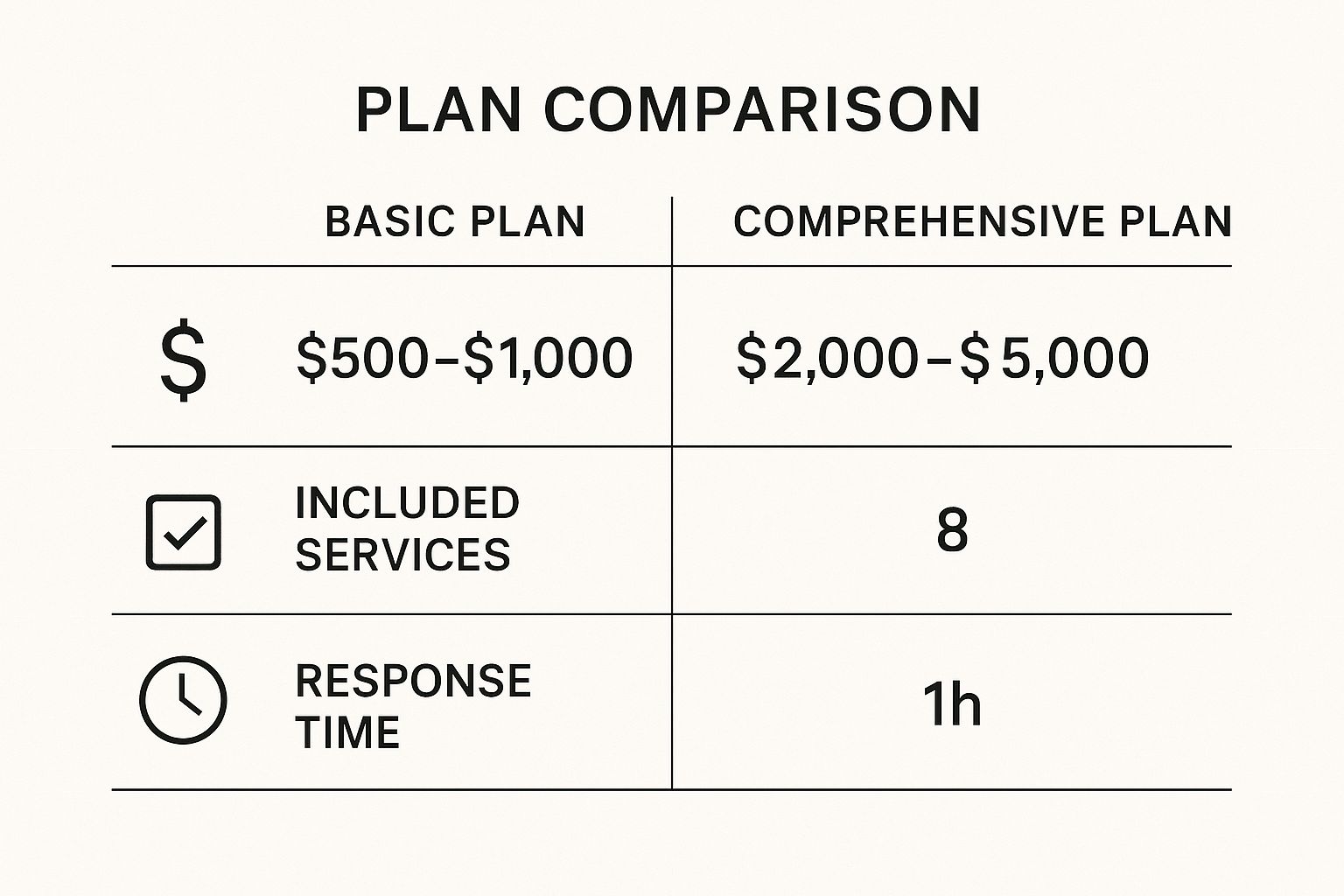
As you can see, a higher investment in a comprehensive plan delivers far more value, especially with faster response times—which are critical during a security incident.
An MSP brings a multi-layered security strategy managed by a dedicated team of security professionals. They use enterprise-grade tools for threat detection and proactive monitoring that are simply too expensive for most small businesses to afford on their own.
Factor 5: Strategic Focus
Finally, think about the strategic impact. An in-house IT person’s day is often filled with troubleshooting and putting out fires. This reactive work leaves little time for the kind of strategic planning that could move your business forward.
Outsourcing lifts the burden of day-to-day IT management off your shoulders. Your employees get fast, reliable support, and you gain a strategic partner. A good MSP acts as a virtual Chief Information Officer (vCIO), helping you align technology with your business goals. They can help you budget for the future and ensure your IT investments deliver a real return.
This frees you and your team to focus on growth. Of course, sometimes a hybrid approach makes sense. For businesses with some internal IT staff, you might want to learn about co-managed services to support your existing IT team and get the best of both worlds.
Strategic Comparison: In-House IT vs. Outsourced MSP
To put it all together, here’s a quick side-by-side look at how these two models compare for a growing business.
| Decision Factor | In-House IT Team | Outsourced Managed Service Provider (MSP) |
|---|---|---|
| Cost Structure | High fixed overhead (salary, benefits, training, tools). A large capital expense. | Predictable monthly fee. Converts capital expense into a manageable operating expense. |
| Expertise & Skills | Limited to the knowledge of one or a few individuals. High risk of knowledge gaps. | Access to a diverse team of specialists (cybersecurity, cloud, networking, etc.). |
| Scalability | Slow and difficult to scale up or down. Hiring/layoffs are costly and time-consuming. | Highly flexible. Plans can be adjusted instantly to match business needs and growth. |
| Cybersecurity | Often reliant on a generalist, creating a single point of failure. Limited by budget for tools. | A dedicated security team with enterprise-grade tools and 24/7 monitoring. |
| Strategic Focus | Time is consumed by reactive "fire-fighting" and daily support tasks. | Provides strategic guidance (vCIO services) to align technology with business goals. |
Ultimately, for most SMBs looking for cost control, deep expertise, and the ability to grow, outsourcing to an MSP provides a clear strategic advantage.
Outsourcing for Better Security and Scalability
Every growing business owner is thinking about two things: keeping company data safe and making sure the business can expand smoothly. When you're weighing your IT options, security and scalability are often the deciding factors. This is where partnering with an expert really shines.
An in-house IT team, especially if it’s just one person, is almost always playing catch-up. The cybersecurity world moves fast, and compliance rules get more complicated every day. Expecting a small team to be an expert on everything, while still putting out daily tech fires, is a recipe for burnout and missed threats.
An MSP, on the other hand, brings a security-first mindset. They’ve already invested in enterprise-level tools that would be a huge expense for most small businesses. It’s not just about having a firewall; it’s about having a team of certified pros managing it 24/7.
Gaining an Enterprise-Grade Security Posture
Let's be honest: relying on a single IT generalist to be your company's security guard is a massive gamble. They're juggling software patches, network monitoring, and data backups all at once. If just one of those plates drops, the fallout for a local business in Salinas or Monterey could be devastating.
When you outsource to an MSP, you get a multi-layered defense strategy from day one. Instead of one person, you have an entire team of security specialists. They’re using advanced threat detection and proactive monitoring systems that are just too costly for most SMBs to buy and manage on their own.
This proactive approach makes all the difference. You can dive deeper into how a solid strategy protects your business in our guide to data backup and disaster recovery. It’s all about making sure that if the worst happens, you’re back up and running fast.
The Power of a Dedicated Security Team
Modern cybersecurity is a full-time, highly specialized job. This is why more and more businesses turn to external providers for these critical services. You can discover more insights about these outsourcing statistics and see where the trend is headed.
Think of an outsourced IT partner as your virtual Security Operations Center. They aren't just reacting to alarms; they are actively hunting for threats, strengthening your defenses, and making sure your business stays protected around the clock.
This lifts the weight of a potential data breach off your shoulders, letting you get back to focusing on your business.
Scaling Your Business Without the IT Headaches
Growth doesn't happen in a straight line. One day you land a huge new client and need to hire ten people, and the next you're planning a new location in Pacific Grove. With an in-house IT setup, these exciting moments can quickly become headaches. Finding, hiring, and training a new IT person can take months.
Outsourcing gives you the agility to grow on your own terms. Your IT support can be scaled up or down almost instantly.
- Adding New Employees: Your MSP can have new user accounts, hardware, and software ready to go in a flash.
- Opening New Locations: They can handle the entire IT setup for a new office, making sure the network is secure from day one.
- Adopting New Technology: Ready to implement a new cloud service? Your MSP has the expertise to make the rollout smooth and secure.
This ability to adapt turns technology from a roadblock into a strategic advantage, ensuring you’re ready for whatever comes next.
So, What's the Right Move for Your Monterey Bay Business?
The best IT solution is always the one that fits your specific business. Deciding whether to hire an IT person or outsource comes down to your budget, your growth plans, and your day-to-day needs.
A few simple questions can help you decide. How complex are your tech needs right now? Do you plan to add more people or open another location in the next year or two? And the big one: what’s the risk to your business if your systems go down or you have a data breach?
Common Scenarios for Local Businesses
Your industry and your stage of growth are usually the clearest signals. A small startup in Marina just using cloud software has different needs than a mid-sized agricultural firm in Salinas dealing with complex compliance rules.
-
Startups and Small Offices: If your needs are basic—like simple helpdesk support and setting up new devices—outsourcing to a Managed Service Provider (MSP) is a smart move. You get professional support at a predictable cost without a full-time salary.
-
Growing Businesses (15-50 Employees): As you add more people and software, the complexity grows fast. Outsourcing at this stage gives you instant access to a team of specialists, making sure your security and IT can keep up with your growth.
-
Established SMBs with Compliance Needs: Local businesses in agriculture, education, or professional services that handle sensitive data benefit the most from an MSP. An outsourced partner can provide enterprise-grade security and compliance oversight that’s nearly impossible for one in-house person to manage alone.
The goal is to pick the path that supports your long-term success. Don't just look at the price tag; consider the hidden costs of risk, downtime, and the inability to scale. Outsourcing can improve security and responsiveness while freeing you up to focus on your business.
If you’re a small business owner in the Monterey Bay Area wondering how to scale IT without overextending your budget, contact Adaptive Information Systems for a free consultation. We’ll help you compare your options—and find the smartest path forward.
Common Questions About Outsourcing IT
As you weigh your options, a few questions always come up. Let's tackle the big ones we hear from business owners trying to decide between hiring in-house and outsourcing their IT.
Is Outsourcing IT Really Cheaper Than Hiring One Person?
In most cases, yes—and by a lot. While a monthly MSP fee might look similar to a single salary on paper, outsourcing gets rid of many hidden costs. You avoid paying for benefits, sick days, ongoing training, recruitment fees, and the expensive software licenses an internal team would need.
Plus, you're not just getting one person. You get an entire team of certified specialists—from cybersecurity pros to network engineers—often for less than the cost of one generalist employee. The value and expertise you gain is on another level.
Will I Lose Control Over My IT If I Outsource?
Not at all. A good partnership with a managed service provider (MSP) actually gives you more strategic control. You're still the one calling the shots and setting the business goals. Your MSP partner handles the day-to-day technical work—the maintenance, monitoring, and troubleshooting.
This frees you from constantly putting out IT fires. Instead, you can focus on running your business, knowing that your technology is being handled by experts.
What if My Business Has Highly Specific Software Needs?
That's a great question and an important point to discuss with any potential IT partner. Many top MSPs, including Adaptive Information Systems, have experience with industry-specific software for local sectors like agriculture, professional services, and education.
A good MSP will take the time to understand your unique workflows and make sure all of your critical systems are fully supported. The goal isn't to fit you into a one-size-fits-all box; it's to build an IT environment that fits your operations perfectly.
If you’re a small business owner in the Monterey Bay Area wondering how to get the IT support you need without stretching your budget thin, contact Adaptive Information Systems for a free consultation. We’ll help you compare all your options and find the smartest path forward for your company.
Adaptive Information Systems
380 Main St, Salinas CA 93901 | 831-644-0300 | hello@adaptiveis.net