If you’re running a business anywhere in Monterey County, whether it's an agricultural firm in Salinas or a boutique shop in Carmel, you’ve probably asked yourself: “Isn’t managed IT overkill for a company our size?”
It’s a fair question, but the answer often surprises local business owners. While it’s easy to dismiss managed services as an expensive luxury meant for bigger companies, the reality is that it’s a strategic move that actually saves you money, locks down your security, and lets you get back to focusing on what you do best.
Why Small Business Owners Question Managed IT
As a local business owner, you’re constantly weighing costs against benefits. The idea of adding a fixed monthly IT expense can feel wrong, especially if your technology seems to be working "just fine" for now.
This mindset is one of the biggest tech myths we see in small business, and it keeps many owners stuck in the unpredictable "break-fix" cycle—only calling for help after something has already gone wrong.
However, recent insights show that less than 30% of SMBs manage IT internally—most are turning to managed service providers to streamline operations and mitigate risks.
What this actually means for you is that managed IT support is designed for businesses like yours—it scales with your needs, handles more than break-fix issues, and reduces long-term IT costs.
Instead of seeing it as just another expense, think about the real savings. You can consider a consultation to review how a single vendor can unify your IT, security, and compliance under one plan—simplifying support and protecting your bottom line. This isn't about adding another bill; it's about making your operations simpler and more predictable. A single, expert team can bring your IT, security, and even your phone systems—like our VoIP Solutions—under one straightforward plan. This approach protects your bottom line and gives you the freedom to focus on running your business.
Still relying on basic tech support? Let’s talk about how managed services give you more for less—schedule a discovery call today.
Understanding Proactive IT vs. Reactive Break-Fix Support
To really get why managed IT is such a game-changer, we first have to look at how tech support has traditionally worked. For years, the go-to model was what we call “break-fix.” It’s exactly what it sounds like: when something breaks, you call someone to fix it.
Your server crashes, an email account locks up, or a laptop just won't turn on. You make a frantic call, get a bill for the emergency service, and then cross your fingers it doesn’t happen again anytime soon.
This reactive approach might seem straightforward, but it’s almost always the most expensive and disruptive way to handle your business technology. Waiting for a disaster guarantees you'll suffer from downtime, and every minute your team can't work is a minute you're losing money.
Think of it like this: the break-fix model is like only taking your car to the mechanic after the engine has already started smoking on the side of Highway 101. It's an emergency, it’s stressful, and it’s always more expensive than just getting a regular oil change.
Managed IT completely flips this script. Instead of waiting for things to go wrong, our entire focus is on preventing them from going wrong in the first place.
The Shift to Proactive IT Management
Proactive IT is like having a complete wellness plan for your company’s technology. At Adaptive, our team keeps a constant watch over your systems, 24/7, identifying and fixing small issues before they can ever grow into business-halting disasters.
This constant oversight ensures your network, computers, and servers are always secure, up-to-date, and running at their best. This infographic busts some of the common myths that hold small businesses back from adopting a smarter IT strategy.
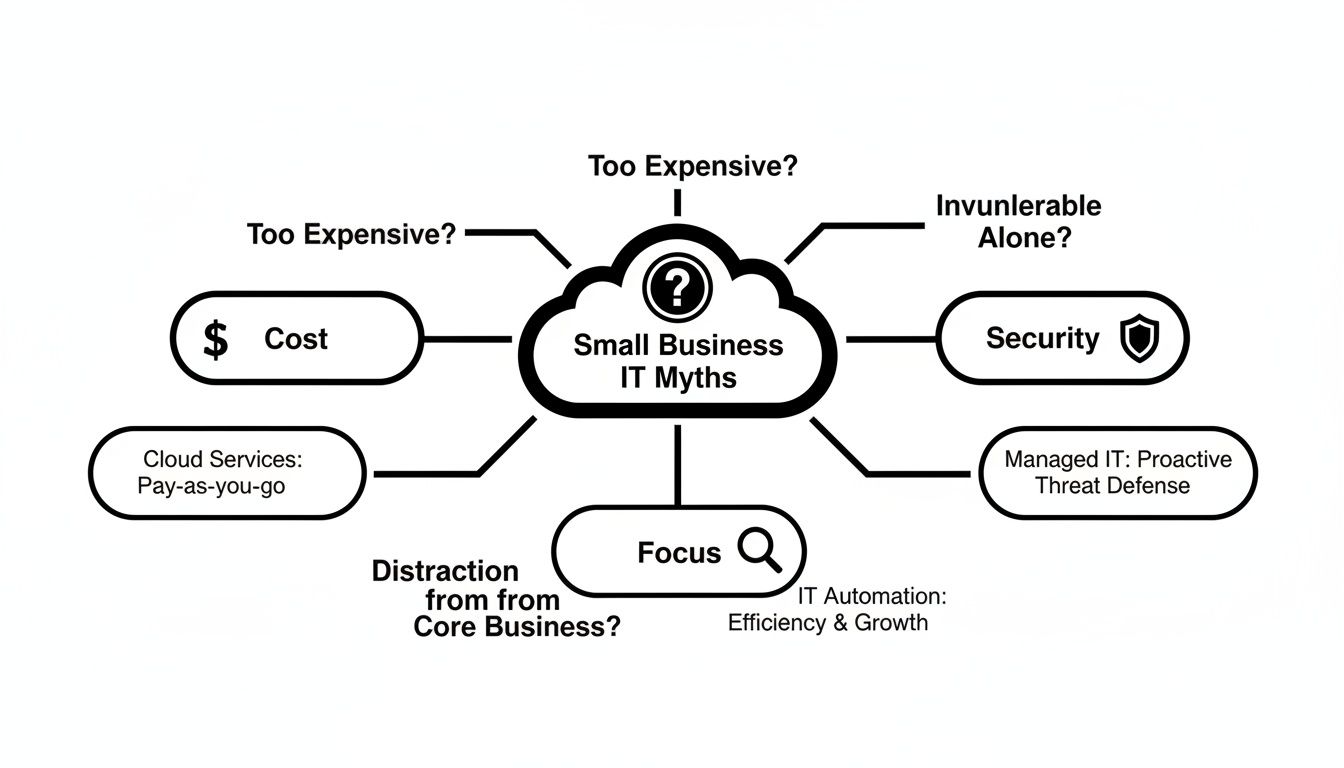
As you can see, misconceptions about high costs and security often stop business owners from finding a better IT solution that actually lets them focus on growth.
To make this clearer, let's compare the two approaches side-by-side.
Break-Fix IT Support vs. Managed IT Services
| Feature | Break-Fix IT Support (The Old Way) | Managed IT Services (The Modern Way) |
|---|---|---|
| Approach | Reactive: Waits for problems to occur. | Proactive: Prevents problems before they start. |
| Cost Structure | Unpredictable: Pay-per-incident, often with high emergency rates. | Predictable: Flat, monthly fee for all-inclusive support. |
| Business Impact | Downtime is guaranteed. Operations halt during emergencies. | Uptime is maximized. Issues are resolved behind the scenes. |
| Focus | Fixing immediate, isolated problems. | Long-term health and strategic alignment of technology. |
| Relationship | Transactional. You only call them when something is broken. | Partnership. Your provider is invested in your success. |
The table really highlights the core difference: one model profits from your pain, while the other is built on preventing it.
With a proactive approach, you gain total predictability. Instead of getting hit with surprise repair bills that can wreck your monthly budget, you pay one flat, consistent fee. This covers everything from routine maintenance and security patching to everyday help desk support for your employees. To get a better handle on this modern approach, check out our complete guide to understanding managed IT support.
This shift doesn’t just prevent headaches; it gives you a real strategic advantage. When your technology runs smoothly, your team can focus on their actual jobs—serving customers, closing deals, and growing the business—instead of fighting with frustrating IT glitches. For businesses in competitive local industries like agriculture or hospitality, that productivity boost is priceless.
Why Being Small Makes You a Bigger Target

It’s a conversation we have all the time with small business owners. They figure their company is just too small to register on a cybercriminal’s radar. It’s an understandable assumption—why would a hacker waste time on a local Salinas shop when they could go after a massive corporation?
Unfortunately, this is one of the most dangerous myths in business today.
The hard truth is that hackers aren’t just hunting for the biggest prize; they’re hunting for the easiest one. They know that most small businesses are running lean, often without the deep, multi-layered security defenses that larger companies have in place. That doesn't make you insignificant. It makes you a prime target.
The Odds Are Not in Your Favor
Thinking you’re too small for managed IT is a bit like leaving your front door unlocked because you don’t think you have anything worth stealing. But attackers know you have customer data, financial records, and access to payment systems—all of which are incredibly valuable on the dark web. An attack isn't a remote possibility; it's a statistical probability.
In fact, small businesses are hit disproportionately hard. Micro-businesses with 1–10 employees face an alarmingly high breach rate, with attackers succeeding in roughly 43% of attempts. What's worse, only about 17% of these businesses carry cyber insurance, leaving them to face the devastating financial fallout all on their own.
This isn’t about fear-mongering. It’s about looking a real-world business risk straight in the eye and meeting it with a smart, affordable strategy. Protecting your digital assets is every bit as important as insuring your physical office, but trying to build an enterprise-grade security system yourself is wildly expensive.
Building Your Digital Fortress Affordably
This is where managed IT services become a powerful equalizer for small businesses. Instead of you having to sink tens of thousands of dollars into hardware, software licenses, and specialized staff, a managed services plan gives you access to a complete security arsenal for a predictable monthly fee.
This includes essential layers of defense that are often too costly for a small business to build and manage on its own:
- Enterprise-Grade Firewalls: Your first line of defense, blocking unauthorized traffic before it ever gets near your network.
- Advanced Endpoint Security: Protecting every single device—laptops, desktops, and servers—from malware and ransomware.
- 24/7 Monitoring and Threat Detection: Expert eyes watching over your systems around the clock, ready to shut down suspicious activity in an instant.
Keeping these systems running effectively is a full-time job. To get out of the reactive, break-fix cycle, many small businesses benefit from adopting broader strategies like these 10 IT Asset Management Best Practices.
Ultimately, you don’t have to become a cybersecurity expert to protect your business. Partnering with a managed IT provider gives you the peace of mind that comes from knowing your data, your reputation, and your customers are safe. You can read more about the top IT myths that put small businesses at risk on our blog.
Unifying Your Technology for Simpler Operations
As your business grows, so does its collection of tech. You might have one company for your internet, another for the phone system, and a third you call when a computer acts up. This patchwork of different providers creates pure chaos the moment something goes wrong.
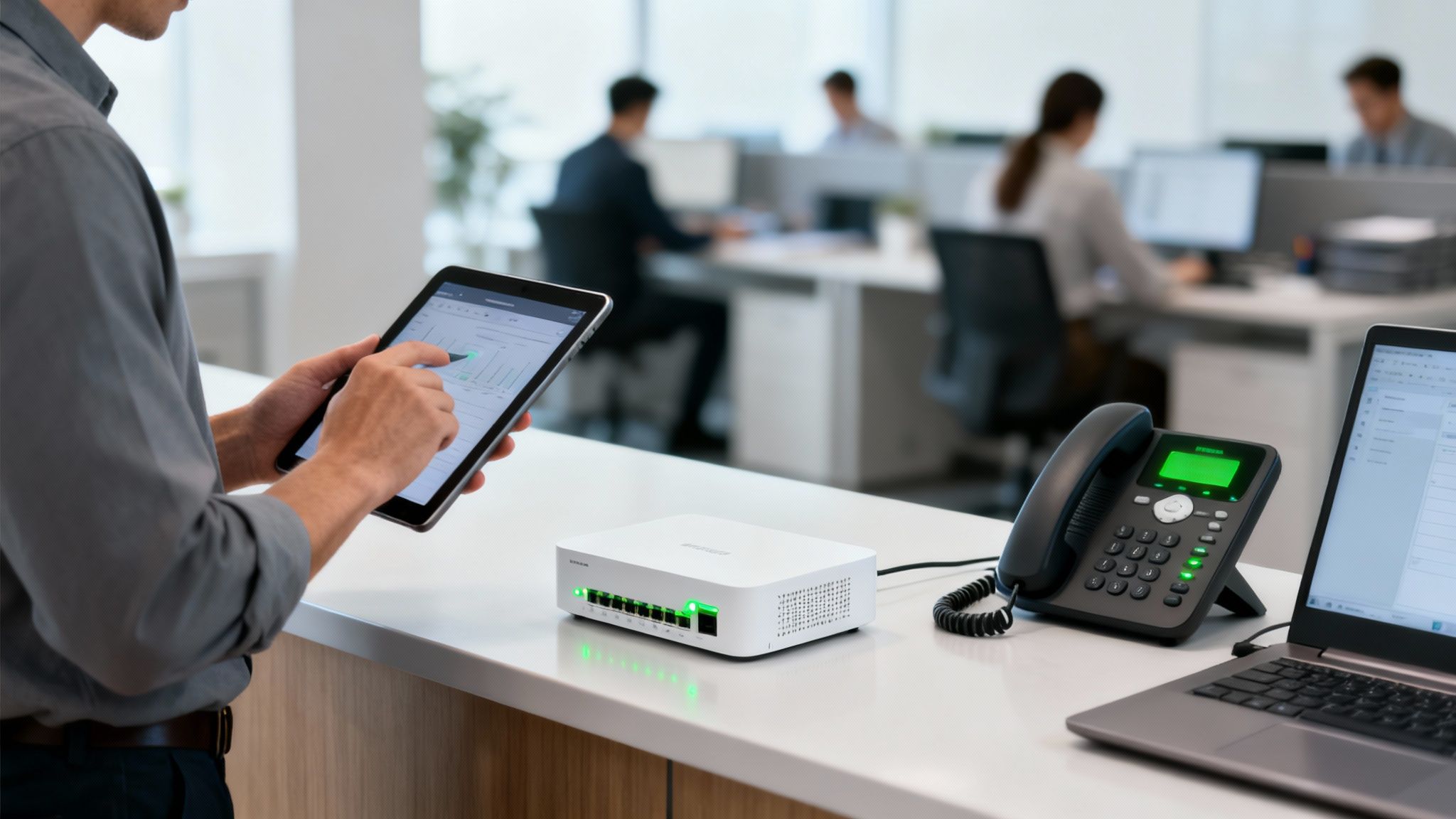
Suddenly, you’re stuck in the middle of a frustrating blame game. Each vendor points a finger at the others, and your business is caught in the crossfire. This finger-pointing doesn’t just cause headaches; it costs you valuable time and money while operations grind to a halt. One of the most immediate benefits of managed IT is vendor unification.
One Number to Call for Everything
Imagine having a single, trusted contact for every single tech issue. Instead of flipping through a list of support numbers, you have one partner who already understands your entire technology stack, inside and out.
A managed service provider doesn't just fix what's broken—we actively manage the relationships with all your other tech vendors, from your internet provider to specialized software companies. This streamlined approach means faster resolutions and way less frustration for you and your team. We handle the technical back-and-forth so you can get back to running your business.
This single-vendor approach simplifies more than just support. When all your systems are managed under one roof, they are designed to work together securely and efficiently, eliminating the weak points created by a disjointed setup.
Seamless Integration for Better Performance
True operational efficiency comes from having technology that actually communicates well. For small businesses, taking advantage of powerful tools like a suite of Unified Communications solutions can dramatically improve day-to-day work, but only if they're integrated correctly.
A managed IT partner ensures all your tools play nicely together. For example, we can seamlessly integrate a modern VoIP phone system directly into your core IT infrastructure. This gives you better features, stronger security, and far more reliable support than a standalone phone service ever could. You can learn more about how this works by reading our guide on what system integration is and how it benefits businesses.
By unifying your technology, you’re not just making IT simpler. You’re building a more resilient, secure, and productive foundation for your company's future.
Calculating the Real ROI of Managed IT Services
It’s easy to look at a managed IT plan and see it as just another monthly expense on your P&L statement. But if you think you’re “too small” for managed IT, you might be looking at the numbers all wrong. The smartest business owners don’t see it as a cost—they see it as an investment with a powerful, measurable return.
The true return on investment (ROI) goes far beyond just fixing computers. It’s about preventing the expensive problems that can quietly drain your profits and grind your operations to a halt.
Beyond the Monthly Fee
The most significant return often comes from minimizing downtime. For a Salinas agriculture business, an offline server during harvest season isn’t an inconvenience; it’s a catastrophe. For a hotel in Pacific Grove, a network failure during a busy tourist weekend means lost bookings and unhappy guests. Every minute your team can't work costs you real money, and proactive managed IT is designed to prevent these costly interruptions before they ever happen.
Another huge factor is employee productivity. Think about it: how many hours does your team waste each week wrestling with slow computers, connectivity issues, or software glitches? Those hours add up fast. When your technology runs smoothly, your staff can focus on their actual jobs—driving revenue and serving customers—instead of acting as reluctant, part-time IT support.
A predictable flat monthly fee is the foundation of a strong IT ROI. It completely eliminates the shock of huge, unexpected repair bills, allowing you to budget with confidence and reallocate those emergency funds toward growth.
A Simple Framework for Your Business
Figuring out your potential ROI isn't as complicated as it sounds. You can get a pretty good idea by thinking about these three key areas:
- Cost of Downtime: Estimate the revenue you would lose if your business was offline for an hour. Now, multiply that by the number of tech-related interruptions you’ve had in the last year. This is a direct cost that managed services are designed to crush.
- Productivity Gains: Think about how much time your employees lose to tech frustrations. Even saving each team member just 30 minutes a day adds up to a massive recovery of paid-for, productive work hours over the course of a year.
- Reduced Capital Expenses: Consider the high cost of replacing a server or firewall out of the blue. A managed plan often includes access to enterprise-grade hardware and expertise without the massive upfront investment, smoothing out your cash flow.
By shifting from a reactive, break-fix expense model to a proactive investment, you’re not just buying IT support. You're buying stability, security, and efficiency. Wondering if your current approach is costing you more than you realize? We break down the numbers in our article exploring if a full-time IT staff is costing you more than you think.
Signs You Have Outgrown Your Current IT Support
How do you know when your IT setup has gone from a helpful tool to a business anchor? It’s rarely a single, catastrophic failure. More often, it's a slow burn—a steady drip of recurring glitches, mounting frustrations, and the nagging feeling that you’re spending more time thinking about tech problems than business opportunities.
The symptoms are easy to spot once you know what to look for. Are your employees constantly troubleshooting printer issues or slow software instead of focusing on their actual jobs? Do you lie awake wondering if your data backups are actually working or if your security is strong enough to stop a real attack? These aren't just minor annoyances; they're warning signs that your current IT model is failing you.
Another huge red flag is unpredictable IT spending. If your budget is constantly being torpedoed by surprise repair bills, it's a clear sign your reactive "break-fix" approach is actively costing you money and making stable financial planning impossible.
When Complexity Outpaces Capacity
Today's businesses are adopting new tools faster than ever. As you invest more in cloud services, automation, and specialized software, the complexity—and the risk—grows right alongside.
A recent industry survey found that 38% of SMBs are already using AI for things like analytics and marketing, while 56% believe it can help solve workforce challenges. This explosion of new tech requires a level of integration and security oversight that most small, in-house teams simply can’t provide. You can dive deeper into these findings in the 2025 small business survey.
This growing complexity is one of the clearest signs that you’ve outgrown a simple support model. Feeling overwhelmed by new technology or constantly worrying about compliance rules isn't a personal failure. It’s a signal that your business has matured and now needs a strategic partner to manage these critical functions. When your tech feels more like a burden than a benefit, it’s time for a change.
Ready to Move Forward? Here’s Your Next Step.
If you’ve made it this far, the idea that your business is “too small” for professional IT support should be a thing of the past. It’s pretty clear now that managed IT isn’t some bloated, overkill solution for giant corporations. It’s simply how smart, modern businesses right here in communities like Salinas and Monterey operate securely and stay ahead.
Trying to get by with outdated, reactive support is a gamble. Sooner or later, you pay the price in lost time, frustrated employees, and—most importantly—critical security gaps that leave your business completely exposed. The good news is that taking the next step toward a better, more predictable solution is simple and completely risk-free.
From Overwhelmed to In Control
The journey from feeling overwhelmed by technology to being in control of it starts with a conversation. Many business owners we talk to are surprised to learn how a single, trusted partner can bring their IT, security, and compliance together under one affordable, easy-to-manage plan. This isn’t about adding another bill; it’s about consolidating costs and gaining a strategic partner who is genuinely invested in your success.
What this really means for you is that managed IT support is built for businesses just like yours. It scales with your needs, solves problems before they start, and actually reduces your long-term IT costs.
A modern IT plan can even integrate your business phone system, providing seamless VoIP Solutions that make communication easier while cutting your monthly phone bill. The goal is simple: simplify your operations, protect your bottom line, and give you back the time you need to focus on actually growing your business.
Still relying on basic tech support? Let’s talk about how managed services give you more for less—schedule a discovery call today.
Adaptive Information Systems
380 Main St, Salinas CA 93901 | 831-644-0300 | hello@adaptiveis.net