For many business owners in the Monterey Bay Area, hiring a dedicated IT person feels like the most direct and secure way to handle technology. But is a full-time IT staff costing you more than you think?
The short answer is almost certainly yes. As a local IT partner to businesses from Salinas to Carmel, we see it all the time. The true cost of an in-house hire goes far beyond their annual salary, and the sticker shock can be significant once you uncover all the hidden expenses.
The Real Cost of an In-House IT Team in Monterey County
When you decide to hire an IT specialist, the number on that job offer is just the tip of the iceberg. In reality, that base salary often represents only about 60-70% of your total investment in that employee.
The rest is made up of numerous direct and indirect costs that can quickly inflate your technology budget. What seemed like a smart hire can easily turn into a significant financial strain, especially for businesses where every dollar counts—from Salinas agriculture firms to Carmel hospitality venues. Understanding the "fully loaded" cost is essential for making a sustainable decision.

Beyond the Paycheck
Let's break down the expenses that often fly under the radar when you're budgeting for a new hire. These aren't one-time costs; they're consistent, ongoing, and add up fast over the course of a year.
- Benefits and Payroll Taxes: This is a big one. It includes health insurance, retirement contributions like a 401k match, workers' compensation, and payroll taxes. These legally required and competitive benefits can easily add another 25-40% right on top of an employee's salary.
- Essential Tools and Licensing: Your IT pro can't do their job without the right software. This means recurring annual fees for diagnostic tools, cybersecurity platforms, and remote management software, which can easily run into thousands of dollars.
- Training and Certifications: Technology changes in the blink of an eye. To keep your systems secure and running efficiently, your IT staff needs continuous training and certifications—another recurring expense you have to factor in.
The financial commitment doesn't stop there. You also have to account for overhead like providing office space and equipment. Then there are the productivity losses from sick days, vacation time, and the inevitable downtime when your single point of IT support is unavailable. You can learn more about this staggering financial impact by exploring the hidden costs of IT downtime in our detailed guide.
Key Insight: The true cost of one in-house IT employee is not their salary. It's the entire ecosystem of expenses required to support their role—from benefits and taxes to the specialized tools and ongoing training they need to be effective.
At a Glance: In-House IT Salary vs. Total Employment Cost
To put it in perspective, let's look at how the visible salary compares to the total, often hidden, costs of employment. This table gives a simple, high-level summary.
| Expense Category | What You Expect to Pay (Base Salary) | What You Actually Pay (Total Cost) |
|---|---|---|
| Salary | $75,000 | $75,000 |
| Benefits & Taxes | Included in salary | ~$22,500 (approx. 30%) |
| Tools & Licensing | Included in salary | ~$5,000+ per year |
| Training & Development | Included in salary | ~$3,000+ per year |
| Total Annual Cost | $75,000 | $105,500+ |
As you can see, the expenses stack up quickly. That initial salary figure doesn't even come close to the real financial commitment, revealing a much larger investment than most business owners anticipate.
What Are the Real Costs of an In-House IT Team?
When you’re weighing the cost of an in-house IT team, the salary and benefits are just the tip of the iceberg. The real financial drain often comes from the significant, ongoing, and sometimes unpredictable expenses that don't show up on a payroll report. These are the costs that quietly inflate your budget and can make a full-time hire far more expensive than you initially planned.
Building an internal team isn't a one-and-done deal; it's a constant cycle of investment. From the minute you post a job opening to the day that employee moves on, your business is absorbing costs. Let's pull back the curtain on these hidden expenses.
The High Price of Finding Good People
In a competitive market like California, finding qualified tech talent is both a marathon and a money pit. You're not just paying for a job board listing. You're sinking dozens, sometimes hundreds, of management hours into sifting through resumes, conducting interviews, and trying to verify technical skills. This process can drag on for months, pulling senior staff away from their actual jobs—the ones that generate revenue.
The direct costs alone are sobering. Industry surveys pin the average cost-per-hire at around $4,700, but that number doesn't tell the whole story for the tech sector. Here, costs often balloon to between $6,000 and $8,000 per position, and for specialized local industries like hospitality or education, it can be even higher. And remember, that's just the cash outlay, not the lost productivity while the seat is empty.
The Bottom Line: A small IT department with typical turnover could easily spend tens of thousands each year just on recruitment—before a new hire even logs in for their first day.
The Never-Ending Training Treadmill
Technology doesn't stand still. The cybersecurity threat that was neutralized last month has already been replaced by a smarter one. The software your business depends on is getting critical updates that demand new expertise. If you want your in-house staff to stay effective, you have to fund their continuous professional development.
This isn't a perk; it's a core operational necessity. These costs stack up quickly:
- Certification Exams: Specialized certifications in networking, security, or cloud platforms can run from hundreds to thousands of dollars apiece.
- Training Courses: Sending an employee to a workshop or enrolling them in an online course keeps their skills sharp, but it’s a recurring line item on your budget.
- Time Out of the Office: When your IT specialist is at a training seminar, they aren’t at their desk solving the urgent problems that pop up back at your office.
This constant need for new skills also means you're investing in the tools for them to do their job, which adds another layer of expense and complexity.
The Productivity Drain from Employee Turnover
Finally, one of the most punishing hidden costs is the massive productivity gap created by employee turnover. When a skilled IT person walks out the door, they take a huge amount of institutional knowledge with them—deep knowledge about your specific network quirks, your systems, and all the past issues they've fixed.
The disruption hits you twice. First, there's the immediate void between their departure and a new hire's start date, leaving your systems vulnerable and support limited. Second, a new employee needs months to get up to speed. They have to learn your infrastructure, understand your business workflows, and build relationships with the team. During that ramp-up period, their effectiveness is limited, and problems take longer to resolve, creating a ripple effect of inefficiency across the entire company.
Comparing In-House IT vs. Managed IT Services Costs
Now that we’ve pulled back the curtain on the hidden expenses of hiring, let's put the numbers side-by-side. For a local Salinas business, what seems like a simple choice—hiring one person versus partnering with a team—has massive financial implications.
Is a full-time IT staff costing you more than you think? Let's move beyond assumptions and take a practical look at the total investment. We’ll contrast the unpredictable, layered costs of an employee with the clear, predictable monthly fee of a Managed Service Provider (MSP). This isn't just about saving money; it's about gaining access to enterprise-level resources at a price that makes sense for a growing business.
A Tale of Two Budgets
Imagine a Salinas-based business with 25 employees. Let's compare their annual IT costs for one in-house hire versus partnering with an MSP like Adaptive.
- The In-House Route: You hire an IT specialist for $70,000. After adding benefits, taxes, training, and software licenses, your total annual cost quickly rockets past $100,000. And this is for one person who takes vacations, gets sick, and can't possibly be an expert in everything from cybersecurity to cloud management.
- The Managed Services Route: With an MSP, you pay a flat monthly fee. This predictable cost gives you access to an entire team of certified experts, proactive monitoring, help desk support, and advanced security tools—often for a fraction of the cost of that single employee.
This infographic breaks down some of the most overlooked costs that come with maintaining an internal team.
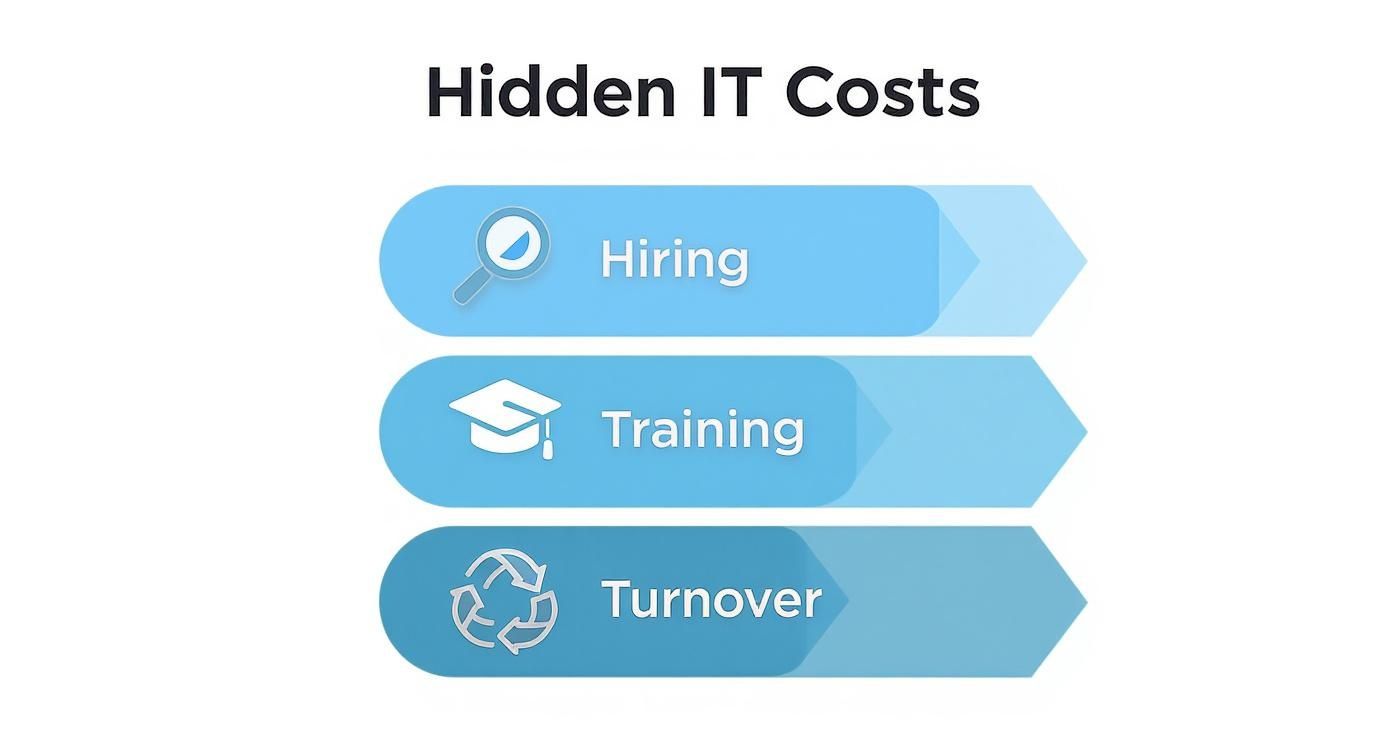
As you can see, the endless cycle of hiring, training, and inevitable turnover creates ongoing expenses that are rarely captured in a traditional budget.
The table below gives you a more detailed, line-by-line comparison of where the money really goes.
Annual Cost Breakdown: Full-Time IT Employee vs. Managed IT Services
| Cost Category | In-House IT Employee Annual Estimate | Managed IT Services Annual Estimate |
|---|---|---|
| Base Salary | $70,000 | N/A |
| Payroll Taxes & Benefits (25%) | $17,500 | N/A |
| Recruiting & Onboarding | $5,000 | $0 |
| Training & Certifications | $3,000 | $0 (Included) |
| IT Tools & Software Licenses | $4,800 | $0 (Included) |
| Coverage Gaps (Vacation/Sick) | $2,700 | $0 |
| Management Overhead | $3,500 | $0 |
| Managed Services Plan | N/A | $30,000 |
| Total Annual Cost | $106,500 | $30,000 |
This breakdown makes it clear: the salary is just the tip of the iceberg. The fully loaded cost of an in-house employee is often more than 3x the cost of a comprehensive managed services plan that delivers far more expertise and reliability.
The True Cost of Turnover
The hidden costs of keeping IT staff go far beyond a base salary. When an IT employee leaves, replacing them can cost six to nine months of their salary. For that $70,000 employee, you’re looking at $35,000 to $52,000 in extra expenses just to get back to where you started.
With the IT sector facing the highest turnover rate of any industry at 13.2%, companies often find themselves repeating this expensive cycle over and over.
An MSP eliminates the costs of recruitment, onboarding, and turnover entirely. Instead of constantly backfilling a role, you have a consistent, reliable partner focused on your success.
From Fixed Overhead to a Flexible Operating Expense
One of the biggest financial shifts when moving to an MSP is converting a large, fixed capital expense (an employee's salary and benefits) into a predictable and scalable operating expense. This change has a powerful, positive impact on your budget and cash flow.
With a managed services plan, you get:
- Predictable monthly costs: Your IT expenses become a stable line item, making budgeting simple and accurate.
- Scalability on demand: As your business grows, your IT support scales with you—no need for another lengthy and expensive hiring process.
- Access to a team of experts: You benefit from a wide range of specialized skills, from cybersecurity to cloud infrastructure, all for one flat fee.
When evaluating different options, it's helpful to get familiar with the outsourced IT leadership models by understanding the differences between vCISO and MSP models to choose the right strategic fit.
For a deeper dive into the financial and strategic trade-offs, check out our complete guide on whether you should hire or outsource your IT. The numbers often prove that outsourcing provides far more value and expertise for every dollar spent.
Gaining a Strategic Advantage with Outsourced Expertise
While the cost savings are compelling, the real value of partnering with a managed service provider (MSP) goes far beyond your budget. It’s about gaining a strategic advantage that a single employee, no matter how talented, simply can’t offer. You'll shift from just fixing problems to proactively building a more resilient and efficient business.
Thinking about your IT in terms of strategy rather than just expense is a game-changer. It’s the difference between having one person putting out fires and having a dedicated team that prevents them from starting in the first place. This proactive approach directly impacts your operations, efficiency, and peace of mind.

Eliminating the Single Point of Failure
Relying on one person for all your IT needs creates a significant business risk known as a single point of failure. If that individual gets sick, goes on vacation, or decides to leave your company, who manages your network? Who responds to a critical security alert or a server crash?
This dependency can leave your business vulnerable, with the potential for extended downtime and data loss. An MSP eliminates this risk entirely.
When you partner with a provider like Adaptive, you’re not hiring a person; you’re gaining an entire IT department. Our team structure ensures there is always someone available who knows your systems and can respond immediately when you need help most.
Access to a Diverse Team of Specialists
The world of technology is incredibly specialized. The person who excels at help desk support and troubleshooting user issues is rarely the same person who is an expert in advanced cybersecurity, cloud architecture, or network engineering. Expecting one hire to master all these domains is unrealistic and, frankly, unfair to them.
An MSP gives your business access to a deep bench of specialists without adding a single new salary to your payroll. This team-based approach means you get:
- Cybersecurity Experts: Professionals who focus exclusively on threat detection, prevention, and compliance, keeping your data safe from ever-evolving risks.
- Cloud Solutions Architects: Specialists who can design, implement, and manage your cloud infrastructure for optimal performance and cost-efficiency.
- Network Engineers: Experts who ensure your network is fast, reliable, and secure, supporting the daily operations of your team.
This collective expertise ensures that no matter what IT challenge arises, you have a certified professional ready to handle it correctly and efficiently.
Scalability That Grows with Your Business
As your business grows, so do your technology needs. Hiring another full-time staff member every time you expand is a slow, expensive, and disruptive process. With an MSP, your IT support scales seamlessly right alongside your business.
Whether you're adding five new employees at your Marina office or opening a new location, your IT partner can quickly adjust your support plan and deploy the necessary resources. This flexibility allows you to stay focused on growth, confident that your technology infrastructure can keep pace without the friction of a new hiring cycle. This partnership approach is key; you can explore more on how educational content builds better IT relationships and turns a vendor into an advisor.
Proactive Support That Prevents Downtime
Most in-house IT roles are, by necessity, reactive. Your employee spends their day responding to tickets and fixing things that have already broken. This constant firefighting leaves little time for the strategic, proactive work that prevents problems from happening in the first place.
An MSP operates on a proactive model. We use advanced monitoring tools to watch over your systems 24/7, identifying and resolving potential issues before they can cause costly downtime. This preventative maintenance keeps your business running smoothly, protects your productivity, and ultimately saves you money by avoiding major disruptions.
When Hiring an In-House IT Specialist Makes Sense
While outsourcing offers tremendous value, it's not a one-size-fits-all solution. As trusted advisors, our goal at Adaptive is to help you find the right fit for your business—and sometimes, that means hiring an in-house IT specialist. The key is to move beyond generic pros and cons and look at specific, practical scenarios where an internal hire is the most strategic choice.
Deciding to hire isn’t just about cost; it's about alignment with your core business operations, regulatory demands, and long-term goals. For some companies, having a dedicated person on-site is non-negotiable, and understanding when this applies is crucial for making a smart, sustainable decision.
You Rely on Highly Specialized or Proprietary Software
Does your business run on custom-built software that’s unique to your industry or your company? Think of a specialized agricultural tech firm in Salinas using proprietary software for crop management that no outside provider could possibly know. In this case, hiring a developer or specialist who can manage, update, and troubleshoot that specific application makes perfect sense.
When your core business function depends on a unique technology, having an on-site expert who lives and breathes that system every day provides an undeniable advantage. Their deep, focused knowledge is a critical asset that an external team, no matter how skilled, would struggle to replicate.
The right IT solution is the one that best supports your business's unique operational needs. For companies with proprietary systems, a dedicated internal specialist can be the most effective and direct line of support.
Your Business Requires Executive-Level IT Strategy
As your company grows, technology shifts from being a simple operational tool to a core component of your business strategy. A larger organization may reach a point where it needs a full-time IT director or Chief Information Officer (CIO) to sit at the executive table.
This role isn't about fixing printers or managing user accounts. It’s about high-level planning:
- Strategic Roadmapping: Aligning technology investments with long-term business objectives.
- Budget Ownership: Managing a complex IT budget and ensuring a strong return on investment.
- Team Leadership: Building and managing an internal IT department to execute the company's vision.
For a business in Pacific Grove with multiple locations and complex operational needs, a dedicated IT leader can be essential for driving growth and innovation from within.
Blending In-House Expertise with Outsourced Support
Even when hiring makes sense, it doesn't have to be an all-or-nothing decision. Many businesses find immense value in a hybrid approach, where an in-house specialist works alongside a managed service provider. This model, often called co-managed IT, truly offers the best of both worlds.
Your internal staffer can focus on strategic projects and handle immediate on-site needs, while the MSP provides the help desk support, 24/7 monitoring, and specialized expertise in areas like cybersecurity and cloud management. This frees up your employee from daily firefighting to concentrate on high-value initiatives. This strategy allows you to maintain an on-site presence while leveraging the depth and breadth of an entire outsourced team.
So, What's the Right IT Move for Your Monterey Bay Business?
Choosing between hiring an in-house IT person and bringing in a managed services partner is a huge decision for any business owner in Salinas. We’ve crunched the numbers, pulled back the curtain on the hidden costs, and looked at the real-world trade-offs. Now it's about making that information work for you—for your specific goals and your budget.
The core question—is a full-time IT staff costing you more than you think?—goes way beyond a simple salary comparison. It’s about value, managing risk, and setting your business up to grow. For many local companies, the fully loaded cost of just one IT employee easily eclipses the predictable monthly fee for an entire team of outsourced experts. But the right choice always, always comes down to your unique situation.
Recapping Your Options
Let's boil this all down to the key differences so you can weigh the decision clearly.
- The Financial Model: An in-house employee is a fixed, heavy overhead cost, and that's before you factor in the unpredictable expenses of recruiting, training, and turnover. Managed services, on the other hand, offer a predictable operating expense that scales up or down with your needs, turning IT into a flexible line item you can actually budget for.
- The Expertise & Coverage: One hire, no matter how brilliant, brings a finite skillset to the table. They also create a massive single point of failure. What happens when they go on vacation or call in sick? An MSP gives you a deep bench of specialists in everything from cybersecurity to cloud solutions, ensuring you're never left without expert coverage.
- The Strategic Focus: An internal employee often gets stuck in a reactive loop, constantly putting out the daily fires. A true managed services partner works proactively, monitoring your systems 24/7 to stop problems before they cause downtime. This lets you focus on running your business, not fixing IT glitches.
For businesses all over Monterey County, from the hospitality sector in Carmel to the agricultural powerhouses in the Salinas Valley, the goal is exactly the same: technology that just works, supports growth, and doesn't drain the bank account.
The most important takeaway is this: you are not just choosing between one person and a service. You are choosing between a fixed, limited resource and a scalable, comprehensive technology partnership.
This choice directly impacts your efficiency, your security, and your ability to compete. It's no surprise that less than 30% of small and mid-sized businesses now handle their IT security entirely in-house. Partnering with an expert team is quickly becoming the standard for smart, forward-thinking companies.
Here at Adaptive, we’re committed to bringing enterprise-level IT to local businesses like yours, but at a price that makes sense. If you're weighing the pros and cons, let's look at the real numbers together. We can give you a clear, no-pressure comparison tailored to your exact needs. Visit adaptiveis.net or schedule a free consult to see how managed IT might save your business time, money, and stress.
Your Questions About Outsourcing IT, Answered
Making the leap from a traditional in-house IT employee to a managed partner is a big move. If you're running a business in the Salinas area, it's only natural to have questions about what that means for your budget, your control, and the transition itself.
We hear the same concerns from many business owners, and they often boil down to one key issue: is my full-time IT staff costing me more than I realize in both hard dollars and missed opportunities? Let's clear up a few of the most common questions.
What Size Business Is the Right Fit for Managed IT Services?
Generally, managed IT services hit the sweet spot for small to medium-sized businesses, especially those with anywhere from 10 to 150 employees. This model is built for companies that need the kind of robust, enterprise-level support that would be incredibly expensive and complex to build internally.
It’s all about giving you the power to scale your IT capabilities on demand as your business grows, without having to go through the hiring process every time you hit a new growth spurt.
Will I Lose Control Over My IT if I Outsource?
Not at all. In fact, what you really gain is a strategic partner. A good MSP doesn't just take over; they work with you.
You stay in the driver's seat for your business strategy, while your MSP handles the day-to-day technical work. Think of it less like losing an employee and more like gaining an expert advisor for your leadership team.
Through detailed reports and regular check-in meetings, a quality provider makes sure their work is perfectly aligned with your business goals. You'll likely end up with more visibility and insight into your technology than you ever had before.
How Hard Is It to Switch from an In-House Employee to an MSP?
The entire process is designed to be as seamless and disruption-free as possible. Any professional managed service provider worth their salt will manage the entire transition from start to finish.
This typically includes:
- A thorough assessment of your current infrastructure to know exactly what we're working with.
- A carefully planned onboarding strategy tailored to your operations.
- Clear and consistent communication with your team so everyone knows what to expect.
The goal is a smooth handover that feels invisible to you and your staff, allowing you to start seeing the benefits of outsourced IT from day one.
If you're weighing the real-world costs of hiring in-house vs. outsourcing your IT, Adaptive Information Systems can walk you through the numbers and find the right fit for your business. Visit adaptiveis.net or schedule a free consultation to see how a managed IT approach can save you time, money, and a whole lot of stress.
Adaptive Information Systems
380 Main St, Salinas CA 93901 | 831-644-0300 | hello@adaptiveis.net