
Direct Answer: Cannabis businesses face unique IT compliance requirements around data security, access controls, and state reporting systems — and most have no formal plan to meet them.
Monterey County now has dozens of licensed cannabis operators — cultivators in the Salinas Valley, dispensaries near Marina and Seaside, distributors moving product through the region — and almost none of them are talking about their IT compliance exposure. That’s not an accusation. It’s just the reality of an industry that spent its first years focused on licensing, banking, and staying legal at the state level.
But California cannabis compliance doesn’t stop at CDTFA tax filings and METRC seed-to-sale tracking. The moment you store employee records, process card payments, collect customer data, or run a camera system tied to your network, you’ve entered compliance territory that has nothing to do with your cannabis license and everything to do with your IT infrastructure.
This article isn’t about scaring anyone. It’s about identifying the two or three IT compliance gaps that show up most often in cannabis operations — and explaining what it actually takes to close them.
Why Cannabis Businesses Face Compliance Pressure From Multiple Directions
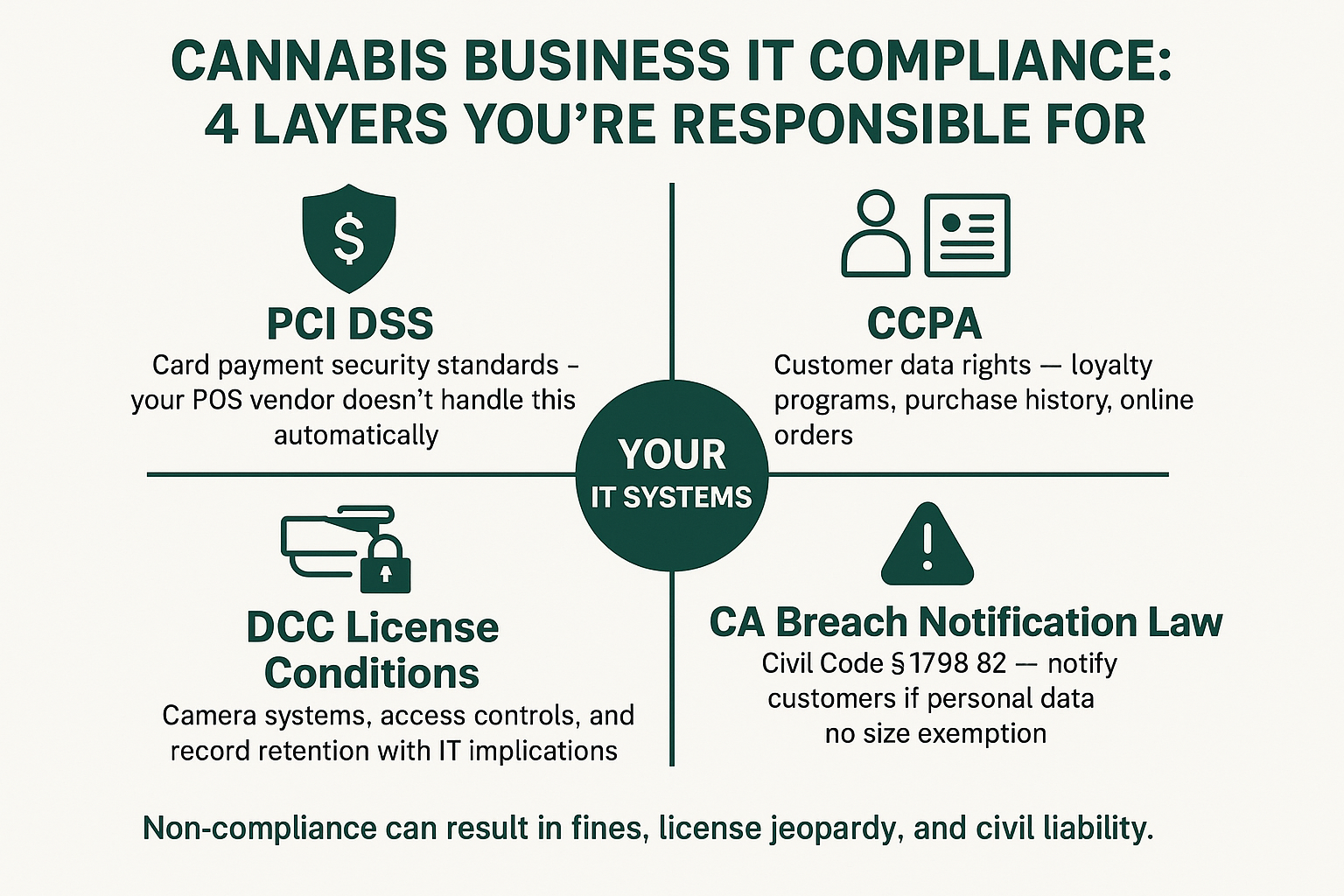
Most industries answer to one or two regulatory frameworks. A dental office deals with HIPAA. A financial services firm deals with GLBA. Cannabis businesses in California answer to at least four overlapping compliance layers simultaneously — and IT systems sit at the intersection of almost all of them.
Here’s what’s actually in play:
- California Consumer Privacy Act (CCPA): If your dispensary collects customer information — even just names and purchase history through a loyalty program — CCPA applies. You’re required to disclose what data you collect, honor deletion requests, and protect that data from unauthorized access.
- California’s data breach notification law (Civil Code § 1798.82): If personal information stored on your systems is compromised, you have a legal obligation to notify affected individuals. There’s no minimum business size exemption.
- PCI DSS: Any operation processing credit or debit card payments must meet Payment Card Industry Data Security Standards. Most small cannabis retailers are either unaware of this or assume their point-of-sale vendor handles it automatically — often incorrectly.
- State license conditions: The California Department of Cannabis Control requires security camera systems, access controls, and record retention. Many of those requirements have direct IT implications that operators don’t connect to their compliance checklist.
As the compliance landscape for Salinas businesses gets more detailed each year, cannabis operators are starting to realize that their IT setup is either a compliance asset or a liability — and right now, for most, it’s the latter.

The Access Control Gap Nobody Audits
Walk through almost any cannabis operation in Monterey County and you’ll find the same pattern: everyone uses the same login credentials for the back-office software, the camera system admin panel runs on a default password from the vendor, and the Wi-Fi password gets shared with every new employee on their first day.
That’s not a security complaint — it’s just what happens when a business grows fast and nobody’s job is to think about IT access controls. But it creates a compliance problem that cuts across multiple frameworks at once.
Under PCI DSS, you’re required to restrict access to cardholder data on a need-to-know basis, assign unique IDs to each person with computer access, and maintain logs that show who accessed what and when. Shared credentials make that impossible.
Under CCPA, if a disgruntled former employee walks out with customer loyalty data because they still have access to systems you forgot to revoke, your business is the one with the exposure — not the employee.
What a proper access control structure actually looks like:
- Every employee has their own named login with role-based permissions
- Access is revoked within hours of someone leaving the company — not days or weeks
- Administrative credentials for cameras, Wi-Fi, and software are held by a designated person or your IT provider, not written on a sticky note in the break room
- Access logs are retained for at least 90 days and reviewed periodically
This is one of the areas where reactive break-fix IT support consistently fails cannabis businesses — nobody’s reviewing access logs or auditing user accounts until something goes wrong.
Four IT Compliance Layers Cannabis Businesses Must Address
California cannabis operators don’t face a single compliance framework — they face four overlapping ones, each with direct IT implications.
What Happens to Your Network When Security Cameras Are on the Same System as Everything Else
The California Department of Cannabis Control requires licensed operators to maintain security camera systems with specific coverage and retention requirements — typically 90 days of recorded footage for most license types. Most operators handle this by installing an NVR or DVR system and calling it done.
The problem is where that camera system lives on your network.
In most cannabis businesses, the security cameras, the point-of-sale terminals, the back-office computers, and the employee Wi-Fi all run on the same flat network. That means a vulnerability in any one of those systems creates a path to all the others. Security cameras in particular are notorious for running outdated firmware and rarely getting patched — which makes them a common entry point for attackers.
The fix isn’t complicated, but it requires someone to actually configure it. Network segmentation — separating cameras, POS systems, and general office traffic into distinct network zones — is a standard practice that most small businesses skip because nobody ever explained why it matters.
For Monterey County cannabis operators, this also intersects with your physical security compliance. If your camera system is compromised and footage is lost or tampered with, that’s not just a cybersecurity incident — it’s potentially a licensing violation. The problems that arise when IoT devices aren’t properly managed show up in exactly this kind of scenario: connected devices that are ignored until they become a liability.
Proper network architecture for a cannabis operation typically includes:
- A dedicated VLAN for security cameras with no access to business systems
- Separate network segments for POS terminals and office computers
- Guest Wi-Fi that is completely isolated from any business or compliance-critical system
- Firewall rules that control what can talk to what — not just what can reach the internet
Common IT Compliance Gaps in Cannabis Operations
These are the gaps that show up most consistently when auditing cannabis business IT environments in California — along with the framework affected and what closing the gap actually requires.
| Compliance Gap | Framework Affected | What Fixing It Requires |
|---|---|---|
| Shared login credentials across staff | PCI DSS, CCPA | Individual named accounts with role-based access controls |
| Default passwords on cameras and network hardware | DCC license conditions, PCI DSS | Credential audit, password policy, firmware updates |
| Flat network — cameras on same segment as POS | PCI DSS, general security | Network segmentation (VLANs), firewall rule configuration |
| No access log retention or review | PCI DSS, CCPA | Centralized logging system with 90-day minimum retention |
| Former employees retaining system access | CCPA, general security | Offboarding checklist tied to HR process, managed by IT |
| No documented incident response plan | CA breach notification law | Written plan identifying who acts, when, and how to notify |
Why Most Cannabis Businesses Don’t Have an IT Partner at All
Cannabis is a cash-intensive, compliance-heavy, rapidly evolving industry — and traditional IT providers often don’t want the business. Some MSPs decline cannabis clients because of internal policy. Others worry about reputational risk or simply don’t understand the regulatory environment well enough to be helpful.
That leaves many cannabis operators doing IT completely on their own or relying on whoever set up the system during buildout and hasn’t been heard from since. It’s one of the reasons some industries have a genuinely harder time finding IT support — the problem is real, not imagined.
And the cost of going without is real too. According to the IBM Cost of a Data Breach Report, the average cost of a data breach for a small business now exceeds $4.45 million globally — but even a localized breach at a Monterey County dispensary could trigger CCPA notification obligations, card brand fines under PCI, and California Attorney General scrutiny. None of those are survivable for most small operators.
Finding an IT provider who will work with a cannabis business — and who understands the compliance framework well enough to actually help — requires looking for someone local with direct SMB experience rather than a national MSP that treats every client identically. What separates a local IT provider from a national one often comes down to exactly this kind of industry-specific knowledge and willingness to engage.
Frequently Asked Questions About Cannabis Business IT Compliance
Does CCPA actually apply to my dispensary if I’m a small operation?
CCPA in its current form applies to for-profit businesses that meet one of three thresholds: annual gross revenue over $25 million, buying or selling personal information on 100,000 or more consumers annually, or deriving 50% or more of revenue from selling personal data. Many small dispensaries won’t hit those thresholds. But California’s data breach notification law under Civil Code § 1798.82 has no size exemption — if you store personal information and your systems are compromised, you may still have a legal notification obligation regardless of size.
My POS vendor says they handle PCI compliance. Is that true?
Partially. Your POS vendor is responsible for the security of their own software and payment processing infrastructure. But PCI DSS compliance is shared — you’re still responsible for the network your POS terminals run on, how you store transaction records, who has access to those systems, and how you handle physical security around the terminals. Your vendor can’t audit your network for you.
How long do I need to keep security camera footage under California cannabis regulations?
The California Department of Cannabis Control generally requires 90 days of recorded footage for most license types. The specific requirement can vary by license category, so check your license conditions directly. The IT implication is that your storage system needs to be sized appropriately, maintained, and protected — footage that gets overwritten early or becomes inaccessible because of a hardware failure puts you out of compliance.
What should an incident response plan actually include for a small cannabis business?
It doesn’t need to be a 40-page document. A usable incident response plan for a small operation should name who is responsible for declaring an incident, who contacts law enforcement or legal counsel, how quickly the business can identify what data was exposed, and how notifications will be sent to affected individuals. California’s breach notification law requires notification to affected residents in the most expedient time possible — having a plan means you’re not making those decisions under pressure.
Is there an IT provider in Monterey County that actually works with cannabis businesses?
Yes — though the options are limited. When evaluating any IT provider, ask specifically whether they have experience with PCI DSS scoping for retail environments, whether they can configure network segmentation for camera and POS isolation, and whether they’ve worked with businesses subject to California’s breach notification requirements. A provider who can’t answer those questions confidently probably hasn’t worked in this space before.
Ready to Know Where Your IT Compliance Actually Stands?
Cannabis businesses in Monterey County are operating in one of the most compliance-layered environments of any industry in California — and most are doing it without any IT support structure at all. If you want a straight assessment of where your systems stand against PCI DSS, CCPA, and your DCC license conditions, Adaptive Information Systems works with SMBs across the Monterey Bay Area and understands the specific pressures local cannabis operators face. Reach out at (831) 644-0300 or visit adaptiveis.net to start a conversation.