
Direct Answer: A local IT provider knows your building, your region’s risks, and your industry. A national one knows your ticket number. For most Monterey County businesses, that gap has real consequences.
At some point, most business owners in the Monterey Bay Area have gotten a cold call or a slick email from a national IT provider promising managed services at a flat monthly rate. The pitch sounds reasonable. But when something actually breaks — a server goes down during harvest season, a ransomware alert fires at 7 PM on a Friday — the difference between local and national support becomes very concrete, very fast.
This isn’t about loyalty to local business for its own sake. It’s about whether your IT partner actually understands the environment your business operates in. A firm based in Austin or Atlanta doesn’t know that Salinas loses power during Caltrans outages on 101, that wildfire smoke season strains HVAC and hardware, or that agricultural businesses here run payroll on tight cycles tied to field operations.
This article breaks down the two areas where that gap matters most: response and accountability and local knowledge that shapes real decisions. If you’re evaluating IT providers right now, these are the things worth asking about.
Response Time and Accountability: What Actually Happens When Something Breaks
National MSPs often advertise response times in their contracts. But there’s a difference between a ticket getting logged and a qualified technician actually fixing your problem.
With most national providers, your first contact is a remote help desk — often staffed in a different time zone — that follows a script. If your issue doesn’t resolve over remote session, it escalates. That escalation might take hours, or a full business day. If the problem requires someone on-site, you’re looking at a third-party dispatch, which means a technician who has never seen your systems before and may not know your industry.
For a Salinas agriculture business, a marina-side hospitality operator in Monterey, or a Watsonville berry processor, that kind of delay isn’t just frustrating — it’s expensive. According to IBM’s 2023 Cost of a Data Breach report, the average cost of a single IT security incident for a small to mid-sized business exceeded $3.3 million. Downtime from slower response compounds that number.
A local provider based in the region carries a different kind of accountability:
- They can physically be in your office within a reasonable drive — not a multi-hour dispatch queue
- They’ve seen your hardware before, often because they installed it
- They know your staff, your workflows, and which systems are actually critical
- Their reputation is tied to your community — a bad outcome affects their referrals directly
That accountability structure changes how they prioritize your call. When someone down the street can walk in and verify what happened, the incentive to get it right the first time is much higher. For more on what real IT accountability looks like in practice, read 6 Signs Your IT Support Partner Is Actually Protecting Your Business.

Local Knowledge That Changes How IT Decisions Get Made
This is the part that rarely shows up in a vendor comparison spreadsheet, but it shapes almost every IT recommendation a provider makes.
A national MSP will give you a standard managed services stack. Same configuration they’d sell to a dental office in Denver or a law firm in Miami. It checks the boxes. But it may not account for the specific risk profile your Monterey County business actually faces.
Here are a few examples of what local knowledge actually looks like in practice:
Wildfire and power outage preparedness. PG&E’s Public Safety Power Shutoffs affect businesses throughout Monterey County and the surrounding region every fire season — sometimes with less than 24 hours notice. A local IT provider will factor this into backup power configurations, cloud failover planning, and backup and disaster recovery design. A national provider working off a standard template may not think about it at all.
California compliance requirements. The California Consumer Privacy Act (CCPA) and California’s data breach notification law (Civil Code 1798.29) impose obligations that differ from federal baselines. Healthcare-adjacent organizations in Salinas and Monterey have HIPAA overlap on top of state law. A local provider who works regularly with Central Coast businesses in agriculture, legal, and medical sectors will already know this landscape. For a closer look at what compliance actually requires, the Compliance with Standard guide for Salinas businesses is worth reading.
Industry-specific infrastructure needs. Agriculture businesses in the Salinas Valley often run ERP and field management software on infrastructure that’s been in place for years. A local IT partner who has worked with growers, packers, or ag-tech firms understands how those systems interact — and where the vulnerabilities are. A national provider approaching this fresh won’t have that context without a significant ramp-up period.
None of this is something you can get by reading a service brochure. It comes from showing up repeatedly in a region and learning how local businesses actually work.
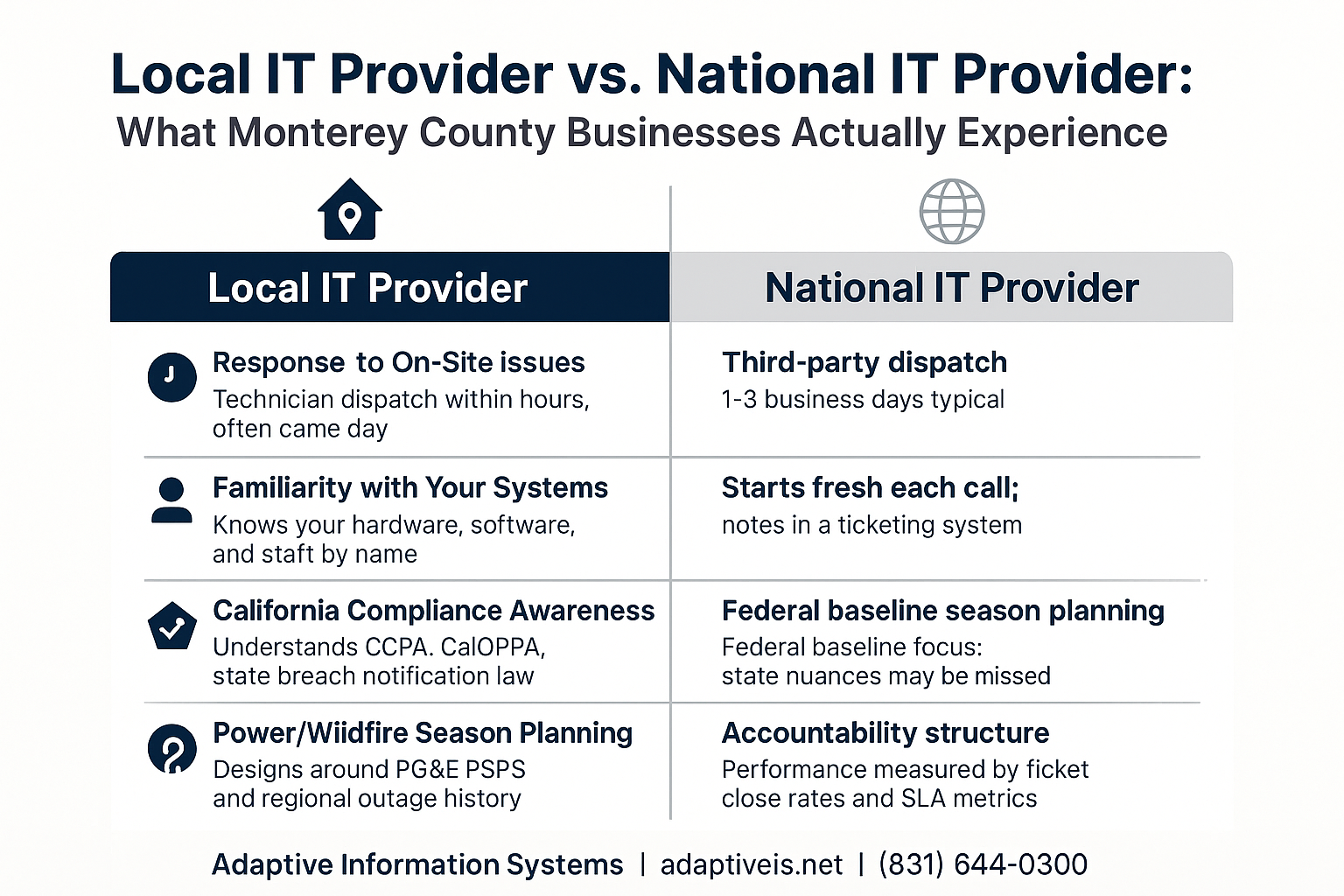
Local vs. National IT Provider: Side-by-Side
This comparison covers the practical differences Monterey County businesses experience between a local managed IT provider and a national one.
What to Ask Any IT Provider Before You Sign
These questions cut through the sales pitch and get to information that actually matters for a Monterey County business.
| Question to Ask | What a Good Answer Looks Like | Red Flag |
|---|---|---|
| How fast can someone be on-site in Salinas or Monterey? | A specific timeframe — ‘within 2 hours’ or ‘same day for critical issues’ | Vague language like ‘as quickly as possible’ or no on-site option |
| Do you know California’s data breach notification requirements? | They can name Civil Code 1798.29 and explain what it requires | A generic answer about ‘staying compliant with all regulations’ |
| Have you worked with businesses in ag, hospitality, or healthcare in this region? | Specific client types and real examples, even anonymized | Name-dropping national clients or pivoting to certifications |
| What happens during a PG&E power shutoff — do you have a plan for that? | A clear answer about UPS, cloud failover, or backup generators | Blank stare or ‘that’s handled by your facilities team’ |
| Who answers the phone when I call at 6 PM on a Friday? | A direct answer — named staff, not ‘our 24/7 help desk team’ | Scripted after-hours service center with no local escalation path |
The Hidden Cost of Starting Over Every Time You Call
One thing that rarely shows up in a contract comparison is the cost of institutional knowledge — or the lack of it.
With a national provider, every interaction often starts at zero. The technician on the call has access to your ticket history, but they don’t know that your accounting server was moved six months ago, that your office manager runs a specific workflow every Monday morning that can’t be interrupted, or that your Wi-Fi dead zone in the warehouse has been a problem since the building expansion.
That gap adds up in two ways. First, resolution takes longer because the technician is gathering context that a local partner would already have. Second, the advice you get is generic — not shaped by what your specific environment actually needs.
For businesses running aging infrastructure, this matters even more. Problems with older systems tend to be interconnected in ways that aren’t obvious from a ticket log. Read more about why aging technology problems stay hidden until systems suddenly crash — it’s a pattern local IT teams who know your systems are far better positioned to catch early.
The businesses that switch from break-fix IT to managed services typically do it after one expensive incident that a provider with better context would have caught before it happened.
Frequently Asked Questions About Local vs. National IT Providers
Aren’t national IT companies better resourced than a local provider?
In some ways, yes — large national MSPs may have more staff and more certifications on paper. But resources don’t help you if they’re not available when you need them, or if the person who shows up doesn’t know your systems. For most SMBs in the 10 to 150 employee range, the depth of relationship and local context matters more than headcount. A local provider with the right partnerships and toolset can deliver enterprise-grade monitoring, security, and support without the overhead.
What does a local managed IT contract actually cost compared to a national one?
Pricing varies by scope, but most Monterey County businesses with 20 to 75 employees can expect managed IT to run between $80 and $180 per user per month depending on what’s included. National providers sometimes advertise lower per-seat rates but charge separately for on-site visits, project work, and compliance add-ons. The total cost of ownership tends to be similar — the difference is in what you get for it.
Does a local IT provider actually have 24/7 support?
Good ones do, yes. After-hours support at a local MSP may be structured differently than a national help desk — it might route to an on-call engineer rather than a staffed call center — but that often works better for critical issues, because the person who picks up knows your environment. Ask any provider you’re evaluating exactly who answers after-hours calls and what their escalation path looks like.
We have remote employees outside of Monterey County. Can a local provider still support them?
Yes. Remote support tools, cloud infrastructure, and mobile device management have made geography largely irrelevant for day-to-day help desk and security work. A local provider manages your core systems and handles on-site needs in Monterey County, while supporting remote staff anywhere through the same platform. The local advantage isn’t about being geographically limited — it’s about having someone accountable and knowledgeable at the center of your IT operation.
How do I evaluate whether an IT provider actually knows my industry?
Ask them to walk you through two or three specific decisions they’ve made for businesses similar to yours. Not certifications — actual decisions. What backup strategy did they recommend for an agriculture company with intermittent connectivity during field operations? How did they handle HIPAA overlap for a healthcare-adjacent client? The specificity of the answer tells you more than any credential.
Want to Talk With Someone Who Actually Knows the Monterey Bay Area?
Adaptive Information Systems is headquartered in Salinas and serves businesses across Monterey County, Santa Cruz County, and the broader Central Coast — including agriculture operations, medical offices, nonprofits, and professional services firms. If you’re evaluating IT providers or have questions about what a local managed IT relationship actually looks like, give us a call at (831) 644-0300 or visit adaptiveis.net to start the conversation.