Direct Answer: Certain industries — agriculture, healthcare, legal, and finance — need IT providers with specific compliance knowledge and operational experience that most general IT shops simply don’t have.
Not every business can just call any IT company and call it a day. A Salinas-based agricultural operation, a Monterey Peninsula medical practice, or a Watsonville legal firm all have technology needs that go well beyond setting up email and keeping the Wi-Fi running.
The problem is that most IT providers aren’t built for the specific demands those industries carry — and when you pick the wrong one, you end up paying for support that doesn’t actually fit your environment. Worse, you may end up out of compliance without knowing it.
This article breaks down which industries run into the most friction when searching for IT support, why that friction exists, and what those businesses should be looking for when they evaluate potential IT partners.
The Real Reason Some Industries Get Left Behind
Most IT providers are built around a generic SMB model — Windows workstations, Microsoft 365, basic networking, maybe some antivirus. That model works fine for a retail shop or a real estate office.
But several industries in Monterey County operate inside a much more complicated technology environment. They have regulatory obligations, specialized software, legacy systems, or operational workflows that generic IT support simply wasn’t designed to handle.
Here’s what makes those industries harder to serve:
- Compliance requirements — HIPAA, PCI-DSS, GLBA, and California’s data breach notification laws (Civil Code § 1798.82) don’t just apply to big corporations. A 15-person medical billing office in Seaside carries the same legal exposure as a hospital system.
- Specialized software — Industry-specific platforms like electronic health record systems, agricultural management software, or legal case management tools require IT providers who understand how those applications interact with the underlying infrastructure.
- Unusual network environments — A Salinas farm operation with IoT sensors across multiple parcels is a fundamentally different networking challenge than a downtown office building.
- Higher-stakes downtime — In some industries, an hour of downtime doesn’t just cost productivity. It can mean a missed court filing deadline, a HIPAA breach event, or spoiled produce in cold storage.
When an IT provider doesn’t understand those stakes, they tend to underbuild the solution — and the business pays for it later. You can read more about what separates a local IT provider from a national one if you’re wondering why a locally rooted provider often handles these nuances better than a national chain.

Agriculture: The Industry Most IT Providers Aren’t Ready For
Salinas is the Salad Bowl of the World. The agricultural economy here isn’t a side industry — it drives billions of dollars in annual output across Monterey County and the broader Salinas Valley. And agriculture has become a deeply technology-dependent business.
Modern ag operations run GPS-guided equipment, soil sensors, cold storage monitoring systems, and enterprise resource planning platforms that track everything from field inputs to shipping manifests. Many of those systems run on proprietary software that most IT providers have never touched.
The specific challenges agriculture faces when searching for IT support include:
- Distributed infrastructure — A single grower might have equipment across several ranches between Greenfield and King City, plus a Salinas packing shed and a remote accounting team. Unified, reliable networking across those locations is not a simple project.
- IoT device sprawl — Sensors, cameras, and connected irrigation controllers multiply fast, and unmanaged IoT devices create serious security vulnerabilities most ag operators don’t see coming.
- Seasonal demand spikes — During peak harvest, operational systems can’t go down for a scheduled patch window at midnight. IT support needs to understand crop calendars, not just maintenance schedules.
- Connectivity limitations — Parts of the Salinas Valley still have limited fiber or cellular coverage. An IT partner who’s never dealt with rural connectivity isn’t going to have good answers for a ranch outside Soledad.
The IT providers who serve agriculture well are the ones who’ve actually worked in that environment — not the ones who learned about it from a brochure.
Healthcare-Adjacent and Legal: Compliance Changes Everything
Healthcare organizations and legal firms don’t just need IT support. They need IT support from someone who understands what happens if they get it wrong.
For healthcare-adjacent businesses — medical offices, dental practices, behavioral health providers, and medical billing firms throughout the Monterey Peninsula and Salinas — the baseline requirement is HIPAA compliance. That means every endpoint, every email account, every backup system, and every cloud application has to be evaluated through a HIPAA lens. An IT provider who doesn’t know what a Business Associate Agreement is has no business touching those systems.
For legal firms, the concerns layer on top of each other:
- Attorney-client privilege obligations affect how data can be stored, who can access it, and where it can travel.
- California’s data breach notification law kicks in for any unauthorized access to personal information — and a law firm’s client files are exactly the kind of data that triggers it.
- Case management platforms like Clio or MyCase require specific integration and security configurations that generic IT support often gets wrong.
What makes this even harder is that small legal and medical offices — a 4-attorney firm in Monterey, a two-dentist practice in Pacific Grove — often assume they’re too small to need this level of IT rigor. They’re not. Attackers specifically target smaller professional service firms because the data is valuable and the defenses are usually weak. The ransomware risk for small businesses is real, and compliance-heavy industries are not exempt.
Proper IT support for these sectors also means having a compliance framework built into the managed services agreement — not bolted on after something goes wrong.
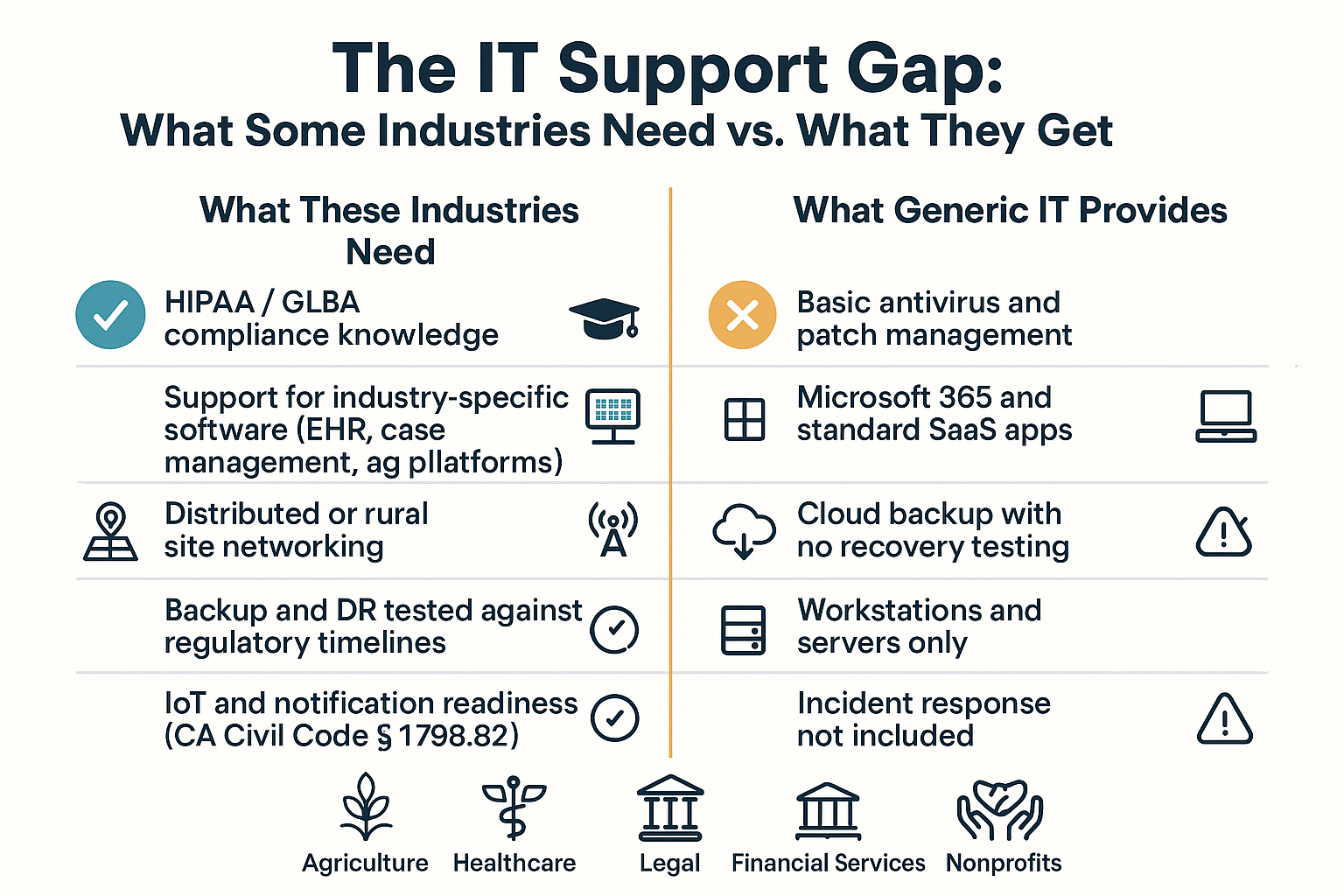
Industries That Need Specialized IT Support vs. What They Actually Get
This infographic shows the gap between what high-compliance industries require from an IT provider and what most general IT shops actually deliver.
IT Complexity by Industry: What to Expect
This table gives a quick reference for the primary IT challenges each industry type faces and what that means for the kind of IT support they need.
| Industry | Primary IT Challenge | Key Support Requirement |
|---|---|---|
| Agriculture (Salinas Valley) | Distributed sites, IoT, rural connectivity | Multi-site networking, IoT management, seasonal flexibility |
| Healthcare / Medical | HIPAA compliance, EHR integration | Compliance-aware managed IT, encrypted backup, BAA coverage |
| Legal Firms | Data privacy, case management software | Access controls, breach response planning, secure file handling |
| Financial Services | GLBA compliance, fraud prevention | Endpoint security, MFA enforcement, audit-ready logging |
| Nonprofits | Limited budget, grant compliance requirements | Cost-effective managed services, donor data protection |
| Hospitality (Monterey Peninsula) | PCI-DSS for payments, seasonal traffic spikes | Network segmentation, POS security, guest Wi-Fi isolation |
What These Industries Should Actually Be Looking For
When a business in a high-complexity industry starts evaluating IT providers, most of the standard questions — ‘How fast is your response time?’ and ‘What’s your monthly cost?’ — miss the point.
The questions that actually matter are more specific:
- Do you have clients in our industry? Not just ‘we serve all businesses.’ Ask them to name a similar client and describe what that engagement looks like.
- How do you handle compliance documentation? A provider who can’t explain what they’d produce for a HIPAA audit or a PCI-DSS assessment probably hasn’t done one.
- What does your backup and recovery process look like, and have you tested it? Not all backup systems are equal, and an untested backup is essentially not a backup at all.
- Have you worked with [specific software platform]? Whether it’s an EHR system, a legal case platform, or an agricultural ERP, the answer to this question tells you a lot.
- What happens when we have an incident? The response to this question separates providers with a real plan from ones who will figure it out as they go.
For businesses that are evaluating multiple providers, this guide on finding the right IT consulting partner for small businesses is a useful starting point before you get on any discovery calls.
The goal isn’t to find the cheapest IT support. It’s to find support that actually understands your environment before something breaks — not after.
Frequently Asked Questions About Finding IT Support for Specialized Industries
We’re a small operation — do we really need industry-specific IT support?
Yes, if your industry carries compliance obligations or uses specialized software. A 6-person dental office in Salinas has the same HIPAA exposure as a large clinic. The size of your business doesn’t reduce your legal liability — it just means you likely have fewer resources to deal with a breach or audit. Getting the right IT support from the start is far less expensive than cleaning up afterward.
How much more does specialized IT support cost compared to generic managed IT?
It depends on the industry and scope, but you’re generally looking at a $20–$50 per user per month premium over basic managed services when compliance work, specialized software support, or multi-site networking is involved. For most Monterey County SMBs, that’s a fraction of the cost of a single compliance violation or ransomware event.
Can a national MSP handle our industry-specific needs?
Sometimes, but national providers often lack the local operational context that matters — things like understanding Salinas Valley connectivity limitations, knowing which compliance auditors operate in Monterey County, or being available on-site when a field-level system goes down during harvest. A local provider with industry experience is usually a stronger fit for businesses that need both specialized knowledge and geographic presence.
What’s the biggest mistake businesses make when choosing an IT provider?
Choosing on price alone. The cheapest IT provider is rarely equipped to handle the complexity of a regulated industry, and the gap shows up at the worst possible time — during an audit, after a breach, or when a critical system fails.
What should we do if our current IT provider doesn’t understand our industry?
Start by having a direct conversation about your specific compliance requirements and software environment. If they can’t speak to those clearly, it’s time to evaluate alternatives. A co-managed IT arrangement is one option — your current provider handles day-to-day support while a more specialized partner takes ownership of compliance, security, and strategic planning. It’s a lower-disruption way to close the gap without a full provider switch.
Ready to Work With an IT Provider Who Actually Knows Your Industry?
Adaptive Information Systems works with businesses across Monterey County — from agricultural operations in the Salinas Valley to professional service firms on the Monterey Peninsula — and we understand the compliance, connectivity, and operational demands that come with those environments. If you’re not confident your current IT support was built for your industry, that’s worth a conversation. Call us at (831) 644-0300 or visit adaptiveis.net to talk through what your business actually needs.