
Direct Answer: Salinas Valley agriculture businesses face IT challenges most generic providers miss: inconsistent multi-site connectivity, unmanaged IoT devices, and seasonal infrastructure risks that can halt packing operations at the worst possible time.
Agriculture is the economic backbone of the Salinas Valley, and the IT problems that come with running an ag operation are nothing like what a dentist’s office or a law firm faces. You have packing sheds, field offices, refrigerated warehouse environments, and sometimes a main headquarters all on the same network, or what used to be the same network before it grew in pieces over the years.
When a generic IT provider shows up and starts asking questions, they often have no frame of reference for what harvest season downtime actually costs, or why your wireless access points fail in a cold storage environment, or why your VoIP phones drop calls every time the packing line spins up. These are not generic IT problems. They are specific to how ag businesses in Monterey County operate.
This article covers the three areas where Salinas Valley ag operations run into the most serious IT friction: multi-site connectivity and infrastructure sprawl, IoT devices that are connected but not managed, and disaster recovery gaps that show up exactly when wildfire or power outage season hits. Each one is worth understanding on its own terms.
Multi-Site Connectivity and Infrastructure You’ve Partially Lost Track Of
One of the most common situations in Salinas Valley ag is infrastructure that grew organically over years, a cable run here, a wireless bridge there, a switch added when the new cold storage unit came online. At some point, no one has a current network diagram. Fiber runs, copper cabling, and conduit paths exist, but no one can say with certainty what connects to what or where a specific line terminates.
This matters more than it sounds. When something breaks during peak packing operations, a failed switch, a severed line during a site expansion, a degraded wireless link to an office trailer, the time it takes to trace the problem is time the line is not running. A real network infrastructure assessment includes fiber tracing, copper tracing, conduit status mapping, and a current network diagram. These are not optional extras for a business running at this scale; they are the baseline documentation that makes any future troubleshooting fast instead of slow.
For ag operations specifically, the multi-site challenge also involves mixed environments that put stress on wireless hardware in ways office buildings do not:
- Refrigerated warehouse temperatures cause wireless access points to fail faster than their rated specs suggest
- Dust and humidity in packing shed environments degrade hardware and connections over time
- Office trailers connected via wireless bridges often run on underpowered equipment that was never designed for the data loads a modern operation generates
- Shared network pipes, where VoIP phones, packing line systems, and general office traffic all compete for bandwidth, create voice quality problems that are easy to misdiagnose as a phone system issue
Proactive infrastructure monitoring catches these problems before they become production stoppages. When a switch starts showing elevated error rates at 2 a.m. on a Tuesday, a monitored environment flags it. An unmonitored one waits for someone to call in a complaint at 7 a.m. when the line is already down. If you are curious what that monitoring actually involves, the piece on how businesses catch network problems before employees do walks through it in plain terms.

IoT Devices in the Field: Connected Is Not the Same as Managed
Mid-sized Salinas Valley ag operations are already running IoT at scale. Soil sensors in the fields, environmental monitors in cold storage, cold-chain tracking on outbound shipments, and fleet telematics on equipment are common. Most of these were deployed because they solve a real operational problem, and they do. But the IT layer underneath them is often an afterthought.
The risk is not that the devices exist. The risk is what happens when they are not managed properly. According to the NIST National Vulnerability Database, unpatched firmware in connected devices is one of the most consistently exploited attack surfaces in any environment. An irrigation controller or cold-chain sensor that has not had a firmware update in 18 months is not a neutral piece of equipment, it is a potential entry point into your business network.
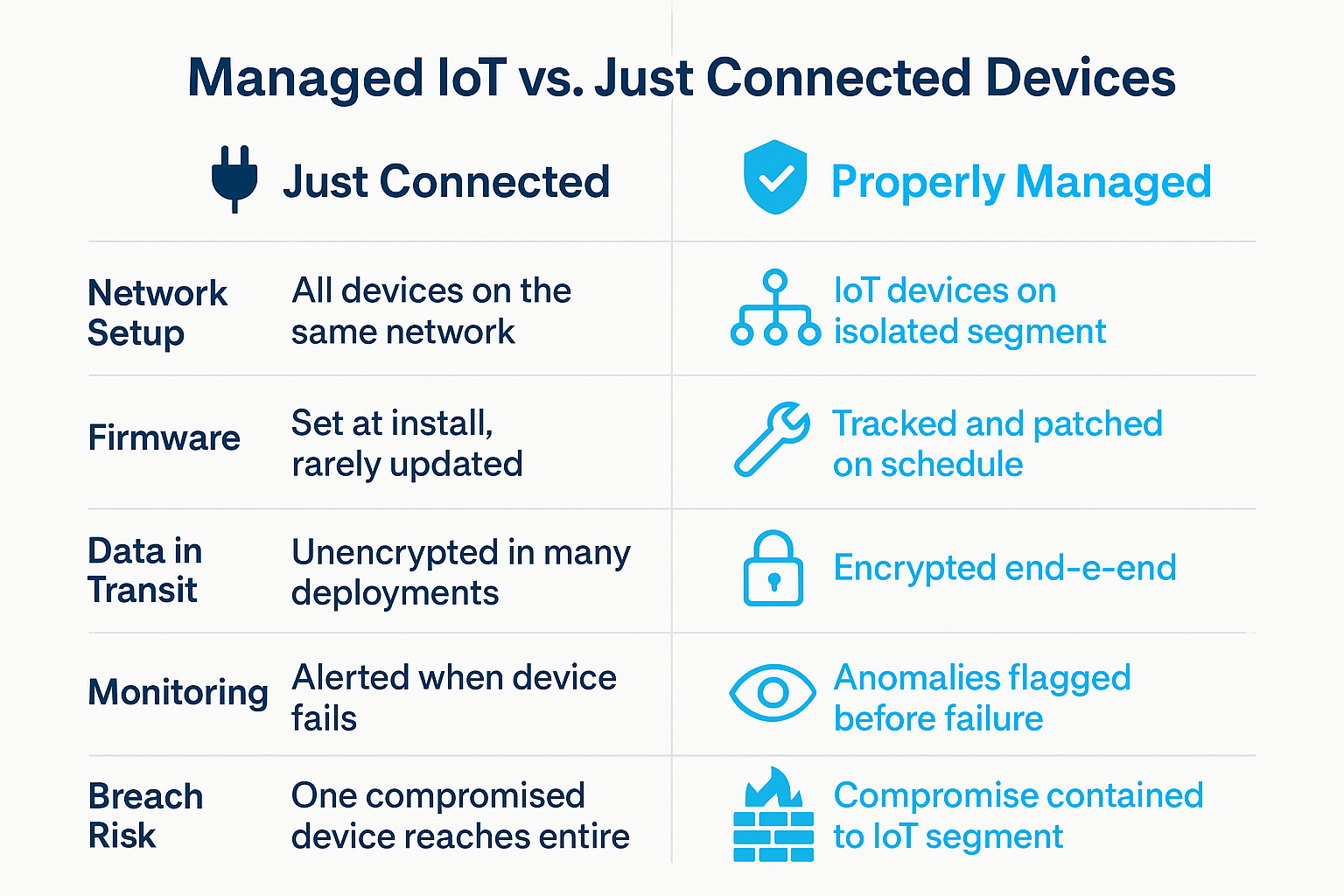
Managed IoT is different from simply connecting devices. The practical difference comes down to three things:
- Network segmentation, IoT devices should sit on their own isolated network segment, separate from your accounting systems, email, and any systems that touch employee or customer data. If a soil sensor is compromised, it should not be able to see your payroll server.
- Firmware patch management, Someone needs to track manufacturer firmware releases, test them, and push updates across your device fleet. This is not something that happens automatically on most commercial IoT hardware.
- Secure two-way device connectivity, Data flowing from field devices back to your management platform needs to be encrypted in transit. Many out-of-the-box IoT deployments skip this step entirely.
For ag operations in Monterey County with HIPAA-adjacent obligations, staff health plans, on-site medical services, or equipment financing relationships that carry GLBA compliance requirements, the stakes on this are higher than a typical small business. A breach that touches employee health data or financial records because an unpatched sensor opened a door is not a theoretical risk. It is the kind of incident that triggers California’s data breach notification requirements and creates real liability.
What Managed IoT Actually Covers vs. Just Connecting Devices
This visual breaks down the gap between a basic IoT deployment and a properly managed one, the three layers that make the difference between operational data and operational risk.
What Wildfire and Power Outage Season Actually Does to an Ag Operation’s IT
Summer and early fall are the highest-risk window for Salinas Valley businesses with physical infrastructure. Wildfire smoke, high-heat events, and PG&E Public Safety Power Shutoffs (PSPS) are seasonal realities, not edge cases. For an ag operation running payroll, compliance documentation, logistics coordination, and packing line management on the same network, a simultaneous loss of power, ISP connectivity, and generator reliability is not a minor inconvenience, it is a significant disruption to every function at once.
The problem most businesses discover too late is the difference between having backups and having a tested recovery plan. Backups are a component of recovery, not the whole thing. A real plan answers specific questions:
- How long can operations continue if the main office network goes down completely?
- Which systems need to come back online first, and in what order?
- If the on-site server is unreachable because the building lost power, can staff access cloud-hosted data from a remote location?
- When was the last time a full restore was actually tested end-to-end, not just verified as complete?
For ag businesses with mixed on-site and cloud systems, a common setup in the valley, where legacy on-prem servers coexist with cloud-hosted applications, the recovery scenario is more complex than a pure-cloud environment. Data stored on local hardware needs to have an off-site copy that is current and restorable in hours, not days. The piece on what a real IT recovery plan actually contains goes into the specific components worth reviewing if you are not sure what your current plan actually covers.
For businesses still running physical servers on-site, the private cloud vs. on-premise decision is worth thinking through before the next fire season, not after it.
Key IT Risks for Salinas Valley Ag Operations: Cause, Impact, and What Addresses It
This table maps the most common IT failure points in ag operations to their operational consequences and the management layer that addresses each one.
| Risk Area | How It Shows Up | What Addresses It |
|---|---|---|
| Infrastructure sprawl | Can’t trace where a line runs; slow troubleshooting during outages | Network assessment with fiber/copper tracing and a current diagram |
| Failing switches or access points | Intermittent connectivity in packing sheds, warehouse, or trailers | Proactive monitoring with alerts before failure causes downtime |
| Unpatched IoT firmware | Connected devices become entry points onto the business network | Managed IoT with scheduled firmware updates and segmentation |
| Shared bandwidth congestion | VoIP call quality drops when packing line systems are active | QoS configuration on switches and routers to prioritize voice traffic |
| Power or ISP outage | Simultaneous loss of office network, phones, and cloud access | Tested backup and disaster recovery with off-site data copies |
| Compliance gaps (GLBA, HIPAA) | Unaddressed regulatory exposure on employee or financial data | Security baseline review and documented compliance controls |
Frequently Asked Questions About IT for Salinas Valley Agriculture Businesses
Our network has grown a lot over the years and we don’t have a current diagram. Where do you even start with something like that?
A network assessment that includes physical tracing is the right starting point. This means walking the infrastructure, identifying where fiber runs, where copper terminates, what conduit is in use, and documenting every switch, access point, and connection in a current diagram. It sounds tedious but it is the only way to build a reliable picture of what you actually have. From there you can identify what is aging out, what is misconfigured, and where the gaps are. Several ag operations in the Salinas area have gone through this process specifically because they knew their infrastructure had outgrown what anyone had documented.
We already have soil sensors and cold-chain monitors running. Are they really a security risk?
They can be, depending on how they are set up. The main concern is network segmentation, if those devices sit on the same network as your accounting software or your email, a compromised device has a path to everything else. The second concern is firmware. Most IoT devices need periodic firmware updates from the manufacturer, and those updates often patch known security vulnerabilities. If no one is tracking and applying those updates, the devices accumulate risk over time. This does not mean you should stop using them, it means the management layer around them matters.
How does a PSPS or wildfire outage actually affect IT systems beyond just the power going out?
Power loss takes down on-site servers and networking gear, but the cascading effects go further. Your ISP connection may go down independently even if your generator holds. VoIP phones that run over the internet lose their connection. If your cloud applications depend on a local server as an intermediary, that path breaks too. A tested recovery plan accounts for each of these scenarios separately and defines which systems come back first and how staff access what they need remotely during the outage window. Summer and early fall are the right time to review and test that plan in the Salinas Valley, not after an event has already happened.
Does our operation need to worry about HIPAA or GLBA compliance if we are primarily a grower or shipper?
Possibly. If your operation carries a self-funded employee health plan or provides any on-site medical services, even something as basic as a clinic for field workers, HIPAA obligations can apply to how you handle that health data. GLBA compliance is relevant if your business has equipment financing relationships or operates any kind of rural credit function. Neither framework requires you to be a hospital or a bank. The compliance question is worth a direct conversation with your IT and legal advisors, not something to assume away.
What does proactive monitoring actually catch that we would not notice ourselves?
Quite a bit. Hardware failures rarely happen all at once, they degrade. A switch that is about to fail often shows elevated error rates for days or weeks before it stops passing traffic. A wireless access point in a cold storage environment may start dropping connections intermittently before it fails completely. Disk space on a server fills gradually. Proactive monitoring watches these metrics continuously and flags anomalies before they become outages. The difference is whether you find out at 2 a.m. when the alert fires, or at 7 a.m. when the line is already down and your team is standing around waiting.
Ready to Get a Clearer Picture of Where Your IT Actually Stands?
If your operation has grown faster than your infrastructure documentation, or you have connected devices running without a real management layer behind them, it is worth having a conversation before harvest season puts everything under pressure. Adaptive Information Systems works with businesses across Monterey County and the Salinas Valley and understands the operational realities that generic IT providers do not. Reach out at (831) 644-0300 or visit adaptiveis.net to talk through what a network assessment or infrastructure review would look like for your operation.