
For your local business, cybersecurity and compliance in Watsonville, CA, is about more than just technology. It's about protecting the digital lifeblood of your company—customer lists, financial records, and employee data—from a growing list of online threats. At the same time, you have to follow the rules on data privacy.
Getting this right means securing your daily operations, building trust with your customers, and avoiding hefty fines. Honestly, it's one of the most important things for any business in our Salinas and Monterey County communities to get a handle on.
Your Guide to Cybersecurity and Compliance in Watsonville

If you've ever wondered whether cybersecurity is a real concern for a local company like yours, the answer is a firm "yes." Your digital information is just like the inventory in your stockroom. You wouldn't leave the door unlocked overnight, and you need to apply that same thinking to your online world.
We built this guide to pull back the curtain on cybersecurity and compliance for businesses right here in our community, from the agricultural fields of the Pajaro Valley to the storefronts in Monterey. We’ll break down these complex topics into simple, actionable steps you can take to protect your reputation, your customers, and your bottom line.
Why This Matters Now More Than Ever
Cyber threats aren't just a big-city problem anymore; they are hitting businesses of all sizes, right here at home. You only have to look at recent local incidents, like the data breach at Watsonville Community Hospital, to see how vulnerable even our most trusted institutions can be. In that case, sensitive health records, social security numbers, and financial details were all exposed.
This wasn't a random event. It's part of a much larger trend, with healthcare being one of the most targeted industries in the country. Data breaches in the sector have been climbing by about 9% year-over-year in the mid-2020s.
To get through this complex regulatory environment and protect what you’ve built, a solid grasp of data security compliance is essential. These rules aren't just about avoiding penalties; they are the foundation for building and keeping the trust of your clients.
The core of good security isn't just about technology—it's about a mindset. Proactively protecting your business data is one of the smartest investments you can make in its future.
We’ve always believed that enterprise-level IT shouldn’t be reserved for massive corporations. Our whole mission is to make it accessible and affordable for you. For a solid primer on the basics, a great place to start is our guide on Cyber Security 101 for small businesses.
Why Local Watsonville Businesses Are a Prime Target
I often hear business owners around here say, “We’re just a small local shop. Why would a hacker care about us?” It’s an understandable thought, but unfortunately, it’s the exact assumption that puts you in a cybercriminal's sights.
They aren't always hunting for a massive corporate giant; they're opportunistic, like a burglar walking down a street checking for unlocked doors. Your small or mid-sized business, often without a dedicated IT security expert on staff, looks like an easy win.
This isn’t some abstract threat you see on the national news. The risk is woven into the very fabric of the work you do every day here in Monterey County. From an ag-tech firm in Watsonville to a law office in Salinas, your business generates and stores a huge amount of valuable data—and criminals have a market for it. This is why professional support for cybersecurity and compliance in Watsonville, CA, has moved from a luxury to an absolute necessity.
The hard truth is, your size is a feature, not a bug, for an attacker. They know you have fewer resources than a Fortune 500 company, making your network a softer target for ransomware, phishing scams, and data theft.
Your Industry Is Your Risk Profile
The unique economic engine of our region creates specific vulnerabilities. A hacker doesn't just see a business name; they see the type of data you handle and how much it's worth. The more sensitive the information, the bigger the payday.
Here in the Pajaro and Salinas Valleys, our local industries are prime examples:
- Agriculture and AgTech: You’re not just growing produce; you're managing sensitive data on crop yields, proprietary farming techniques, or multi-million dollar contracts. A breach here could expose trade secrets or grind your supply chain to a halt.
- Hospitality and Tourism: Think about it. Hotels in Carmel and restaurants in Pacific Grove process thousands of credit card transactions every single day. That payment data is a goldmine for criminals, and a breach can crush customer trust and bring on devastating PCI DSS compliance fines.
- Healthcare and Professional Services: From a small medical clinic to a trusted accounting firm, you hold confidential patient and client records. This data is not only heavily regulated but also incredibly valuable on the dark web, making you a high-stakes target.
Every invoice, every patient file, and every credit card swipe adds to your digital footprint, expanding the area that needs to be defended.
A common mistake is thinking your data isn't valuable. To a cybercriminal, your customer list, payment records, and employee information are all marketable assets. Their goal isn't always one massive score; it's often about making smaller, consistent profits from many easy targets.
Proactive Defense Is Always More Affordable
Waiting for a cyberattack to happen is, without a doubt, the most expensive strategy you can adopt. The cost of a data breach goes far beyond the immediate cleanup. You’re looking at potential regulatory fines, legal fees, the staggering cost of restoring your systems, and worst of all, the loss of the reputation you’ve worked so hard to build in our community.
Think of cybersecurity as preventative maintenance for your business. You service your equipment to avoid a catastrophic breakdown. In the same way, investing in proactive security prevents a digital disaster that could shut you down for good. This is where a solid, affordable IT plan makes all the difference, bringing enterprise-level IT to you at a price that makes sense.
Making Sense of California Compliance Regulations
The word "compliance" can make any business owner’s shoulders tense up. It sounds intimidating, expensive, and frankly, like a massive headache you don't have time for. You probably picture stacks of paperwork and dense legal jargon.
But here’s the truth: understanding the rules that govern data protection is one of the most powerful ways to build trust with your customers and shield your company from risk.
Instead of getting bogged down in legal text, let's focus on what these regulations are really about. At their core, they’re just frameworks for handling people's personal information responsibly. Following them isn’t just about dodging fines; it’s about proving to your clients in Watsonville and beyond that you take their privacy seriously. In today's market, that's a huge competitive advantage.
Getting a handle on the key regulations is the first step toward building a practical plan for cybersecurity and compliance in Watsonville, CA.
The Big Three Regulations for Local Businesses
For most small and mid-sized businesses in our area, compliance boils down to three main sets of rules. You might have other industry-specific standards to follow, but getting a grip on these three will cover most of your responsibilities. Each one protects a different kind of data, but they all share the same goal: protecting people.
Here’s a simple breakdown of what you need to know:
- CCPA (California Consumer Privacy Act): This is California’s landmark privacy law. Think of it as a bill of rights for your customers' data. It gives them the right to know what information you collect, the right to ask you to delete it, and the right to tell you not to sell it. If you do business in California and hit certain thresholds (like annual revenue or the amount of data you handle), you absolutely need to pay attention to CCPA.
- HIPAA (Health Insurance Portability and Accountability Act): If your business is in healthcare—or you’re a vendor for a healthcare company, like an IT provider or a billing service—HIPAA is non-negotiable. It’s the national standard for protecting sensitive patient health information. The fines for slipping up are severe because the goal is to safeguard incredibly personal medical data.
- PCI DSS (Payment Card Industry Data Security Standard): Do you take credit or debit cards? It doesn’t matter if you run a small café in Marina, a retail shop in Carmel, or an e-commerce store—PCI DSS applies to you. It's a set of security standards designed to ensure any company that accepts, processes, stores, or transmits credit card information does so in a secure environment.
The point of these regulations isn't to punish small businesses. It's to create a safer, more trustworthy environment for everyone. When you view compliance as a framework for building customer trust, it stops being a burden and starts becoming a business asset.
To help you keep track, here’s a quick overview of how these regulations apply to businesses in the Watsonville area.
Key Regulations at a Glance for Watsonville Businesses
| Regulation | Who It Affects | What It Protects | Core Requirement Example |
|---|---|---|---|
| CCPA | CA businesses meeting revenue or data processing thresholds. | California consumers' personal information (names, emails, browsing history). | Providing a "Do Not Sell My Personal Information" link on your website. |
| HIPAA | Healthcare providers, health plans, and their business associates. | Protected Health Information (PHI), like medical records and billing info. | Implementing access controls to ensure only authorized personnel can view patient data. |
| PCI DSS | Any business that accepts credit or debit card payments. | Cardholder data (credit card numbers, expiration dates). | Not storing sensitive cardholder data after authorization (like the 3-digit CVV code). |
This table provides a high-level look, but remember that the specifics of how you comply will depend on your unique operations.
Turning Rules into Actionable Steps
Knowing which regulations apply to you is only half the battle. The real work is translating those requirements into clear, concrete actions. For example, CCPA compliance means having a crystal-clear privacy policy on your website and a simple way for customers to request their data. For PCI DSS, it means doing things like never storing credit card security codes and making sure your payment systems are locked down.
We get it—this can feel like a lot to manage on top of your daily operations. That’s why we’ve put together a resource to help you get started. For a more detailed breakdown of what you need to do, our practical small business compliance checklist can guide your efforts.
Ultimately, navigating compliance comes down to understanding your specific duties based on the business you run and the data you handle. By taking a clear-eyed look at these rules, you can create a straightforward plan to protect both your customers and your business.
Building Your Cybersecurity Defense Plan Step by Step
Alright, now that you understand the rules of the road, it’s time to build your defense. Creating a cybersecurity plan can feel like a massive undertaking, but it’s really just a series of small, practical steps. Think of it like securing your home: you don’t install a laser grid before you remember to lock the front door.
You start with the basics—the simple but powerful actions that give you the biggest return on your investment. From there, you gradually add more layers of protection. This measured approach makes securing your business manageable and ensures you have a solid foundation.
This isn’t about buying expensive, complicated software you don't understand. It's about putting smart, common-sense controls in place that close the most common doors used by attackers. This is the core of effective cybersecurity and compliance in Watsonville, CA—a thoughtful, step-by-step plan.
Start with the Foundational Locks
Your defense plan begins with the digital equivalent of deadbolts on your doors and windows. These are low-cost, high-impact actions that immediately slash your risk. If you do nothing else, focus on getting these right first.
-
Create a Strong Password Policy: Don't leave password creation to chance. Require employees to use long, complex passwords—think 12 characters or more with a mix of letters, numbers, and symbols—and enforce regular changes. More importantly, teach your team why they should never reuse passwords across different services.
-
Enable Multi-Factor Authentication (MFA): This is one of the single most effective security measures you can take. MFA demands a second form of verification, like a code sent to your phone, on top of a password. It slams the door on a criminal who has a stolen password. You should enable it on every single service that offers it, especially email and banking.
-
Keep Your Software Updated: Cybercriminals love to exploit known security holes in outdated software. Turn on automatic updates for your operating systems, web browsers, and any other programs you use. These "patches" are free fixes for vulnerabilities before they can be turned against you.
Build Up to More Robust Defenses
Once your basic locks are in place, you can move on to more advanced security layers. These next steps address broader threats and help you prepare for a potential incident. They are crucial for protecting the business data that matters most.
This graphic helps visualize how different compliance rules protect specific types of business data, which in turn guides which defenses you should prioritize.
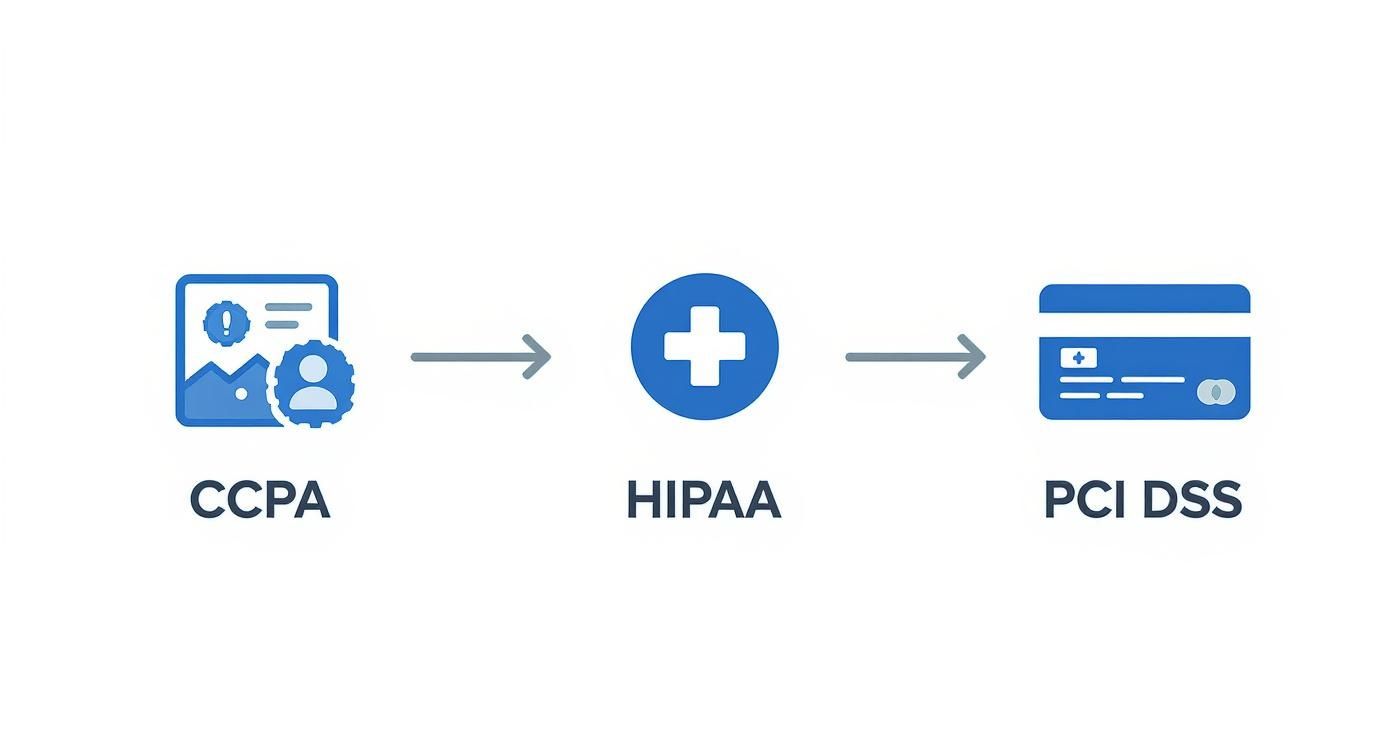
This visual flow helps connect specific regulations like CCPA, HIPAA, and PCI DSS directly to the data they are designed to protect, whether that's customer information, health records, or payment details.
A strong defense plan is layered. If one control fails, another one is there to stop an attack. No single tool is a silver bullet; your security comes from combining multiple strategies.
A crucial part of this process is figuring out where your greatest risks lie. To help you map out your specific vulnerabilities and focus your efforts, you can use our detailed cybersecurity risk assessment template.
Implement a Plan for Your People and Data
Technology is only part of the solution. Your employees are your first line of defense, and your data is your most valuable asset. The final layers of your plan should focus on protecting both.
- Regular Employee Security Training: The most common way hackers get in is by tricking an employee. Short, regular training sessions can teach your team how to spot phishing emails, avoid suspicious links, and handle sensitive data securely. A well-trained team is a powerful security tool.
- Establish a Reliable Data Backup System: If a ransomware attack locks up all your files, a reliable backup is the only thing that will get you back in business without paying a ransom. Your backups must be automated, tested regularly, and stored separately from your main network—ideally with one copy offsite.
- Secure Your Network with a Firewall: A firewall acts as a gatekeeper for your network, monitoring and filtering traffic to block malicious activity. It’s an essential barrier preventing unauthorized access to your computers and servers.
This step-by-step approach turns a daunting task into a clear action plan. These aren't just expenses to check off a list; they are smart business decisions that protect your company’s future.
How Managed IT Support Simplifies Your Security
You're an expert in your field—whether that’s growing the best produce in the Pajaro Valley or running a successful shop in Seaside. You shouldn’t have to become a cybersecurity and compliance expert on the side. This is where bringing in a dedicated partner can turn a massive headache into a solved problem.
For a lot of local business owners, "managed IT services" can sound like just another corporate buzzword. But what does it actually mean for your business in Marina or Watsonville? Think of it this way: it’s like having your own dedicated IT department that’s always on, always watching, and always working to keep you safe and operational.
Instead of just reacting to problems after they’ve happened, managed support is all about preventing them from ever starting. It's the most effective and affordable way to handle the demands of cybersecurity and compliance in Watsonville, CA.
Your Proactive Defense Team
A managed IT support partner is your technology guardian. Our entire job is to handle the technical heavy lifting so you can stay focused on what you do best: running and growing your business. It’s a true partnership designed to give you peace of mind.
This approach connects directly to all the risks and rules we’ve been talking about. It’s not just about fixing computers when they break; it's about building a security program that aligns with your real-world needs and challenges.
Here’s what that looks like for you:
- 24/7 Threat Monitoring: We don't just set up a firewall and cross our fingers. Our team actively monitors your network around the clock, looking for any suspicious activity that could signal an attack. It’s like having a security guard watching your digital front door, even when you're asleep.
- Critical Software Updates: Remember how important it is to keep your software patched? We manage that for you, ensuring your systems are always updated with the latest security fixes so criminals can't sneak in through known weaknesses.
- Secure Data Backups: We implement and manage a rock-solid backup and recovery system. Your data is regularly backed up to a secure, separate location, so if a disaster like a ransomware attack ever strikes, we can restore your operations quickly—without you having to pay criminals a dime.
Making Compliance Manageable
Trying to navigate the complex rules of CCPA, HIPAA, or PCI DSS on your own is a monumental challenge. A managed IT partner acts as your compliance guide, helping you translate those dense legal requirements into practical, technical controls. We help implement the systems and document the processes you need to show you're doing things right.
Partnering with a managed IT provider means you're no longer alone in this fight. You gain access to a team of experts with enterprise-level tools and knowledge, all at a predictable, budget-friendly cost.
Our mission has always been to bring enterprise-level IT to the table at an affordable price for local SMBs. We firmly believe that top-tier security shouldn't be a luxury. You can find out more about what this kind of partnership entails by exploring the benefits of managed IT support for local businesses.
Ultimately, simplifying your security means handing off the technical burdens to a team you can trust. It’s about gaining a strategic partner who understands the unique challenges of doing business here and is genuinely invested in your success.
Understanding the True Cost of a Data Breach

When you think about the cost of a data breach, you probably picture the immediate expenses. Things like regulatory fines or the big invoices from IT experts who come in to clean up the mess. While those costs are real, they're only the tip of the iceberg.
The true cost of a security failure runs much deeper. It creates long-term damage that can ripple through your business for years, hitting everything from your reputation in the community to your basic ability to operate.
For a local business, the hit to your reputation can be the most painful blow of all. Monterey County is a tight-knit community where word travels fast. Losing the trust of your customers in Salinas, Watsonville, or Carmel isn't a temporary setback; it can be a permanent wound that’s incredibly difficult, if not impossible, to fully heal.
The Hidden Financial Drains
That initial bill for a breach? It's just the beginning. The hidden costs keep piling up long after the incident is supposedly "resolved," and these are the consequences that truly threaten the long-term health of your company.
Think about the operational disruption alone. A ransomware attack can shut your business down completely. Every single hour you're offline is an hour you can’t serve clients or bring in revenue. For a small business, this downtime can be financially devastating.
Then come the legal battles. A breach often triggers lawsuits from customers or partners whose data was exposed, leading to lengthy and expensive legal fights. Beyond the immediate financial and reputational damage, the true cost of a data breach can be lessened by developing a robust data breach response plan, especially for hosted email security.
A Local Example of a Lasting Crisis
We don't have to look far to see how a single security failure can spiral into a prolonged crisis. After an initial breach at a Watsonville healthcare provider, a hacking group publicly listed the provider on a dark web leak site, claiming to possess sensitive hospital and patient data. Months later, a second hacker group launched another attack, leaking even more stolen data. This suggests that the attackers maintained access or that there were multiple distinct breaches over time, showing how a single incident can become a persistent threat. To explore more about this multi-faceted local event, you can read a detailed account of the Watsonville hospital data breach.
The goal here isn't to scare you. It's to highlight the enormous value of prevention. Investing in strong cybersecurity and compliance in Watsonville, CA, is not an expense—it’s an investment in your company’s survival and future.
Take the First Step to Secure Your Business Today
We've covered a lot of ground, but the path forward from here is actually pretty clear. Tackling cybersecurity and compliance in Watsonville, CA, can feel like a heavy weight, but it’s not something you have to do alone. With a proactive strategy, meeting your obligations is entirely manageable, and protecting your valuable data is well within reach.
Taking control of your security isn't just another box to check. It's a powerful way to build lasting trust with your customers and carve out a real competitive edge in our local market. Protecting your business is simply one of the smartest investments you can make in its future.
Your Partner in Protection
You don't need to be a cybersecurity expert to run a secure business—you just need a reliable partner who is. Our mission is to bring the same level of expertise and protection that large corporations rely on, but at a price that actually fits a local business budget. We’ll handle the technology so you can get back to what you do best: running your company with total peace of mind.
Let's just start with a simple conversation about where you stand today. We invite you to take one easy, no-obligation first step to see how we can help.
Your security journey begins with a single step. Proactively addressing your cybersecurity posture today is the best way to prevent a costly and damaging incident tomorrow.
A solid security plan goes far beyond just fixing immediate issues; it involves ongoing management and support to stay ahead of whatever new threats pop up. To learn more about how we can act as your dedicated IT department, check out our guide on managed IT services in Watsonville, CA.
Let's Talk About Your Business
Ready to strengthen your defenses and simplify your compliance? Let's connect and find the most practical, cost-effective ways to secure your operations. Our team is here to provide clear, straightforward advice that’s tailored to your specific needs.
Contact Adaptive Information Systems to schedule your complimentary security consultation. Let us show you how affordable and effective enterprise-level IT can be.
Adaptive Information Systems
380 Main St, Salinas CA 93901 | 831-644-0300 | hello@adaptiveis.net