
Direct Answer: It depends on your team size, compliance requirements, and how critical daily IT operations are to your business. Most small businesses in Monterey County save money and reduce risk by outsourcing most IT — but some functions may still belong inside your walls.
Most small business owners in the Monterey Bay Area reach a point where they wonder: should we hire someone in-house, or keep outsourcing IT? It’s a fair question, and the answer isn’t the same for every organization.
A 15-person accounting firm in Monterey has very different IT needs than a 90-employee ag-tech operation in Salinas or a regional nonprofit with staff spread across Watsonville, Marina, and King City. What works for one business can be overkill — or dangerously underpowered — for another.
This article focuses on the two or three questions that actually determine whether in-house IT makes financial and operational sense for your business. No theory — just the real tradeoffs so you can make an informed call.
What ‘In-House IT’ Actually Costs in the Monterey Bay Area
Before deciding what to keep in-house, it helps to know what you’re actually buying when you hire someone full-time.
A mid-level IT generalist in Salinas or Monterey earns between $65,000 and $85,000 per year depending on experience. Add benefits, payroll taxes, equipment, training, and paid time off, and that number lands closer to $95,000 to $115,000 in total annual cost per employee.
And that’s one person — covering one knowledge set, one schedule, and one availability window. When they’re sick, on vacation, or simply don’t know how to handle a specific problem, your business is exposed.
For context, a fully managed IT services agreement for a 20 to 50 person business in this area typically runs $3,000 to $7,500 per month — or $36,000 to $90,000 per year — and includes a full team of engineers, 24/7 monitoring, cybersecurity tools, and help desk support. The math often favors outsourcing at this scale, which is part of why so many small businesses in Monterey are handling IT without an in-house team.
But cost alone doesn’t tell the whole story. There are situations where having someone on-site — even part-time — solves problems that a remote team simply can’t.

When In-House IT Actually Pulls Its Weight
There are real scenarios where keeping IT functions inside your organization makes sense — not as a cost savings measure, but because the operational fit is right.
You have 75+ employees with high daily IT volume. At this scale, the math starts to shift. If your team is generating dozens of help desk tickets per week, has dedicated server infrastructure, and runs industry-specific software that requires hands-on administration, a dedicated IT person or small team earns their salary. This is common in larger Salinas-area agricultural operations, regional medical groups, and school districts across Monterey County.
You handle sensitive regulated data on-premise. Some compliance frameworks — HIPAA, CJIS, and certain financial regulations — have requirements that are easier to manage when someone with authority is physically present. A healthcare-adjacent organization running local servers with patient data may find it easier to maintain audit-readiness with an internal IT lead coordinating day-to-day access control.
You have physical infrastructure that requires constant on-site management. Warehouses, manufacturing floors, and large hospitality properties with complex wired and wireless networks sometimes need someone who can walk the building quickly. If you’re running a property in Monterey with 200 guest devices on a managed network, an on-site presence can matter during peak season.
The key distinction here: these are specialized, volume-driven, or physical-access situations. They’re not typical of most small businesses in this region.
In-House vs. Outsourced IT: Where Each Model Fits
This comparison breaks down the key differences between keeping IT in-house and outsourcing to a managed services provider — based on real conditions, not theory.
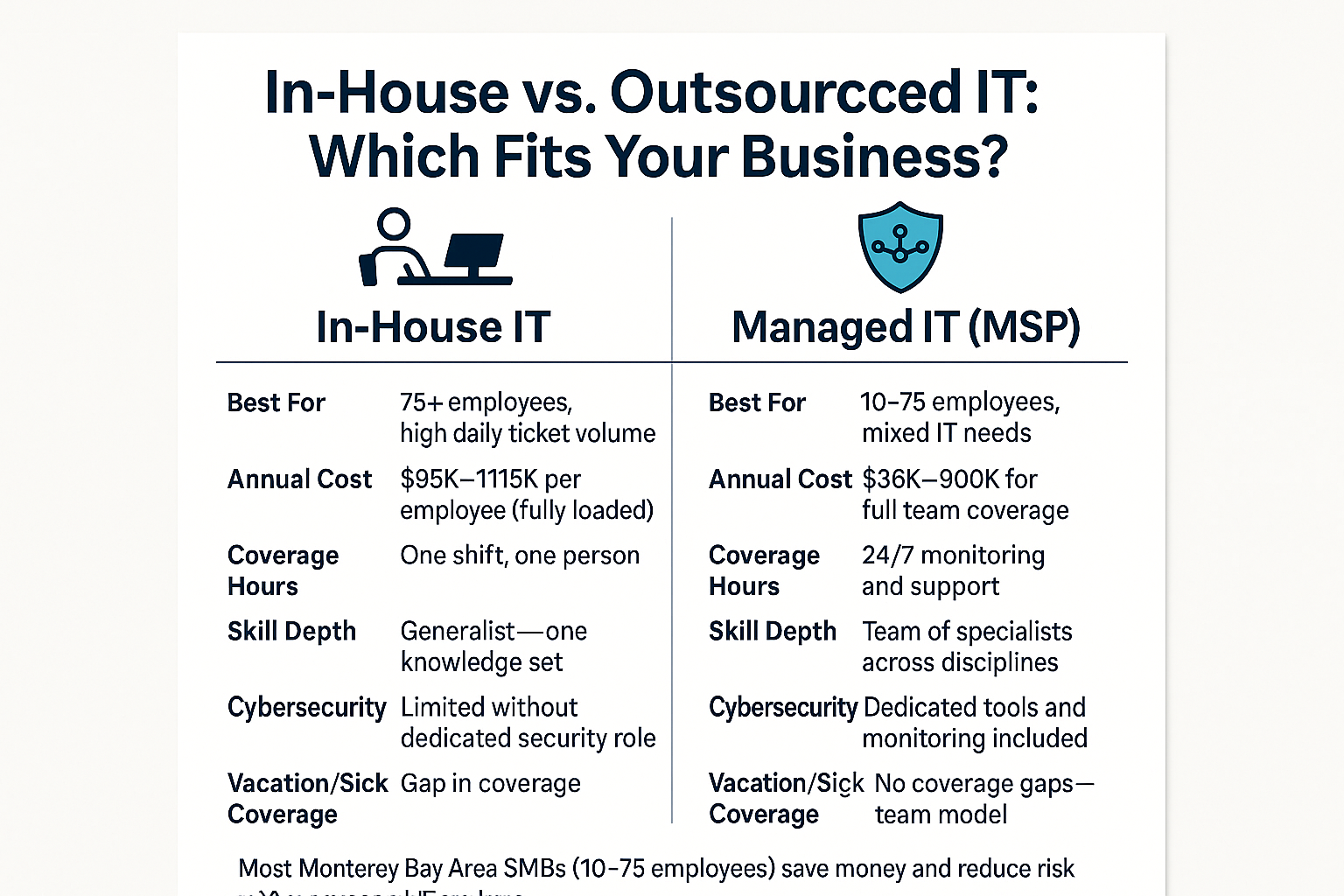
The Co-Managed Model: A Practical Middle Ground
A lot of Monterey Bay Area businesses land somewhere in the middle — they already have one IT person on staff (or a part-time coordinator), but that person is stretched thin, doesn’t have deep security expertise, or is mostly handling day-to-day troubleshooting with no time left for planning or compliance work.
This is where co-managed IT makes a lot of sense. Instead of replacing your internal person, an outside managed IT partner works alongside them — filling in the gaps they can’t cover.
In practice, that might look like:
- Your internal IT coordinator handles first-line help desk and end-user requests
- The MSP manages security monitoring, patching, backup, and compliance oversight
- Strategic decisions — hardware refresh cycles, cloud migrations, compliance audits — are handled jointly
This model works especially well for organizations that have a person who knows the business deeply (the relationships, the workflows, the staff quirks) but needs backup on the technical and security side. A Salinas-area agricultural business with a trusted operations coordinator who doubles as IT support is a classic fit.
The risk of not building in that backup is real. If your one IT person leaves, or gets sick during a critical period — say, harvest season when your systems can’t go down — you’re exposed in a way that waiting until something breaks only makes worse.
Staffing Models by Business Size: A Quick Reference
Here’s how IT staffing decisions typically break down by employee count for Monterey Bay Area businesses across the industries we see most often.
| Business Size | Typical IT Model | Average Annual IT Cost |
|---|---|---|
| 10–25 employees | Fully managed MSP | $36,000–$54,000/year |
| 25–60 employees | Fully managed MSP or co-managed | $54,000–$90,000/year |
| 60–100 employees | Co-managed (internal + MSP) | $90,000–$150,000/year |
| 100–200 employees | In-house team + MSP for security/compliance | $150,000–$250,000+/year |
| 200+ employees | Full in-house IT department | Varies — typically $250K+/year |
The Cybersecurity Gap That In-House IT Often Can’t Close
This is where the in-house argument loses ground fastest — especially for businesses in regulated industries.
A generalist IT hire knows how to reset passwords, set up workstations, and troubleshoot network drops. That’s genuinely useful. But modern cybersecurity requires a different level of specialization — threat monitoring, endpoint detection, vulnerability scanning, incident response planning, and compliance documentation. Most IT generalists aren’t trained for that, and expecting them to cover it is how breaches happen.
California’s data breach notification law (Civil Code 1798.29) requires businesses to notify affected individuals — and in some cases, the California Attorney General — within a specific window after discovering a breach. The cost of getting that wrong, or missing it entirely, is significant. According to the 2023 IBM Cost of a Data Breach Report, the average cost of a data breach for a small to mid-sized business exceeded $4.45 million globally, with under-resourced security teams cited as a primary contributing factor.
For a 40-person financial services firm in Monterey or a healthcare-adjacent practice in Salinas, the realistic question isn’t whether you can afford outside cybersecurity help — it’s whether you can afford not to have it. And a single generalist IT hire almost never covers that exposure on their own.
If you’re evaluating what good IT support actually looks like from a protection standpoint, cybersecurity depth is one of the clearest differentiators between a capable partner and someone who’s just keeping the lights on.
Frequently Asked Questions About In-House vs. Outsourced IT
We already have an IT person on staff. Do we still need a managed IT partner?
Possibly, yes — depending on what your internal person is actually covering. If they’re handling daily help desk requests and user support but don’t have time or expertise for security monitoring, compliance, or infrastructure planning, a co-managed arrangement fills those gaps without replacing anyone. A lot of Salinas and Monterey businesses find that their internal IT coordinator becomes significantly more effective when they’re not trying to do everything alone.
At what company size does hiring in-house IT start to make financial sense?
Generally somewhere around 75 to 100 employees — but it depends on your IT complexity, not just your headcount. A 60-person business running simple cloud-based tools may never need a full-time hire. A 50-person organization running on-premise servers, custom software, and regulated data might need one sooner. The cost comparison in this article gives you a reasonable starting point.
Can a managed IT provider respond fast enough if something breaks at our office?
For most issues, yes. Remote access tools resolve the majority of IT problems without anyone needing to walk through your door. For physical issues — a server that won’t power on, a network switch that needs replacement, a workstation that needs hardware repair — local providers have a clear advantage over national ones. If your MSP is based in Salinas or Monterey, on-site response times are typically measured in hours, not days. You can learn more about what separates a local IT provider from a national one and why that matters for businesses in this region.
What IT functions should almost always stay in-house regardless of company size?
User administration decisions — who gets access to what, who gets onboarded or offboarded — often stay with an internal HR or operations lead because they require business context an outside team won’t always have in real time. The technical execution of those decisions (provisioning accounts, setting permissions, pushing MDM policies) can absolutely be handled by an outside partner. The approval layer is what belongs inside your organization.
We’re in agriculture and have seasonal IT demands. Does that change the calculation?
Yes, and it’s actually one of the strongest arguments for managed IT over in-house hiring in the Salinas Valley. Hiring full-time staff to cover peak-season IT load means you’re paying year-round for capacity you only need part of the year. A managed IT agreement scales with your support volume and doesn’t leave you with idle headcount during slower months. Proactive IT management also reduces the emergency calls that tend to spike during harvest when your systems can’t afford to go down.
Not Sure Which Model Fits Your Business?
If you’re weighing whether to hire in-house, stick with your current setup, or bring in outside support, Adaptive Information Systems works with businesses across Monterey County — from Salinas to Monterey to Watsonville — to figure out what actually makes sense at your scale and in your industry. Call us at (831) 644-0300 or visit adaptiveis.net to talk through your situation with someone who knows this region.