
What Makes Modern IT Service Providers Different
The world of IT service providers has changed completely. Think of it like the difference between a local mechanic who only fixes specific car problems and a modern auto wellness center that offers full diagnostics, preventative maintenance, and performance tuning. Not long ago, IT support was mostly reactive—a break/fix model focused on solving immediate issues like a broken computer or a lost password. Today, that approach just doesn't work anymore.
Modern providers have grown into strategic business partners. Their job isn't just to keep the technological lights on but to use technology to drive growth and create a competitive edge. They've moved from being simple vendors to trusted advisors who combine deep technical knowledge with a sharp understanding of business. This shift is fundamental and changes how businesses should think about managing their technology.
From Technicians to Strategic Advisors
The main difference is in perspective. A traditional IT technician asks, "What is broken?" A modern IT service provider asks, "How can technology make your business better?" This forward-thinking approach leads to conversations about efficiency, security, and scalability.
For instance, a family-owned restaurant might partner with a provider for more than just managing its point-of-sale system. The provider could suggest and set up a cloud-based integration that sends online orders directly to the kitchen, potentially doubling their takeout capacity without needing more staff. In another case, a manufacturing company could rely on its provider not just for network uptime but for putting strong cybersecurity measures in place to prevent expensive data breaches while improving daily operations. This proactive, business-first mindset is the signature of modern IT service partnerships.
A Rapidly Expanding and Evolving Market
This change is happening on a massive scale, showing a global reliance on strategic IT. The worldwide market for IT services is seeing incredible growth. In 2024, the market size was valued at approximately USD 1.50 trillion, a number expected to nearly double to an estimated USD 2.98 trillion by 2034. This growth is driven by businesses realizing that expert IT service providers are crucial for overcoming complex challenges and finding new opportunities. You can find more details on this trend in a comprehensive market analysis.
This transformation requires a new way of thinking. When you evaluate a provider, you're not just hiring a help desk; you are choosing a partner who will help shape your business's future.
Decoding the IT Services Landscape
Figuring out the world of IT service providers can feel like trying to assemble complex furniture with a confusing manual. You have all these parts and tools, but it's hard to know which one to use first. Let's simplify this by breaking down the major types of IT services and what they actually do for your business. Think of it as your guide to picking the right tool for the right job, ensuring what you build is strong, secure, and ready to grow.
The infographic below shows the core pillars of modern IT services that businesses depend on.
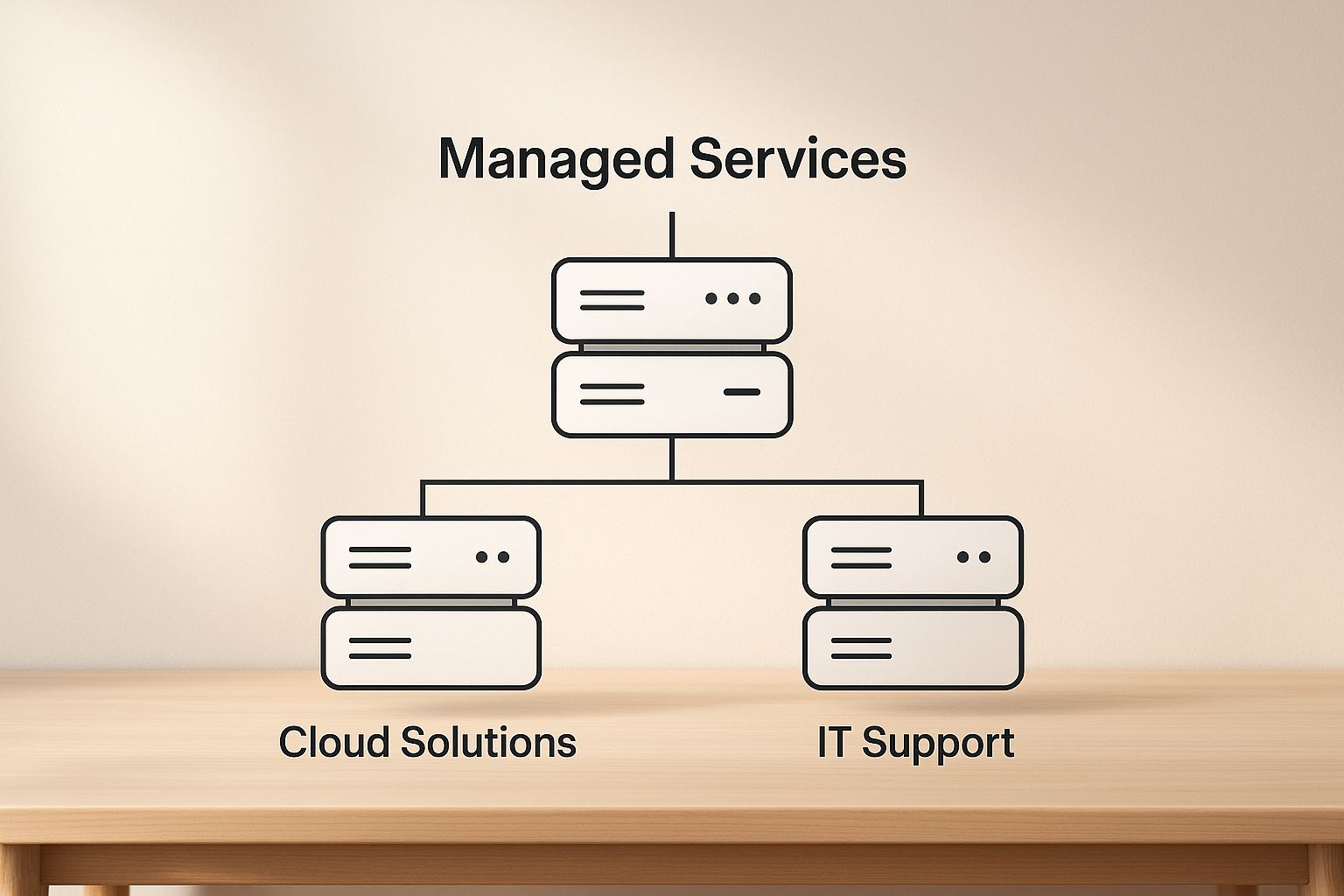
This visual demonstrates how different services like managed support, cloud solutions, and cybersecurity work together. Each component reinforces the others, creating a stable and effective technology foundation for any organization.
Core Service Categories Explained
To get a clearer picture of what an IT service provider can offer, let's look at the main categories of services they provide. These represent the fundamental ways technology is delivered and managed for businesses today.
- Managed Services: This is like having a full-time, expert IT department without the high cost of hiring an in-house team. A managed service provider (MSP) keeps a watchful eye on your systems—from servers to networks—to find and fix issues before they become real problems. For a small law firm, this means their client data is constantly monitored, ensuring confidentiality and system availability.
- Cloud Solutions: Imagine cloud services as being like your home's thermostat; you can turn the heat (computing power, storage, or software) up or down whenever you need to. This adaptability is ideal for a growing e-commerce business that sees big sales spikes during the holidays and needs more capacity without purchasing expensive hardware.
- On-Demand IT Support: This is the modern version of the classic help desk. When an employee is locked out of their account or a crucial application crashes, you need quick and effective assistance. This service ensures that small daily tech glitches don't snowball into major productivity killers.
- Cybersecurity Services: With digital threats lurking everywhere, this service acts as your company’s personal security detail. Providers install firewalls, check for system weaknesses, and manage threat detection to shield your sensitive information from cyberattacks.
- IT Consulting: Sometimes, what you really need is a strategic plan. IT consulting helps businesses make intelligent technology investments. For instance, a nonprofit organization on a tight budget could use consulting to find the most cost-effective software and hardware to help them achieve their mission.
To better understand how these services fit different business needs, the table below breaks down each category, its function, and common applications.
| Service Type | Primary Function | Best For | Typical Cost Range |
|---|---|---|---|
| Managed Services | Proactive monitoring, maintenance, and management of IT systems to prevent issues. | Businesses wanting predictable IT costs and continuous system uptime without an in-house IT team. | $100 – $250 per user/month |
| Cloud Solutions | Providing scalable, on-demand access to computing resources like storage, servers, and software. | Companies needing flexibility to scale operations up or down, like retail or startups. | Varies widely based on usage; starts from $50/month for basic storage. |
| On-Demand IT Support | Reactive troubleshooting and help desk support for immediate technical problems. | Organizations with minimal IT needs that prefer to pay for support only when it's required. | $75 – $200 per hour |
| Cybersecurity Services | Protecting data, networks, and devices from digital threats and breaches. | Any business that handles sensitive data, including customer, financial, or patient information. | Starts at $500/month; can be much higher for comprehensive packages. |
| IT Consulting | Offering strategic advice and planning for technology roadmaps and projects. | Businesses planning major tech upgrades, digital transformations, or needing an expert opinion. | $150 – $350 per hour; project-based fees are also common. |
This table shows that there isn't a one-size-fits-all solution. The right choice depends entirely on your specific goals, from needing ongoing management to seeking advice for a single project.
The global investment in these technologies is significant. In fact, worldwide IT spending is projected to reach $5.61 trillion in 2025, which is a 9.8% increase from the previous year. This figure underscores the vital role IT service providers play in today’s economy. You can find more details about these global IT spending trends on Gartner.com. Understanding these service categories helps you identify exactly what your business requires to succeed.
Why Smart Leaders Choose IT Service Partnerships

The choice between hiring an in-house IT team and partnering with an IT service provider often starts as a cost comparison. But that perspective misses the biggest advantage: immediate access to a deep bench of specialized experts that would be nearly impossible for a single company to assemble on its own.
Think of it like building a championship sports team. You can't win with just a few good all-rounders. You need a star quarterback for offense, a brilliant defensive coach, and a top-notch medical staff to keep everyone in the game. In the same way, a modern business needs dedicated specialists for cybersecurity, cloud infrastructure, network management, and data recovery. Hiring, training, and keeping an expert for each role is a huge financial and operational commitment.
A partnership with an IT service provider gives you this entire specialized team from day one. This allows your business to tap into enterprise-grade skills without the enterprise-level payroll. For example, a growing consulting firm can scale its operations smoothly because its provider plans for future needs, while a regional healthcare CEO can feel confident that patient data is shielded by cybersecurity professionals.
Weighing the Pros and Cons
Choosing to work with an external partner is a strategic decision that balances cost, capabilities, and control. While the benefits are significant, it's also important to recognize the trade-offs. To help clarify this, let's compare the key differences between building an in-house team, partnering with a provider, and finding a middle ground.
In-House vs. Outsourced IT: Cost and Capability Analysis
Detailed comparison of maintaining internal IT teams versus partnering with service providers
| Factor | In-House IT | IT Service Provider | Hybrid Approach |
|---|---|---|---|
| Expertise | Skills are limited to the staff you hire. Gaps in knowledge are common. | Access to a diverse team of specialists in security, cloud, and networking. | Your in-house team handles daily tasks; the provider covers specialized projects. |
| Cost | High fixed costs, including salaries, benefits, and ongoing training. | Predictable and scalable monthly fees that align with your budget. | A mix of fixed salary costs and predictable fees for outsourced services. |
| Availability | Limited to standard business hours, vacation schedules, and sick days. | 24/7/365 monitoring and support, ensuring constant coverage. | In-house support during business hours, with the provider covering after-hours. |
| Scalability | Scaling the team up or down is slow, expensive, and difficult. | Services can be scaled up or down easily as your business needs change. | Flexible; you can scale specialized services as needed without hiring new staff. |
This comparison shows why many leaders are leaning into partnerships. While giving up some direct control is a valid consideration, the best partnerships are founded on clear communication and shared goals. This creates the right mix of expert management and strategic oversight.
This model allows leaders to concentrate on running their core business, certain that their technology is secure, efficient, and managed by professionals. If you're curious about how a local partner can support your goals, learning about what a technology company in Salinas offers can provide valuable insights into this powerful approach.
Behind the Scenes: How Exceptional IT Management Works
The real mark of a top-tier IT service provider is often what you don't notice. Think of it like a five-star restaurant: you enjoy a flawless meal without ever seeing the intense, coordinated effort happening in the kitchen. Exceptional IT management operates on the same principle, turning technological chaos into a smooth, predictable system through disciplined processes. This operational excellence is what separates a decent provider from a true strategic partner.
The Power of ITSM Frameworks
At the heart of this behind-the-scenes work are established frameworks like ITIL (Information Technology Infrastructure Library). Instead of creating a new solution for every problem, ITIL offers a set of proven best practices for delivering IT services. It ensures every task, from fixing a minor ticket to planning a major system upgrade, follows a standardized and efficient path. This structure is what enables a provider to deliver on its promise of reliable service.
This structured approach is part of a broader discipline called Information Technology Service Management (ITSM). The ITSM market is growing quickly, valued at around USD 13.49 billion in 2024 and projected to climb to approximately USD 51.93 billion by 2034. This growth shows just how vital structured management has become for business success. You can find more details about the expanding ITSM market on Precedenceresearch.com.
Proactive Operations in Action
Modern IT service providers elevate this approach with advanced tools. Many now use AI-driven systems that can anticipate problems before they impact your operations. For example, a system might detect early warning signs of a server's hard drive failing. It can then automatically create a service ticket for a technician to replace the drive during off-hours, completely avoiding business downtime.
This proactive stance delivers clear business benefits:
- An accounting firm can go through its busy tax season for two years straight with zero significant downtime.
- A retail business can open new stores with all IT systems fully configured and operational from day one.
- A professional services company gains the ability to accurately forecast its IT budget a full year ahead.
This level of operational maturity doesn't happen by chance; it is the direct outcome of disciplined processes and smart investments in management technology. For any business looking for a partner to help them succeed, understanding these behind-the-scenes practices is crucial. Learn more about how Salinas IT consulting can bring this operational excellence to your company.
Choosing Your IT Partner: What Actually Matters
Picking an IT service provider based on the lowest price alone is a bit like choosing a surgeon who offers the biggest discount—it completely overlooks the factors that lead to a successful outcome. To find a genuine partner for your business, you need a thoughtful evaluation that goes beyond a simple cost sheet. The focus should be on alignment, experience, and reliability. This means asking the right questions to find out if a provider truly understands your business and has the tools to support it.
Start by digging into their experience. Don't just ask if they work with clients in your industry; ask for specific examples of problems they've solved for businesses similar to yours. This will help you measure their practical knowledge and see if their solutions fit your day-to-day reality. A provider that has successfully guided a local accounting firm through a hectic tax season is far more likely to understand the critical need for uptime than one without that direct experience.
Vetting for Resilience and Scalability
A provider's true value often shines brightest during a crisis, making their emergency protocols a crucial point of evaluation. You need to know their game plan for when things go wrong.
Key questions to ask:
- What does your after-hours support process look like?
- What is your guaranteed response time for a critical system failure?
- Can you walk me through your disaster recovery and data backup procedures?
Their answers should be clear, detailed, and give you confidence. Vague responses are a major red flag. Just as important is their commitment to your future growth. An ideal IT service provider acts as a strategic ally, anticipating your needs as you expand. Discuss how they manage scalability. Will they trap you in a rigid contract, or do their services offer the flexibility to change as your business does?
Evaluating Security and Service Philosophy
You don't need to be a cybersecurity expert to check a provider's security practices. Instead, focus on their overall security posture and their dedication to protecting your data. Ask about their security certifications, staff training, and the tools they use to defend against threats. A provider who openly discusses their multi-layered security strategy—from firewalls to employee awareness training—is showing a serious commitment.
Ultimately, the goal is to find a partner whose service philosophy aligns with your operational needs. Some businesses might prefer a hands-off approach, while others need frequent communication and collaborative planning. Talking about these expectations upfront can prevent friction down the road. For businesses in our community, understanding how a partner handles support is vital; you can find helpful examples in this guide to Salinas managed IT services to see what local partnership looks like. A great partnership is built on this mutual understanding, ensuring the provider you select is genuinely invested in your success.
Avoiding Common Pitfalls and Misconceptions
Every partnership with an IT service provider comes with potential hurdles, but knowing what to look out for is your best defense. Many business leaders have valid concerns about security, control, and becoming too dependent on an outside company. The thought of an external team holding the keys to your digital kingdom can be unsettling, but these fears often prevent businesses from forming valuable partnerships. Let's tackle these common issues directly with realistic expectations and clear strategies.
Addressing the Fear of Losing Control
A primary worry for many business owners is data security and giving up control. It’s natural to be cautious when you’re entrusting a third party with your most critical assets. Research shows that data confidentiality is a major concern when businesses consider moving away from their own on-premise systems.
However, a reputable provider often has far more robust security measures than a typical small business can afford. Their entire business model is built on their ability to protect client data, which means they invest heavily in enterprise-grade firewalls, advanced threat detection systems, and certified security experts.
To put these fears to rest, focus on the partnership agreement. A strong Service Level Agreement (SLA) should clearly outline:
- Data ownership and who has permission to access it.
- Security protocols and who is responsible for what.
- Clear procedures for how security incidents will be handled.
- Guaranteed uptime and performance metrics to hold them accountable.
This document is more than just a contract; it's a blueprint for maintaining control and ensuring transparency. It shifts the relationship from one of simple dependency to one of mutual accountability.
Navigating Disagreements and Setting Expectations
Another common pitfall is a mismatch in expectations. Disagreements over priorities, budgets, or project timelines can happen in any partnership. For instance, a provider might recommend a costly infrastructure upgrade to ensure long-term stability, while your business needs to prioritize immediate cash flow.
Success in these situations comes down to proactive and transparent communication. The best partnerships operate like a strategic board meeting, not just a help desk ticket system. You should establish regular check-ins to discuss performance, review business goals, and adjust strategies as needed. This collaborative rhythm ensures both you and the provider understand each other's priorities and limitations.
By treating your IT service provider as a strategic advisor rather than just another vendor, you can work through challenges together. This approach helps build a resilient partnership that not only survives but thrives.
Your Roadmap to IT Partnership Success
Now it's time to turn what you've learned into a clear, practical plan for finding the right IT service provider. This isn’t about vague advice; it’s a guide to taking real steps that will improve your technology setup. The journey begins with an honest look at where your business technology stands today.
Assess Your Current IT Landscape
Start by making a simple list of your current technology. This doesn't have to be a highly technical audit. Just write down the essential tools your business depends on every day, like your accounting software, customer relationship management (CRM) system, and communication tools.
Next to each item, jot down any ongoing problems or frustrations. Think about things like slow performance, frequent glitches, or nagging security worries. This simple self-assessment helps you pinpoint your biggest technology headaches. Is your team constantly sidetracked by IT issues? Are you confident in your cybersecurity defenses? These are the specific challenges you’ll bring to potential IT service providers, which shifts the conversation from a generic sales pitch to a focused problem-solving session.
Prepare for Productive Conversations
Once you have a clear picture of your needs, you can have structured conversations with providers to find the best match. Your goal is to understand not only their technical skills but also how they do business and if their company culture fits with yours.
Here are a few key questions to ask during your initial calls:
- Experience: Can you provide examples of how you've helped a business of our size in our industry tackle similar problems?
- Process: When a critical system fails, what is your exact step-by-step response plan?
- Onboarding: What does the implementation timeline typically look like for a company similar to ours?
- Metrics: How do you measure and report on the success of your services?
A provider's answers will tell you a lot about their expertise and operational style. Pay close attention to how they communicate. A genuine partner will be transparent, ask smart questions about your business, and offer clear explanations without hiding behind jargon.
The final steps involve checking the contract details and setting clear goals for success. Make sure the agreement protects your interests but also offers the flexibility for your business to grow. Define what success looks like—whether it’s less downtime, better security scores, or faster ticket resolution—and make it a formal part of the partnership. This keeps everyone accountable and ensures you're all working toward the same objectives from the very beginning.
Ready to build a technology foundation that helps your business move forward? Contact Adaptive Information Systems today to start a conversation about your IT needs.