
If you think your business is too small to be a target for hackers, I have some bad news. The hard truth is that your small business in Monterey County isn't just a potential target; it's an easy one. Cybercriminals don't care about your company's size. They use automated attacks that look for any open digital door, whether it's in Salinas, Monterey, or Carmel. The common question we hear is, "Why would anyone target a small business like mine?" The answer is simpler and more dangerous than you think.
Why Salinas Businesses Believe They Are Safe From Hackers

Standing in your Salinas office or Monterey storefront, it’s understandable to ask, "Why would a hacker waste their time on my small company?" This is one of the most common—and dangerous—assumptions we hear from local business owners every day.
You believe your business is just too small to attract any real attention. Maybe you run a popular restaurant in Carmel, a family-owned farm in the Salinas Valley, or a small professional service in Pacific Grove. You’re focused on serving your community, not fighting off some shadowy international cyber threat.
The Myth of Being "Too Small to Target"
The belief that your size equals safety comes from a misunderstanding of how modern cyberattacks actually work. Attackers aren't sitting in a dark room, hand-picking targets based on revenue or fame. They're using automated bots that scan the internet 24/7, looking for any open digital door.
What this actually means for you is that size doesn't offer protection—it's actually what makes small businesses an easy target. Most lack dedicated security teams or layered defenses, making them attractive for automated attacks like phishing or ransomware.
This mindset creates a false sense of security that can be devastating. However, recent insights show that 79% of SMBs have suffered a cyberattack in the last 5 years—even though 26% still believe they’re too small to be targeted. This dangerous gap between what people think and what's really happening is exactly where attackers thrive.
Your Local Business is a Prime Opportunity
Hackers see your small business not as insignificant, but as a low-risk, high-reward opportunity. They know you likely don't have the same defenses as a large corporation, making you "low-hanging fruit." They aren’t after your company’s name; they’re after your data, your money, and your access.
This is just one of many dangerous tech beliefs that can put your business at risk. For a deeper look, check out our guide on busting the biggest tech myths in small business.
The very first step to protecting your business is to recognize that you are on the radar. The question isn't if you'll be targeted, but when—and whether you'll be prepared for it. The best defense begins with understanding your vulnerabilities. The most actionable step you can take is to start with a cybersecurity audit. Adaptive offers SMB-friendly risk assessments and compliance checks to uncover blind spots—before attackers do.
Want to know if your business is a soft target? Let’s schedule a free consult and walk through your current risk exposure.
Adaptive Information Systems
380 Main St, Salinas CA 93901 | 831-644-0300 | hello@adaptiveis.net
Your Size Is A Target, Not A Shield
To really get why your small business is on a hacker's radar, you have to think like one. Forget the Hollywood image of a genius thief planning a high-stakes heist on a single corporate giant.
The reality is much simpler. Think of cybercriminals as prowlers walking down a long street, checking every single car door. They don't care if it's a new sedan or an old work truck—they’re just looking for the one that’s unlocked.
Your business, likely operating without a dedicated IT security team, is the digital version of that unlocked car. It’s not your revenue that makes you a prime target; it’s your lack of defenses.
Why Hackers Love Small Businesses
Modern attackers use automated software to scan thousands of businesses at once, hunting for common, easy-to-exploit weaknesses. It's a numbers game, and small businesses are a massive pool of potential victims.
They know that many small and mid-sized businesses (SMBs):
- Lack Dedicated Security Staff: You're busy running your business, not watching network logs or keeping up with the latest security rules.
- Often Use Outdated Software: Without an IT team, critical security updates for your accounting software or point-of-sale system can be easily overlooked.
- Have Insufficient Employee Training: Your team is your greatest asset, but they can also be your biggest weakness if they aren't trained to spot a phishing email or other common scams.
These factors make your business "low-hanging fruit." It takes far less effort for a hacker to breach ten small businesses than it does to crack one fortified corporation, and the combined payout can be just as good.
What this actually means for you is that size doesn't offer protection—it's actually what makes small businesses an easy target. Most lack dedicated security teams or layered defenses, making them attractive for automated attacks like phishing or ransomware.
The data backs this up. Small and medium-sized businesses make up about 50% of all cyberattack targets. Digging deeper, the numbers show that 46% of all cyber breaches impact businesses with fewer than 1,000 employees. Cybercriminals see smaller companies as easy wins because they have limited resources and often no dedicated IT staff to fight back.
Your Local Data Is A Goldmine
You might not think the information you hold is that valuable, but to an attacker, it's a treasure chest.
Whether you run a hospitality business in Carmel collecting guest information or a medical office in Monterey managing patient records, that data is a hot commodity on the dark web. Customer lists, payment details, and employee records can be sold or used to launch even bigger attacks.
The data from your small agricultural operation in Salinas could be used in a larger supply chain attack. It’s not about the size of your company; it’s about the value of the information you're protecting.
Attackers know this, and they specifically target the weaknesses that small businesses often overlook. You can learn more about the cyber threats no one warns small businesses about in our detailed guide.
The bottom line is simple: your business has valuable assets, and criminals will test your defenses to get them. Your size doesn't make you invisible; it makes you a more appealing target for automated attacks. The key is to stop thinking like a target and start building your defenses.
The Five Biggest Security Gaps In Local Businesses
If you think your business is too small to be a target for hackers, it’s time for a reality check. Cybercriminals aren’t looking for a challenge; they’re looking for an easy payday. And from what we’ve seen right here in Monterey County, most successful attacks don't come from some high-tech, movie-style heist. They happen because a business left the digital front door unlocked.
These weaknesses are often surprisingly simple to fix, yet they’re the ones we see exploited time and time again. Let’s walk through the five biggest security gaps we find in local businesses and the first practical step you can take to close each one for good.
1. Weak and Reused Passwords
Think of your password as the key to your office. Using something simple like “Monterey123” or, even worse, using that same weak key for your email, your bank, and your client database is like leaving a copy under the doormat.
Attackers use software that can guess millions of password combinations in seconds. Once they get that one key, they don't just have access to one system—they can often unlock your entire business.
Your First Actionable Step: Put a real password policy in place. Require long, complex, and unique passwords for every account. The easiest way to manage this is with a password manager, which securely stores everything behind one strong master password.
It sounds basic, but an alarming 80% of all hacking incidents involve weak or stolen passwords. This is the most common and easily preventable security risk for any business.
2. No Multi-Factor Authentication (MFA)
If a strong password is the lock on your front door, Multi-Factor Authentication (MFA) is the deadbolt. MFA requires a second piece of proof—usually a code sent to your phone or an app—before granting access.
Without MFA, a stolen password is an open invitation for an attacker to walk right in. With MFA enabled, a criminal can have your password and still be stopped cold at the door because they don't have that second key. This single layer of security is incredibly effective.
Your First Actionable Step: Turn on MFA for every critical account. Start with your email, financial software, and any cloud service that holds customer data. Major platforms like Microsoft 365 and Google Workspace offer it for free.
Despite how powerful it is, a shocking 20% of small businesses use MFA consistently, leaving a massive security hole that attackers are more than happy to use. To see how these gaps can be found and fixed, you can learn more about avoiding common cybersecurity gaps with penetration testing.
3. Untrained Employees
Your team is your greatest asset, but they can also become your biggest security liability if they aren't trained to recognize threats. A clever phishing email disguised as an invoice from a known vendor can trick even the most careful employee into clicking a malicious link.
Cybercriminals are masters of trickery, preying on human trust to get into your network. Without security awareness training, your team is like an untrained guard at the front desk, unintentionally letting threats slip right past. A recent study reveals that 83% of small businesses have no phishing training for their employees. Discover more insights about these small business cybersecurity statistics.
Your First Actionable Step: Schedule regular, simple security awareness training. Focus on the basics: how to spot a suspicious email, why they should never click on unknown links, and who to alert if they see something that doesn't feel right.
4. Outdated Software and Systems
Running your business on outdated software is like living in a house with a window that won’t lock. When developers find security flaws in their software, they release updates, or "patches," to fix them.
If you ignore these updates, you’re leaving those digital windows wide open for anyone to climb through. Hackers actively scan for systems running old software because they know the weaknesses are easy to exploit.
Your First Actionable Step: Enable automatic updates for your operating systems (like Windows and macOS) and web browsers. For everything else, create a simple schedule to check for and install updates on all your critical business software.
5. No Data Backup and Recovery Plan
Ask yourself this: what would happen if a fire, flood, or ransomware attack wiped out all of your business data tomorrow? A solid data backup and recovery plan is your business's insurance policy against a disaster.
Without reliable, tested backups, you have no way to restore your operations. You could lose years of financial records, customer lists, and critical files in an instant, potentially forcing you to shut down for good.
Your First Actionable Step: Implement the "3-2-1" backup rule. Keep at least three copies of your data, store them on two different types of media (like a local hard drive and the cloud), and make sure one of those copies is stored off-site. Most importantly, test your backups regularly to make sure they actually work when you need them.
Common Security Gaps And Your First Step To Fix Them
We've covered the top five risks, but it helps to see them all in one place. This table breaks down each gap, explains why it’s so dangerous in simple terms, and gives you that first actionable step you can take today.
| Security Gap | Why It's A Major Risk | Your First Actionable Step |
|---|---|---|
| Weak Passwords | They are incredibly easy for automated software to guess, giving criminals a key to your entire business. | Implement a company password policy and start using a password manager to enforce it. |
| No MFA | A stolen password is all an attacker needs to gain full access to an account without MFA acting as a deadbolt. | Enable MFA on all critical accounts, especially email and financial software. |
| Untrained Employees | Your team can be tricked by phishing emails, unintentionally letting attackers bypass your technical defenses. | Schedule a basic security awareness training session focused on identifying suspicious emails. |
| Outdated Software | Unpatched software has known security holes that hackers actively search for and exploit. | Turn on automatic updates for your operating systems and web browsers. |
| No Backup Plan | A single event like a ransomware attack or hardware failure could wipe out your business data permanently. | Set up a "3-2-1" backup system with at least one copy of your data stored off-site in the cloud. |
Closing these gaps isn't about becoming a cybersecurity expert overnight. It's about taking small, consistent steps to build a stronger defense. Start with one of the actions above this week—you’ll be surprised how much more secure your business will be.
The Real Cost Of A Cyberattack On Your Business
A security breach isn’t just a technical glitch. For a small business, it's a potential business-ending event. When you think you're too small to be hacked, it’s easy to overlook the catastrophic price tag that comes with a successful attack.
The costs aren't just about paying a ransom or buying new software. They add up quickly, hitting you from all sides. We’re talking about direct financial losses, crippling downtime, and the one thing you can’t easily buy back: your customers' trust.
This diagram breaks down some of the most common—and deceptively simple—entry points hackers use to kick off this costly chain reaction.
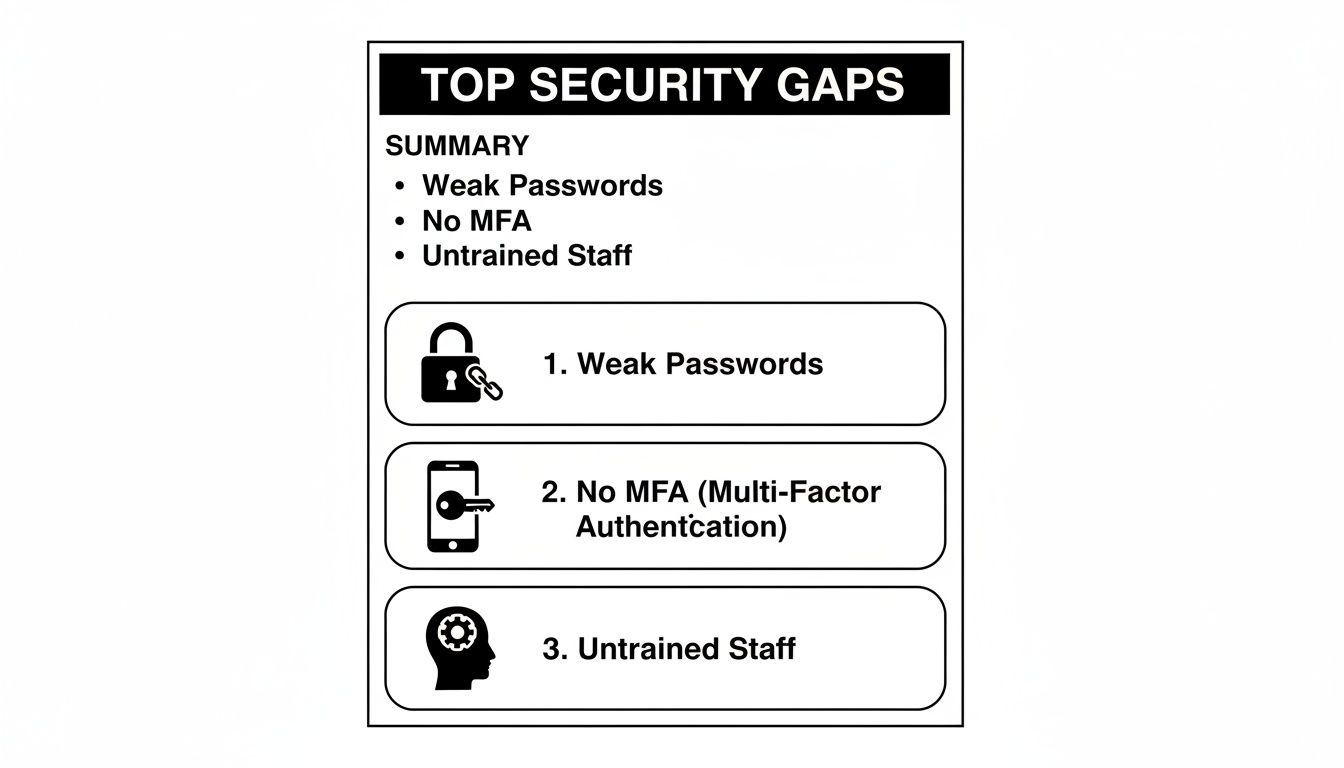
These three gaps are the digital version of leaving your front door wide open with a sign that says "Help Yourself." They make it incredibly cheap and easy for criminals to walk right in.
The Financial Fallout Of A Breach
Let’s talk real numbers, because the financial impact of a cyberattack can be staggering and can completely overwhelm a small business's resources.
The figures are sobering. A single cyberattack can wipe out a small business almost overnight, with a devastating 60% of victims closing their doors within six months. The average cost for an SMB breach hits $254,445, but it can climb much higher. Cybercrime drains a staggering $2.4 billion from small firms every single year.
This isn't just one big payment, either. The costs pile up from all directions:
- Ransom Payments: The demand to get your data back, with no guarantee the criminals will honor the deal.
- Recovery and Remediation: Hiring experts to clean your systems, restore data, and rebuild your network.
- Regulatory Fines: Failing to protect customer or patient data can lead to steep penalties. If you handle sensitive health information, failing to maintain HIPAA compliance isn't just a mistake—it's a critical vulnerability with hefty fines.
- Legal Fees: On top of everything else, you could face lawsuits from customers whose data was exposed.
For many local businesses, the margin for survival is razor-thin. Fifty-five percent say a financial hit of less than $50,000 would sink them.
A Local Example: The Seaside Hotel Breach
Imagine you run a successful boutique hotel in Seaside. One Tuesday morning, an employee in accounting gets an email that looks like an invoice from a regular vendor. They click the link.
At first, nothing seems to happen. But behind the scenes, ransomware is silently locking every file on your network: guest reservations, financial records, everything. By lunchtime, your entire system is locked, and a message demands a hefty payment.
Suddenly, your booking system is down. You can't check guests in or out. You can't process payments. Every minute of downtime costs you money and angers your guests. This is where a robust plan for data backup and recovery becomes the difference between a bad week and a closed business.
The Hidden Costs That Linger For Years
The most damaging costs aren't always the ones you can see on an invoice. The long-term consequences of a breach can haunt a business for years, long after the technical issues are fixed.
The real currency of your business is trust. Once a cyberattack shatters that trust, it’s incredibly difficult to rebuild. Customers will think twice before doing business with a company that couldn't protect their personal information.
After an attack, a shocking 80% of businesses are left scrambling to rebuild client trust. In a tight-knit community like Monterey County, bad news spreads fast. Your brand, which you spent years building, can be permanently damaged.
The investment in prevention—through regular audits, employee training, and managed IT support—is a tiny fraction of the cost of recovery. Thinking you're too small to be hacked isn't a strategy; it's a gamble you simply can't afford to lose.
Start Protecting Your Business With A Cybersecurity Audit
After seeing the true costs of a cyberattack, it’s normal to feel a bit overwhelmed. You know the risks are real, but what’s the first practical step you should take? The answer isn’t to buy a dozen different security products. It's to start with a clear, professional assessment of where you stand right now.
That first step is a cybersecurity audit. Think of it as a health check-up for your company's digital operations. It’s not about finding fault—it’s about finding and fixing the weak spots before a hacker does.
What A Cybersecurity Audit Uncovers
An audit is a systematic review of your technology and security practices. We approach this as your IT partner, not a critic. We look at everything, from your network setup and password rules to your data backup procedures and employee access rights.
The real goal here is to answer some critical questions:
- Are there unpatched software or systems on your network waiting to be exploited?
- Is your customer data properly secured?
- Could a single stolen password give an attacker the keys to your entire business?
- Do you have a reliable plan to get your data back if a ransomware attack hits?
This process demystifies your security. Instead of guessing where your weaknesses are, you get a clear, prioritized roadmap based on real-world risks. You can get a head start by reviewing our cybersecurity audit checklist to understand the key areas we examine.
What this actually means for you is that an audit turns your security from a vague worry into an actionable plan. It shows you exactly where to invest your time and budget for the biggest impact, ensuring you get enterprise-level protection without the enterprise-level price tag.
Your Path To Affordable Security
We get it. For a small business in Monterey County, every dollar counts. That's why our risk assessments are designed for SMBs. We provide a straightforward report that cuts through the technical jargon, highlighting your most urgent security gaps and offering practical, cost-effective solutions. For a broader look at proactive security, you can consult these comprehensive cybersecurity resources.
An audit is the foundational step. Once you understand your risks, the next move is to put a consistent, proactive defense in place. This is where ongoing services like our Managed IT Support here come in, providing the continuous monitoring and maintenance needed to keep you protected.
The "too small to be hacked" mindset leaves your business exposed. Taking that first step toward a cybersecurity audit is how you fight back.
Want to know if your business is a soft target? Let’s schedule a free consult and walk through your current risk exposure.
Adaptive Information Systems
380 Main St, Salinas CA 93901 | 831-644-0300 | hello@adaptiveis.net
Answering Your Questions About Small Business Cybersecurity
Even after seeing the risks, you probably still have some specific questions about how this all applies to your business. The world of cybersecurity can feel confusing, but our goal is to give you clear, direct answers to the things we hear from local business owners every day.
We want to give you the confidence to make smart decisions to protect the company you’ve worked so hard to build.
Is My Business Still At Risk If We Use Cloud Software?
This is a question we hear all the time, and the answer is yes. Using cloud-based tools like Microsoft 365 or QuickBooks Online doesn’t automatically make you safe. In fact, hackers love targeting cloud accounts because a single stolen password can give them access to everything—your financial records, customer data, and sensitive emails.
Think of it this way: the cloud is just someone else's computer. While the cloud provider secures the building, you are still responsible for locking your own office door (your accounts).
Attackers use bots that hammer popular cloud services 24/7, trying to break in with common or stolen passwords. This is why having strong, unique passwords and Multi-Factor Authentication (MFA) is non-negotiable. It’s your first and best line of defense for anything in the cloud.
Isn't Professional Cybersecurity Too Expensive For A Small Business?
This is one of the biggest and most dangerous myths out there. Years ago, robust security was a luxury for large corporations. But that world is long gone, and clinging to that old belief is exactly what makes you a perfect target today.
The real question isn't whether you can afford proactive protection; it's whether you can afford a breach.
What this actually means for you is that the cost of a single data breach—which for 60% of small businesses leads to permanent closure—is devastatingly higher than the cost of prevention. Investing in security isn't just another expense; it's an essential investment in your business's survival.
At Adaptive, our mission is to provide enterprise-level IT at a price that makes sense for local SMBs in places like Salinas and Marina. We offer scalable solutions, like our Managed IT Support here, that wrap complete protection into a predictable monthly fee, making top-tier security affordable for everyone.
What Exactly Is A Cybersecurity Audit?
A cybersecurity audit is like a health check-up for your company's technology. It's a professional review of your entire digital footprint to find weaknesses before an attacker does.
During an audit, an expert will carefully examine your:
- Network: We check your routers, firewalls, and Wi-Fi for weak spots.
- Computers & Servers: We hunt for outdated software and missing security patches.
- Security Policies: We review things like your password rules and how you handle employee access.
- Backup Systems: We make sure your data is actually being backed up correctly and can be restored quickly when you need it most.
After the review, we give you a clear, easy-to-understand report. It highlights your biggest risks in plain English and lays out a prioritized, actionable roadmap to fix them. An audit takes all the guesswork out of security and gives you a concrete plan.
Are My Employees A Major Security Risk?
Your team is your most valuable asset, but from a security perspective, they can absolutely be your biggest vulnerability. This isn't because they're careless; it's because modern cyberattacks are incredibly sneaky.
Even your sharpest employee can be tricked. Phishing emails today can perfectly imitate messages from your bank, a trusted client, or even your own boss, creating a sense of urgency that causes people to click without thinking.
Statistics show that over 80% of all security breaches involve a human element. This is why security awareness training is so critical. It’s not about blaming your team; it’s about empowering them. By teaching them how to spot the red flags, you turn your weakest link into your strongest line of defense.
Want to know if your business is a soft target? Adaptive Information Systems can help. Let’s schedule a free consult and walk through your current risk exposure.
Adaptive Information Systems
380 Main St, Salinas CA 93901 | 831-644-0300 | hello@adaptiveis.net