
Disaster recovery plan testing is the only way you can know if your business can actually survive a major outage. It’s the process of simulating a disaster to see if your recovery procedures and systems work exactly as you expect them to. Think of it as a fire drill for your data—it proves your plan is more than just a document, but a real-world strategy to get your business back online fast. For any business in Salinas or across Monterey County, this isn't optional; it's essential for survival.
Why Disaster Recovery Testing Is Essential For Salinas Businesses

Imagine your Salinas-based agricultural business suffers a total system shutdown right in the middle of harvest season. Your disaster recovery plan might look solid on paper, but if you've never tested it, you're betting the entire season on an unproven process. This is why consistent DR plan testing is a core business activity, not just an IT chore.
This isn't just a hypothetical problem. The consequences of an untested plan can be devastating, leading to crippling downtime, permanent data loss, and a shattered reputation with your customers. For businesses all over Monterey County, from hospitality in Carmel to education in Seaside, operational continuity is everything.
Beyond The Document: Turning Theory Into Action
A plan sitting on a shelf is pure theory. Testing is what transforms that document into a reliable, repeatable process your team can execute under immense pressure. It’s how you build the "muscle memory" needed to respond effectively when every second counts.
Without regular testing, you’re flying blind. You have no way of knowing about critical flaws until a real disaster strikes. Some of the most common hidden issues we see include:
- Outdated Information: Key contacts have left the company, or phone numbers are wrong.
- System Incompatibilities: A new piece of software was never added to the backup protocol.
- Unrealistic Timelines: The recovery time you thought you had is nowhere near what's actually possible.
The goal of testing isn’t for you to get a perfect score; it’s to find the problems before a real disaster does. A test that uncovers weaknesses is a successful test because it gives you the chance to fix them.
The Alarming Reality Of Untested Plans
The statistics paint a pretty concerning picture. A 2021 study revealed that only 54% of organizations even have a documented disaster recovery plan. Even worse, about 7% of businesses admit to never testing their plans, and half of those that do only test once a year or less. You can read more about these disaster recovery statistics and see just how common this oversight is.
This is exactly why we stress the importance of proactive validation. The difference between a well-tested plan and a theoretical one is often the difference between a minor hiccup and a business-ending catastrophe. Any proper Salinas backup and disaster recovery services provider should always include a structured, regular testing component. It’s the only way to build genuine confidence that your business can survive—and thrive—through any disruption.
Choosing the Right Test for Your Business
You don’t have to simulate a full-blown catastrophe every quarter to have a solid disaster recovery plan. In fact, for most small and mid-sized businesses, that’s just overkill—a massive drain on time and resources that you can’t afford.
The secret to effective disaster recovery plan testing is picking the right kind of test. It’s about matching the test to your goals, your budget, and the specific risks your business faces day-to-day.
Think about it. A boutique hotel in Carmel that depends on its digital reservation system has very different immediate recovery needs than a large agricultural firm in Salinas that relies on complex supply chain software. The goal is always to match the test to the risk. This strategic approach is how you get enterprise-level results at a price that actually makes sense for a local business.
A simple, focused action can be part of a much larger, structured test to ensure your business is truly ready for anything.
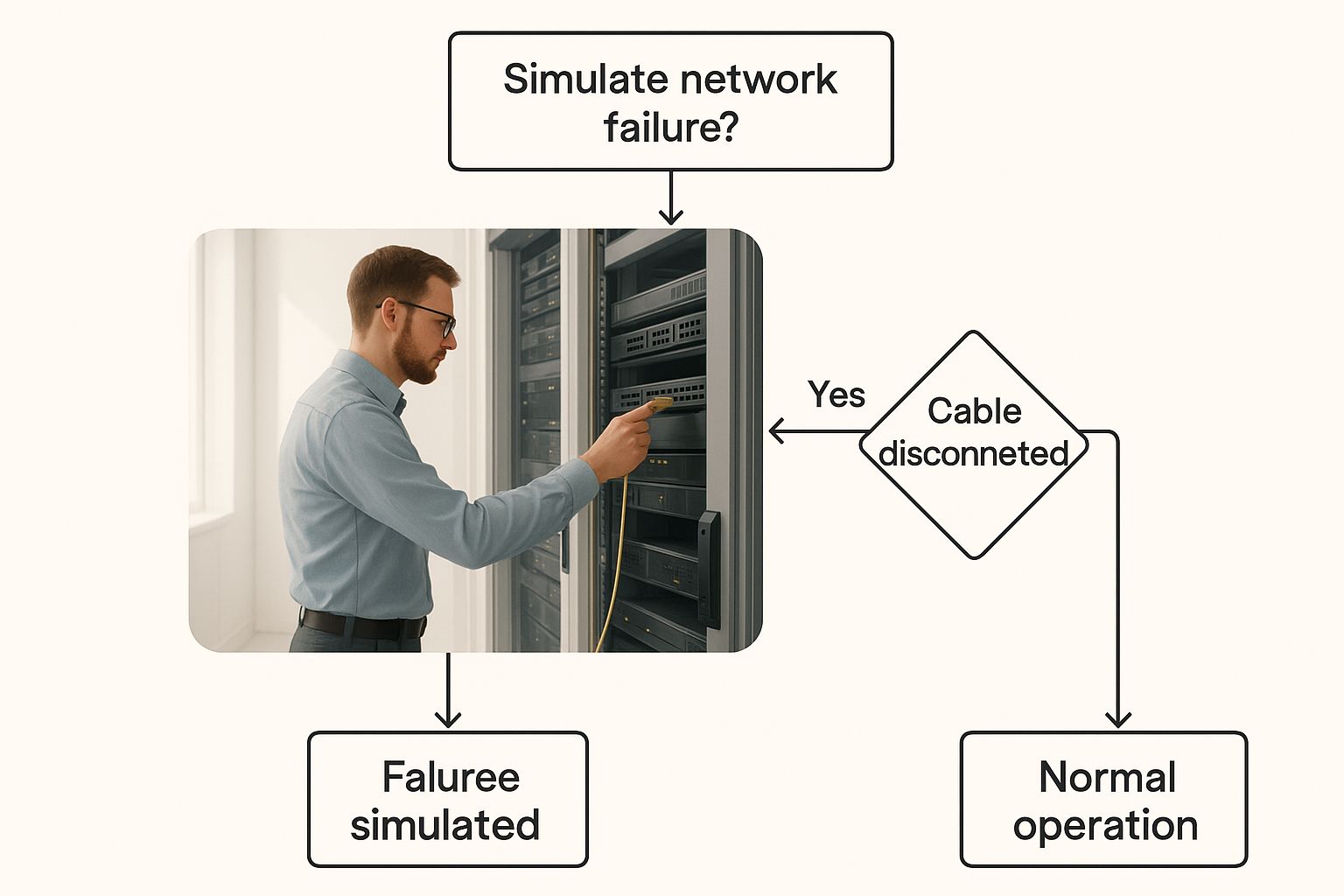
As the image suggests, testing doesn't always have to be some huge, disruptive event. Sometimes, a targeted simulation is all it takes to find a critical flaw in your plan. Let's walk through the most common testing methods so you can build a scalable program that grows with your business—without overwhelming your team.
From Simple Reviews to Full Simulations
There’s a whole spectrum of tests out there, each with its own level of complexity and resource commitment. The smart move is to mix and match these throughout the year to create a well-rounded testing program that covers all your bases.
A great starting point is a Plan Review, sometimes called a Checklist Test. It's the most basic test, but it's essential. You and your team gather around a table and read through the disaster recovery plan, step-by-step. The goal is simple: hunt for obvious errors. You’re looking for things like outdated contact info, incorrect server names, or procedural steps that just don’t make sense anymore. It’s low-impact, costs next to nothing, and you can knock it out in an afternoon.
From there, you can graduate to a Tabletop Exercise, also known as a Structured Walk-Through. This is a more involved discussion where you introduce a specific disaster scenario. For example: “A sudden power surge just fried our main server. What do we do?” Team members then talk through their assigned responsibilities according to the plan. This isn't about touching any live systems; it's about identifying gaps in communication or logic before a real crisis hits.
A successful tabletop exercise feels more like a strategy session than a test. It’s your chance to uncover weaknesses in your process and coordination in a calm, controlled environment, long before you’re under real pressure.
More Advanced Testing Methods
As your business and its technology mature, you’ll want to introduce more hands-on tests that really validate your technical recovery capabilities. These are definitely more resource-intensive, but they provide priceless proof that your systems will actually work when you need them most.
A Parallel Test is an excellent next step up the ladder. In this test, you bring your recovery systems online, but in a completely isolated environment—totally separate from your live production network. This lets you see if you can actually restore your data and applications from your backups without any risk of disrupting your daily operations. This is a critical step in making sure your backups are sound. Of course, to do this right, you need a solid backup system in the first place. You can learn more by checking out our guide on data backup strategies for Monterey Bay businesses.
Finally, there’s the Full Failover Test. This is the most comprehensive and, frankly, highest-risk option. It involves intentionally taking your primary systems offline and shifting all your operations to your disaster recovery site. While it provides the ultimate proof of your plan’s effectiveness, it carries the very real risk of downtime if something goes wrong. Because of the risk involved, we typically only recommend this for organizations with mature DR plans and with expert guidance on hand to manage the entire process.
Preparing for a Flawless Recovery Test
The success of your disaster recovery plan test isn't decided on test day—it's won in the preparation. I've seen it time and time again: companies that rush into a test without a clear strategy end up with more chaos than clarity. For businesses from Monterey to Pacific Grove, this careful prep work is what turns a potentially stressful exercise into a goldmine of actionable intelligence.
Think of it like preparing for a big presentation. You wouldn't just walk on stage without knowing your material, right? The same logic applies here. Proper planning ensures everyone knows their role, the goals are crystal clear, and you get the most value out of the time you invest.
Define Your Objectives
Before you do anything else, you have to decide exactly what you want to achieve. A test without clear objectives is just an exercise in futility. Are you trying to see if you can restore a specific critical server? Validate your team's communication plan? Confirm you can meet a two-hour Recovery Time Objective (RTO)?
Your objectives must be specific and measurable. Forget vague goals like "test our backups." Instead, aim for something precise, such as:
- Objective: Restore the primary accounting database to the recovery server within one hour.
- Objective: Verify that all employees can access the emergency communication channel and respond.
- Objective: Confirm that our remote access solution can support the entire sales team simultaneously without performance degradation.
Defining these goals beforehand gives you a clear benchmark for success and keeps the entire team focused on what matters most.
A well-defined objective is your North Star for the entire test. It guides every decision you make and provides the exact criteria you'll use to judge whether the test was a true success.
Assemble Your A-Team
A recovery test is a team sport, and every player needs a specific, well-defined role. Simply telling everyone to "be available" is a surefire recipe for confusion. Assigning clear duties ensures accountability and a smooth, organized process.
Your test team should include:
- Test Coordinator: This person is the director of the show. They oversee the entire test from start to finish, kick off the simulation, and make sure the plan is being followed.
- The Scribe: This might be the most important role. This individual's sole job is to document everything—every action taken, every timestamp, every problem encountered, and every deviation from the plan. Their notes are the raw data for your post-test analysis.
- Technical Team: These are the hands-on folks who will actually perform the recovery steps, like restoring servers, reconfiguring networks, and verifying data integrity.
- Department Liaisons: You need representatives from key business units (like finance, operations, or customer service) who can validate that restored applications are functioning correctly from an end-user's perspective.
Pre-Test Verification and Communication
The final step in your preparation is to verify that everything is actually ready to go. You don’t want a simple, preventable oversight to derail your entire test. This means double-checking that your backups are current and that the recovery environment is fully synced with your production systems.
Industry best practices all point to this structured approach. Experts strongly recommend that organizations only conduct disaster recovery tests after thorough preparation. This includes validating that recovery systems mirror the current production environment at least a week beforehand, appointing a lead coordinator, and briefing all participants on their specific roles.
This level of readiness is the cornerstone of any effective plan. It's a key part of how we help you protect your business data with backup and recovery in Salinas. With your objectives set, your team briefed, and your systems verified, you’re ready for a productive and flawless test.
Executing the Test and Documenting Your Findings
This is the moment of truth. All the planning, meetings, and prep work come down to this: executing your disaster recovery test with focus and precision. Your written DR plan isn't just a guide—it's the script everyone must follow to the letter.
The goal here isn't to improvise or show off how quickly your team can solve problems on the fly. It's about testing the plan exactly as it's written.
The Critical Role of the Notetaker
As the test kicks off, the most important person in the room is your designated notetaker. Their only job is to be the official scribe, logging every single detail without bias. This is the raw data that will tell you if your plan actually works.
Their log should capture:
- Timestamps: When did each major step begin and end?
- Actions Taken: What did the team actually do, step by step?
- Challenges Encountered: What went wrong? What didn't work as expected?
- Deviations: Where did the team have to stray from the written plan to make things work?
This record is far more than just administrative busywork. It's the evidence you'll use to see if you can meet your Recovery Time Objectives (RTOs) and uncover the hidden weaknesses a simple plan review would never catch.
What to Watch For During the Test
It’s easy to get tunnel vision and focus only on the main recovery objective. But a truly successful DR test means observing the entire process, especially the soft spots where plans often crumble under real-world pressure.
For example, did you suddenly find an unexpected system dependency? Maybe the accounting software won't launch because a secondary, undocumented service isn't running. Or perhaps the communication plan fell apart because key contact lists were outdated, leaving the team scrambling to reach critical personnel.
These discoveries are the golden nuggets of information a test provides.
Think of the test as a full-system diagnostic. You are actively looking for the small cracks in the foundation—like outdated vendor contacts or communication breakdowns—before they can cause a catastrophic failure during a real event. Finding these issues is the hallmark of a successful test.
Keeping Your Team on Track
During the test, it's the coordinator's job to keep everyone on script. If the team starts ad-hoc problem-solving, the notetaker should document it, but the coordinator needs to steer them back to the plan.
Why the strict approach? Because the primary purpose is to test the plan you have, not to see how clever your team is. Sticking to the script gives you a clean, evidence-based account of what happens when you follow your documented procedures.
It’s this rigorous process that provides the accurate data needed for meaningful improvements, turning a theoretical document into a reliable, battle-tested strategy.
Turning Test Results Into a Stronger Plan
A perfect score on a disaster recovery test is nice, but it's not the real prize. The true value comes from the unfiltered, honest feedback you get when your plan finally meets reality. Once the dust settles and all systems are carefully returned to normal, the most important work begins: turning those raw observations into real, tangible improvements.
This all kicks off with a formal review meeting. Get everyone who was involved in a room. Here, your scribe's detailed notes become the star of the show. You'll use them to walk through the entire test, comparing what actually happened against what you thought would happen. Did you meet your RTO? Where did communication get messy? What unexpected problems threw a wrench in the works?
From Raw Notes to Actionable Insights
The point of this meeting isn’t to play the blame game. It’s about finding the cracks in the system. Go through the timeline with a fine-tooth comb. If a specific recovery step took 45 minutes instead of the planned 15, you need to dig in and find out exactly why. Was it a technical snag, a gap in someone's knowledge, or a crucial detail missing from the instructions?
This is where you strike gold. These bottlenecks are the opportunities that make the whole exercise worth it.
A post-test report isn't just a summary of what happened. It’s a strategic blueprint for improvement, ensuring you learn from every mistake and turn each weakness into a future strength.
This cycle of testing, analyzing, and refining is what builds genuine business resilience. A lot of organizations talk about it, but few follow through with the necessary discipline. While research suggests annual testing is the bare minimum, many businesses simply don't keep up, leaving themselves dangerously exposed. You can discover more insights about disaster recovery testing frequency to see how a consistent, disciplined approach really sets you apart from the crowd.
Creating Your Improvement Roadmap
The final result of your analysis should be a clear, concise post-test report. Forget long, dense summaries nobody will read. This needs to be a straightforward, actionable roadmap.
For every issue you uncovered, structure your report to include three key things:
- The Finding: A simple, clear statement of the problem. (e.g., "The offsite backup server was not configured with the latest security patch.")
- The Proposed Solution: A specific, concrete action to fix it. (e.g., "Add a pre-test verification step to ensure all recovery systems are fully patched.")
- Ownership and Deadline: Pin the action item on a specific person or team with a firm due date. (e.g., "IT Team Lead, due by next Friday.")
Assigning ownership is critical—it creates accountability and makes sure the flaws you found actually get fixed. This is how your disaster recovery plan evolves from a static document on a shelf into a living, battle-tested playbook. This active approach is the cornerstone of a solid strategy; our guide to backup and disaster recovery for small businesses dives deeper into building this kind of robust foundation.
Common Questions About Disaster Recovery Testing
We work with businesses all across Monterey County, and over the years, we've heard just about every question you can imagine when it comes to disaster recovery. It's a topic that feels complicated on the surface, but the core ideas are actually quite simple.
Let’s clear up some of the most common questions we get, so you can move forward with your disaster recovery plan testing with confidence.
How Often Should We Test Our Plan?
This is, without a doubt, the question we hear most. The short answer? For most small and mid-sized businesses, we recommend a comprehensive test at least once a year. Think of it as an annual check-up to get a solid benchmark of your capabilities.
But that's not the whole story. A truly resilient plan needs more frequent attention. We strongly advise running smaller-scale tests, like a tabletop exercise or a simple plan review, every quarter. These don't require a ton of resources but are perfect for keeping your plan—and your team—sharp.
A disaster recovery plan is a living document. Any time you make a significant change to your IT—like adding new business software or migrating a server—is the perfect time to test the parts of your plan that are affected.
Do We Have to Take Our Main Systems Offline?
Not necessarily. The thought of intentionally taking your primary systems offline for a test is enough to give any business owner anxiety, especially if every minute of uptime counts. While a full failover test does involve shutting down production systems, it’s just one of several tools in the toolbox.
A parallel test is a fantastic alternative that we often recommend. It lets you have your cake and eat it too. Here’s the process:
- We bring your recovery environment online, but in a completely isolated network bubble.
- Your primary systems keep chugging along, so your daily operations are never interrupted.
- You get to fully validate your recovery process—restoring data, launching applications, and checking dependencies—without risking a single second of real-world downtime.
This method is a game-changer for proving your plan works without disrupting the business, making it a perfect fit for companies that simply can't afford any service interruption.
What Is the Biggest Mistake Businesses Make?
The single biggest mistake we see is treating the test like a pass/fail IT exam. That’s completely missing the point. The real goal isn't to get a perfect score; it's to find the flaws in your plan before a real disaster does it for you.
From our perspective, a test that uncovers problems is actually a successful test.
When you shift the mindset from a performance review to a learning opportunity, it encourages total honesty and leads to genuine improvements. Finding a gap in your plan isn't a failure; it's a chance to get stronger. The real failure is not testing at all, because that’s what leaves you completely exposed to the hidden costs of IT downtime that can absolutely cripple a business.
Can a Managed IT Provider Help with This?
Absolutely. In fact, this is a core part of what we do for our clients. For many local businesses, orchestrating a full disaster recovery test can feel completely overwhelming on top of everything else.
A trusted partner like Adaptive can step in and facilitate the entire process for you. We help you with:
- Planning: Defining clear, realistic objectives and selecting the right type of test for your needs.
- Execution: Coordinating the test itself and ensuring everything is properly documented.
- Analysis: Digging into the results to identify the weak points and areas for improvement.
- Refinement: Helping you update your DR plan with concrete, actionable steps.
This takes the burden off your internal team and gives you the benefit of expert guidance, ensuring your testing is thorough, effective, and delivers real peace of mind.
Ready to build a disaster recovery plan you can truly count on? Contact Adaptive Information Systems to see how our enterprise-level IT services can protect your Monterey County business at an affordable price.
Adaptive Information Systems
380 Main St, Salinas CA 93901 | 831-644-0300 | hello@adaptiveis.net