Digital transformation isn't just a fancy term for big companies in Silicon Valley. For your small business, it means using smart, affordable technology to work better, not just harder. It’s about making practical upgrades to how you work every day—think of a Salinas farm automating its watering schedule or a Carmel hotel making its online booking a breeze for tourists. This guide is your starting point for digital transformation for small business right here in our local community.
What Digital Transformation Really Means For Your Monterey Business

Let's cut through the jargon. When you hear "digital transformation," it's easy to picture huge corporations with massive IT budgets. But for a local business here in Monterey County, it’s something much more practical and powerful. It’s about making smart, affordable upgrades that solve your daily headaches and open up new opportunities.
Think of it as giving your business a modern engine, not just a new coat of paint. You don’t need to chase every new tech trend. You just need to find the right tools that fit your specific needs and your budget.
Ultimately, this is about moving from "the way we've always done it" to a more efficient, secure, and customer-friendly way of running your business. For a restaurant in Pacific Grove, that could mean using an online reservation system to free up your host. For a retail shop in Seaside, it might be an inventory system that stops you from running out of your best-selling items.
It’s A Business Strategy First
Seeing this process as a core part of your business plan, not just another IT expense, is the secret to getting it right. Your goal isn’t just to buy new software; it’s to get real business results.
Digital transformation is about carefully adding technology to change how you work and serve your customers. It’s about building a smarter, stronger business that’s ready for the future.
This smart approach is what really drives growth. It's no surprise that 55% of small businesses say growth is their main reason for using digital tools. In fact, by the end of 2023, 68% of small businesses had a website, proving that a solid online presence is now a must-have.
Making Technology Work For You
So, what does this look like in the real world for businesses here on the Central Coast? The opportunities are everywhere, from the agricultural fields of Salinas to the busy tourist shops in Monterey.
It all comes down to three main ideas:
- Improving the Customer Experience: Make it easier and more pleasant for people to do business with you. This could be anything from a simple website to an easy online payment system.
- Boosting Your Efficiency: Automate the repetitive tasks so you and your team can focus on what really matters. This saves time, reduces mistakes, and cuts costs.
- Strengthening Your Security: Protecting your business and customer data is no longer optional—it's essential. A key part of modernizing is building a secure digital foundation. For more on this, check out our guide on small business network security.
By focusing on smart, targeted improvements, you can get enterprise-level results without the enterprise-level price tag. For a fantastic overview of how to get started, take a look at A Guide to Small Business Digital Transformation. It’s all about making technology a true partner in your success.
Building Your Small Business Digital Strategy
Jumping into digital transformation without a plan is like setting sail from the Monterey Harbor without a map. You're moving, but you probably won't get where you want to go. A solid digital strategy is your blueprint. It's the clear guide that turns your good ideas into real, measurable business growth. It also makes sure every dollar you invest in technology pushes you forward.
You don't need to write a hundred-page document that will just collect dust. Instead, you can focus on four essential pillars that create a strong foundation for any small business looking to modernize. By breaking it down this way, you can build a strategy that’s practical, affordable, and perfectly matched to your goals.
This image shows how a modern business owner can manage key digital tools from a single, unified interface.
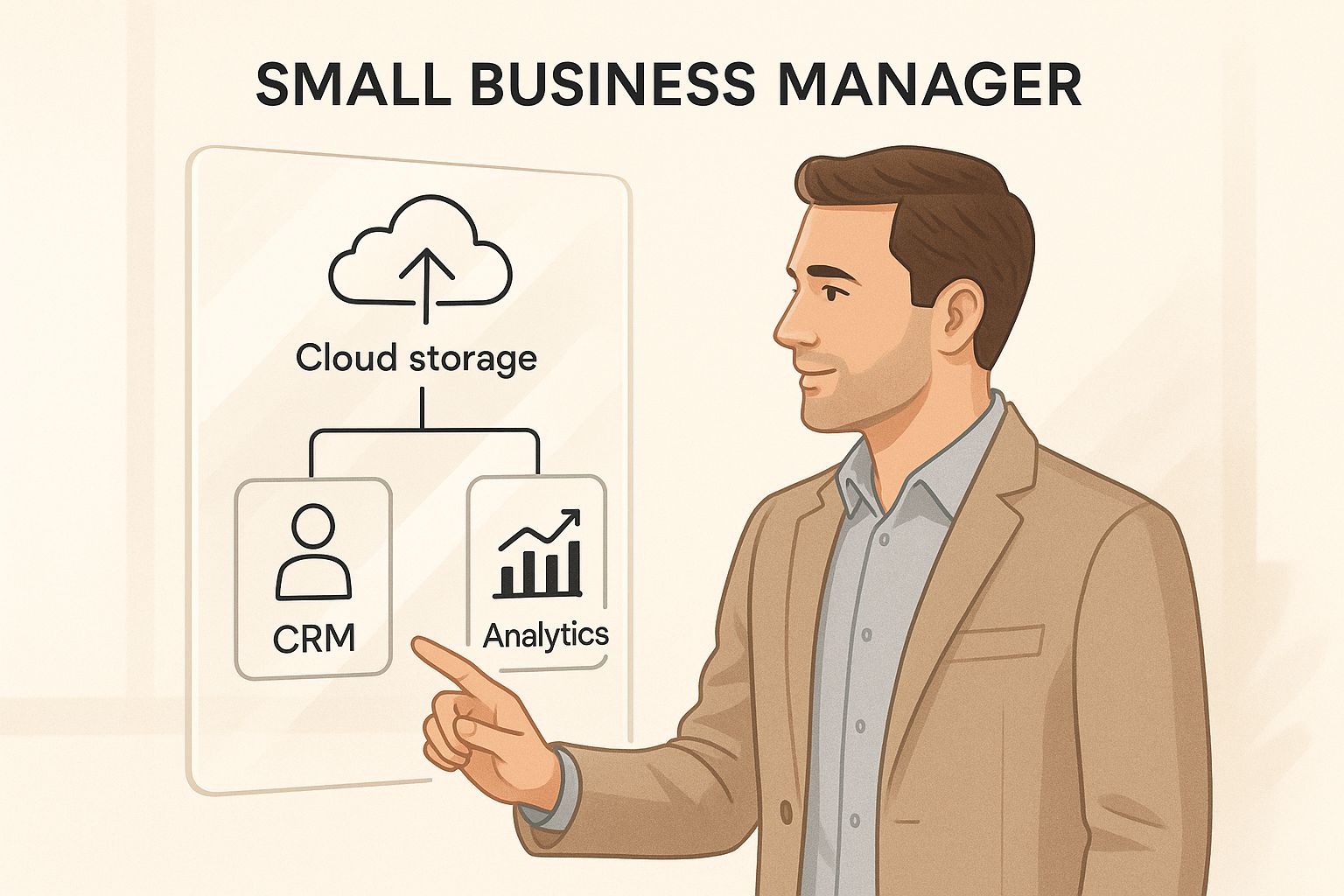
This visual really brings to life how different technologies can be integrated, making it easier to see them working together to support your overall strategy.
Pillar 1: Enhance Customer Experience
First things first: it’s all about your customers. How can technology make every interaction with your business smoother, faster, and more pleasant? For a café in Pacific Grove, this could be as simple as a mobile ordering app that lets tourists grab their coffee without waiting in line. For a service provider in Seaside, it might be an online booking system that lets clients schedule appointments 24/7.
The goal here is to remove any hassle. Today's customers expect convenience. Even small improvements can make a huge difference in building loyalty and getting those glowing online reviews.
Pillar 2: Boost Operational Efficiency
Next, it's time to look at your own operations. Every business has those repetitive, time-sucking tasks that drain energy and resources. The second pillar of your strategy is all about finding those chores and using digital tools to automate them. This is where you really start working smarter, not just harder.
Your time is your most valuable asset. Digital transformation gives it back to you by letting technology handle the tedious work, so you can focus on strategy, customer relationships, and growth.
Think about these areas for quick efficiency wins:
- Automated Invoicing: Use software that automatically sends out invoices and payment reminders. No more chasing down payments.
- Inventory Management: Get a system that tracks your stock levels in real-time to avoid running out of popular items.
- Team Communication: Switch to a single platform for internal messages to cut down on messy, confusing email chains.
Each little bit of efficiency adds up, saving you money and freeing your team to tackle more important work. To get expert guidance on spotting these opportunities, exploring business technology consulting can provide a clear path forward.
Pillar 3: Make Data-Driven Decisions
You’re likely sitting on a goldmine of information and might not even realize it. The third pillar is about using the data your business already creates to make smarter, more confident decisions. This might sound complex, but it can be very simple.
Your point-of-sale system can tell you which products sell best on certain days. Your website analytics can show you which services customers are most curious about. By paying attention to these simple data points, you can improve everything from staffing schedules to your marketing budget.
As you build out your digital plan, it's essential to explore comprehensive marketing strategies for small business that know how to use this kind of data.
Pillar 4: Unlock New Business Models
Finally, we get to the most exciting part: creating entirely new ways to make money. Digital tools can open doors that were completely closed to small businesses in the past. For instance, a local farm in Salinas could launch an online subscription box for fresh produce, reaching customers directly all across Monterey County.
A local artist could start offering online classes, or a consultant could sell digital guides and courses. This pillar is all about thinking creatively. It pushes you to consider how technology can expand your business beyond its physical location and create new, steady streams of income.
Key Technologies Driving Local Business Growth

You don’t need a huge IT department or a blank check to make a real impact on your business. The best part about today's technology is that many of the most powerful tools are affordable, easy to use, and ready to help you compete with bigger companies.
Think of these as the essential items in your digital toolbox. Each one is designed to solve a specific problem and give you back more of your time and money. For a small business, it's all about choosing the right tools for the job. Let’s look at the technologies that give you enterprise-level power without the enterprise-level price tag.
The Power of the Cloud
Think of cloud computing as your digital filing cabinet, office, and hard drive all in one. You can access it from anywhere with an internet connection. Instead of locking your important business files and software on a single computer in your office, the cloud lets you keep them in a secure, professionally managed online space.
For a local business, this is a huge advantage. If you're visiting a client in Marina or checking inventory from home, you have the same access to your data as you would in the office. This flexibility helps you stay quick and responsive.
It also means you get top-tier security and backup without having to build and maintain it yourself. This approach makes powerful IT available and affordable for everyone.
Your Digital Rolodex
A Customer Relationship Management (CRM) system is like a smart, digital rolodex that helps you build stronger relationships with your customers. It goes way beyond just storing contact information. A good CRM helps you track every interaction you have with a customer—from their first visit to your website to their most recent purchase.
Why does this matter? Imagine knowing a customer’s entire purchase history the moment they call. You could offer personalized recommendations or follow up on a previous conversation, making them feel truly valued.
A CRM turns customer data into your most powerful sales and marketing tool. It’s the difference between guessing what your customers want and knowing what they need.
For businesses in hospitality or retail, a solid CRM can be the key to building a loyal local following.
Essential Cybersecurity Protections
In today's connected world, cybersecurity isn't a luxury; it's a basic part of doing business. A single data breach can wreck the reputation you've worked so hard to build and cost you a lot of money. Digital transformation means building a secure foundation from the start to protect your business and your customers.
This doesn’t have to be complicated. It starts with the basics:
- Strong Passwords and Multi-Factor Authentication: Simple steps that create a powerful barrier against hackers.
- Regular Software Updates: Keeping your systems up-to-date ensures you have the latest security fixes.
- Employee Training: Your team is your first line of defense. Teaching them to spot scam emails is crucial.
Getting these fundamentals right is a must for protecting your business. We offer a range of professional IT services for small businesses that can help you build and maintain strong security.
The Rise of AI and Automation
Artificial Intelligence (AI) and automation might sound futuristic, but they are practical tools that are already helping small businesses save time and improve service. Automation is all about letting technology handle repetitive, manual tasks so you and your team can focus on what really matters.
Here are a few ways you can put these tools to work right away:
- Automated Email Marketing: Set up systems that automatically send welcome emails to new subscribers or follow-up messages after a purchase.
- AI-Powered Chatbots: Use a simple chatbot on your website to answer common customer questions 24/7, like "What are your hours?" or "Where are you located?"
- Social Media Scheduling: Plan and schedule your social media posts in advance so you always have a consistent online presence without constant effort.
These technologies are no longer out of reach. In fact, many businesses are using them. Recent data shows that 87% of small businesses already use social media, and about 85% of owners report success after adding technology into their operations. You can explore more about these trends and their impact on small business tech adoption on bizplanr.ai.
Creating Your Digital Transformation Roadmap
A great idea without a solid plan is just a wish. The same is true when it comes to modernizing your small business. Simply buying a new piece of software isn’t a strategy. You need a clear, practical roadmap to get you from where you are today to where you want to be.
This roadmap doesn't have to be a huge document. It's about thinking through your goals, taking an honest look at your business, and making smart choices that fit your budget and vision. Think of this as your guide to turning digital ideas into real business results.
Start With a Clear Assessment
Before you can map out your route, you have to know your starting point. Take a good, honest look at how your business runs day-to-day. What's working well, and what’s creating problems for you, your team, or your customers?
Think about your daily grind. Are you spending too much time entering data by hand? Is your team struggling to communicate? Are customers complaining about long wait times? Finding these pain points is the first step because it tells you exactly what problems technology needs to solve.
For example, a local Salinas agricultural business might realize that tracking equipment maintenance on paper is a mess, leading to costly downtime. That’s a specific problem a digital tool can fix.
Set Measurable and Realistic Goals
Once you know the problems, you can set specific and measurable goals. Vague goals like "get better with tech" won't get you anywhere. You need clear targets that you can track.
Instead of a general goal, define a precise outcome:
-
Vague Goal: "Improve customer service."
-
Specific Goal: "Reduce customer wait times by 15% in three months by using a new online ordering system."
-
Vague Goal: "Be more efficient."
-
Specific Goal: "Cut time spent on manual invoicing by 50% by using an automated billing platform."
These clear goals give you a finish line and make it easy to see if your investments are paying off. They also help keep your digital transformation for small business focused on what matters.
A well-defined goal acts as your compass. It ensures every tool you choose is moving your business in the right direction, preventing wasted time and money on solutions that don’t serve a purpose.
Choose the Right Tools for the Job
With your goals in place, you can start looking for technology. The key here is to avoid "shiny object syndrome" and pick tools that directly solve your problems. This is where our mission to provide enterprise-level IT at an affordable price really shines. You don't need the most expensive software; you just need the right fit.
When you're building your roadmap, it's smart to see what's working for others. For ideas on how to automate tasks, check out these business process automation examples. And don't forget about security. Any new tool has to come with a solid plan for protecting your data. You can learn more about the importance of backup and disaster recovery for small businesses to make sure your information is always safe.
Get Your Team Onboard
The final—and most important—piece of your roadmap is your team. Technology is only as good as the people using it. It's essential to explain your vision clearly and get your employees excited about the changes.
Explain the why behind the updates—how they'll make everyone's job easier and help the business grow. Provide real training and be patient as people learn new ways of working. When your team understands the benefits and feels supported, they’ll become your biggest champions in making your digital transformation a success.
Overcoming Common Digital Transformation Hurdles
Making big changes in your business is rarely a straight line, but that’s okay. Every challenge has a solution. When it comes to digital transformation for small business, the best way to have a smooth ride is to prepare for the common roadblocks ahead of time.
If you know what hurdles to expect, you can move forward with confidence. Let's tackle the most common obstacles and turn them into stepping stones for your success.
Taming the Budget Monster
The first question is almost always the same: "How much is this going to cost?" That's a fair concern for any business owner. The fear of a huge bill can stop a great idea before it starts. The key is to be smart with your budget, not just write a blank check.
Instead of trying to do everything at once, focus on the investments that will give you the biggest and fastest return.
- Start with a Pain Point: Find the single biggest bottleneck in your business right now. Is it manual invoicing that takes hours? A tool that solves that one problem will pay for itself quickly.
- Embrace Scalable Solutions: Look for cloud-based software that you pay for monthly. This helps you avoid big upfront costs and lets you pay for what you need now, with the option to add more as you grow.
- Focus on ROI: Think of technology as an investment, not just a cost. A $100 per month tool that saves you ten hours of manual work is a massive win for your bottom line.
Finding Time in a Packed Schedule
As a business owner, your time is your most precious asset. The idea of adding a major tech project to your already full to-do list can feel impossible. But finding the time is about working smarter, not just longer. This is where having a trusted partner can make all the difference.
Digital transformation shouldn’t feel like taking on a second job. With the right support, you can hand off the technical work and stay focused on running your business while still making progress.
Your best friend here is a step-by-step approach. Break your plan into small, manageable projects you can finish one at a time. This keeps you and your team from feeling overwhelmed. Each small win builds momentum for the next step. To see how we can help, check out our approach to managed IT services.
Turning Team Resistance into Enthusiasm
The final hurdle, and often the biggest one, is your team. Change can be uncomfortable, and it's natural for employees to resist new tools. The secret to getting your team on board is clear communication. Focus on what’s in it for them.
Show your team how the new technology will make their jobs easier, not harder. Frame it as a way to get rid of their most frustrating tasks. Provide good training, be patient while they learn, and celebrate small wins together.
This people-first approach is key. While 59% of European businesses have a basic level of digital tools, many still struggle to keep up. This shows the need for a balanced strategy. To succeed, you have to focus on your people, processes, and technology equally. You can learn more by exploring key digital transformation statistics on walkme.com.
Your Local Partner for Digital Success
You don't have to figure out digital transformation for your small business all by yourself. Hopefully, this guide has shown that modernizing your business is not just possible—it's essential for growth. But having the right local partner in your corner, someone who truly understands Monterey County, can make all the difference.
We're committed to serving the businesses that make our community special. Whether you're one of the agriculture leaders in Salinas or a hospitality pro welcoming visitors in Monterey, we're here to help. We believe every local business deserves access to the same great technology the big corporations use. Our mission is to make that happen at a price that works for your budget.
Your Strategic Ally
We’re more than just an IT provider; think of us as your strategic partner. Our first job is to understand your unique challenges and opportunities. From there, we build a technology plan that directly helps you succeed. This team approach means you get solutions that are the right fit for you, not just a one-size-fits-all product.
Think of us as part of your team—a dedicated resource focused on making your business more efficient, secure, and profitable through smart technology choices.
The good news is that the future looks bright for businesses that embrace these changes. CEOs are optimistic, with most expecting to see real benefits from digital transformation within a few years. Yet, only about 21% of companies in North America and Europe were actively transforming at the time of those estimates. That gap creates a huge opportunity for you to get ahead of the curve. You can explore more on the future of digital adoption on scoop.market.us.
Taking that next step toward a more efficient future is a powerful move. With the right support, you can confidently navigate the entire process and unlock your business's full potential. We're here to guide you every step of the way.
Still Have Questions? Let's Clear a Few Things Up
Even with a clear plan, it's natural to have questions. Here are some straightforward answers to the questions we hear most often from local business owners right here in Salinas and Monterey County.
How Much Does This Actually Cost?
This is always the first question, and the honest answer is: it depends on your goals. Digital transformation isn't one giant purchase. Think of it as a series of smart, scalable investments.
You can start small. Focus on one high-impact area, like automating your invoicing with affordable cloud software, and then build from there. The goal isn't to buy flashy tech; it's to find tools that give you a real return by saving you time or boosting your sales. We're here to provide enterprise-level results at a price that makes sense for your small business.
How Long is This Going to Take?
There’s no fixed finish line here. Digital transformation is an ongoing journey, not a one-time project. But the good news is you can see real results very quickly. For example, setting up a new online booking system could start paying for itself in just a few weeks.
The most important thing is to get started. The digital transformation market is growing fast and could reach $3.375 trillion by 2032. That kind of growth tells you one thing: businesses are seeing real value and moving quickly. You can explore more of these trends on scoop.market.us.
What If My Team Isn't Great With Technology?
That's a completely fair and common concern. The best tool in the world is useless if your team won’t use it.
Success isn't about forcing complex systems on your staff. It's about choosing user-friendly tools that actually make their jobs easier and then providing the right training and support to get everyone on board.
We make it a priority to find solutions that are easy to use from the start. A huge part of our job is helping your team feel confident with new tools, turning any hesitation into genuine excitement for a better way of working.
Ready to build a smarter, more efficient future for your business? The team at Adaptive Information Systems is here to be your local partner, providing the strategic guidance and affordable IT solutions you need to succeed.
Schedule Your Free Consultation Today
Adaptive Information Systems
380 Main St, Salinas CA 93901 | 831-644-0300 | hello@adaptiveis.net