

As a business owner here in the Monterey Bay area, you're juggling a lot. Maybe you're managing agricultural shipments in Salinas or welcoming tourists in Carmel. The last thing you need is a data headache. But what happens to all the customer, employee, and financial data you collect? A solid data retention policy isn't just for big corporations; it's a vital shield for your local Salinas business.
A clear policy tells you exactly what data to keep, how long to keep it, and how to get rid of it safely. Without one, you risk big fines, legal trouble, and losing the trust you've worked so hard to build. Protecting your data is key to keeping your good name and running your business smoothly.
This guide gives you clear, industry-specific data retention policy examples to help you build a plan that protects your business, your customers, and your wallet. We'll look at real-world templates for healthcare, finance, e-commerce, and more. You'll get advice you can use right away. Let's see how you can get big-business IT protection at a price that makes sense for your company.
1. GDPR-Compliant Data Retention Policy
A GDPR-compliant data retention policy is a plan that helps your business handle personal data from people in the European Union (EU). This isn't just for European companies. If you have customers or even website visitors from the EU, it applies to you. The main ideas are data minimization (only collect what you need), purpose limitation (only use data for the reason you said you would), and storage limitation (only keep it as long as you have to). This means you need a clear, good reason for every piece of personal data you store and for how long you store it.

Using one of these strong data retention policy examples involves making a detailed schedule. This schedule lists different data types, the legal reason for having them, and how long you'll keep them. For local businesses in Monterey County, from farms in Salinas to hotels in Carmel, being proactive about data privacy builds a lot of customer trust.
Strategic Analysis & Examples
The great thing about a GDPR-style policy is that it makes you careful and open about data. This lowers your risk of data breaches and fines. It also makes your brand look more trustworthy.
- Microsoft: Their privacy dashboard is a great example of giving users power. It lets people see, manage, and delete their own data. This directly follows GDPR's "right to erasure" and builds trust by making data control easy to see and use.
- Airbnb: The company keeps booking data for three years to handle any arguments and follow financial rules. Importantly, their policy is easy to understand, and they get permission from users, which shows they have a legal reason for keeping the data.
- Spotify: Spotify has different levels for data. Data needed for the service is kept as long as an account is active. Other, less important data might be deleted sooner. This shows they are following the rules of data minimization and storage limitation.
Actionable Takeaways
You can set up a similar plan by focusing on a few key steps. Start by knowing what data you have and why you have it.
- Conduct Data Mapping: Before you write your policy, you need to know what personal data you collect, where you keep it, and why you need it. This is the foundation of your whole plan.
- Create Clear Schedules: Group your data by type (like employee records, customer purchase data, or marketing leads). Then, give each group a specific time limit and a method for getting rid of it.
- Automate Deletion: Use tools that automatically delete data when its time is up. Doing it by hand can lead to mistakes and break the rules.
- Train Your Team: Make sure everyone on your staff, from managers in Monterey to cashiers in Seaside, understands the policy. They need to know their role in protecting people's data rights. Creating a full plan is a key part of our small business compliance checklist.
2. Healthcare HIPAA Data Retention Policy
A Healthcare HIPAA Data Retention Policy is a special plan for groups that handle Protected Health Information (PHI). This policy is vital for any healthcare provider, from big hospitals to small clinics in Monterey. It has to balance patient privacy with medical needs and strict legal rules. The core of a HIPAA policy is to keep PHI safe and private for a required amount of time, and then destroy it securely so no one else can see it.

Using one of these special data retention policy examples means you have to understand both federal HIPAA rules and different state laws about medical records. For healthcare providers in Salinas and across Monterey County, this policy is a must-have for keeping patient trust and avoiding huge fines. The policy must explain how different types of PHI, from patient charts to billing records, are handled from start to finish.
Strategic Analysis & Examples
The big win here is twofold: less risk and better workflow. A clear policy lowers the risk of data breaches and fines while making it easier to manage records. It shows that your practice is a safe and trustworthy place for sensitive patient data, which is a big deal in the healthcare world.
- Mayo Clinic: This organization uses a complete Electronic Health Record (EHR) system that automatically archives and deletes records. The system flags records for disposal based on state and federal laws, which cuts down on human error.
- Kaiser Permanente: Their patient portal is a great example of giving access while managing data. It lets patients see their past health data, which is very transparent. At the same time, the system behind it manages the data according to strict, pre-set rules.
- Epic Systems: As a software company, Epic builds HIPAA compliance features right into its EHR products. These built-in controls help healthcare groups enforce their own policies, making sure data isn't kept longer than needed.
Actionable Takeaways
You can create a HIPAA-compliant plan by focusing on details, security, and training. This starts with a clear understanding of the laws that affect your practice.
- Know Federal and State Laws: HIPAA requires you to keep records for six years from when they were made or last used, whichever is later. But California law might require you to keep some records longer. You always have to follow the stricter rule.
- Implement Role-Based Access: Limit who can see PHI based on their job. A billing specialist in your Carmel office doesn't need to see full medical histories. This is a core security idea in our IT security policy template.
- Define Destruction Procedures: Your policy must say exactly how PHI will be safely destroyed. This could mean shredding paper files or using special software to erase digital files. You should also document every time you destroy records.
- Use Secure Third-Party Tools: A key part of HIPAA is using Business Associate Agreements (BAAs) in video conferencing. These are legal contracts that explain how outside services will handle your protected health information.
3. Financial Services Data Retention Policy
A financial services data retention policy is a very structured plan made to meet the tough rules of the finance industry. This policy controls how companies manage, store, and get rid of sensitive data, from transaction records to customer emails. The main goals are to follow rules from groups like the SEC and FINRA, prevent fraud, and keep good customer service records. This requires a very careful and trackable way of managing data.
For financial firms in Monterey County, from investment advisors in Carmel to banks in Salinas, a strong policy isn't just a legal rule; it's the foundation of client trust. The infographic below shows the critical steps for handling regulatory data, a process that ensures you are following the rules from start to finish.
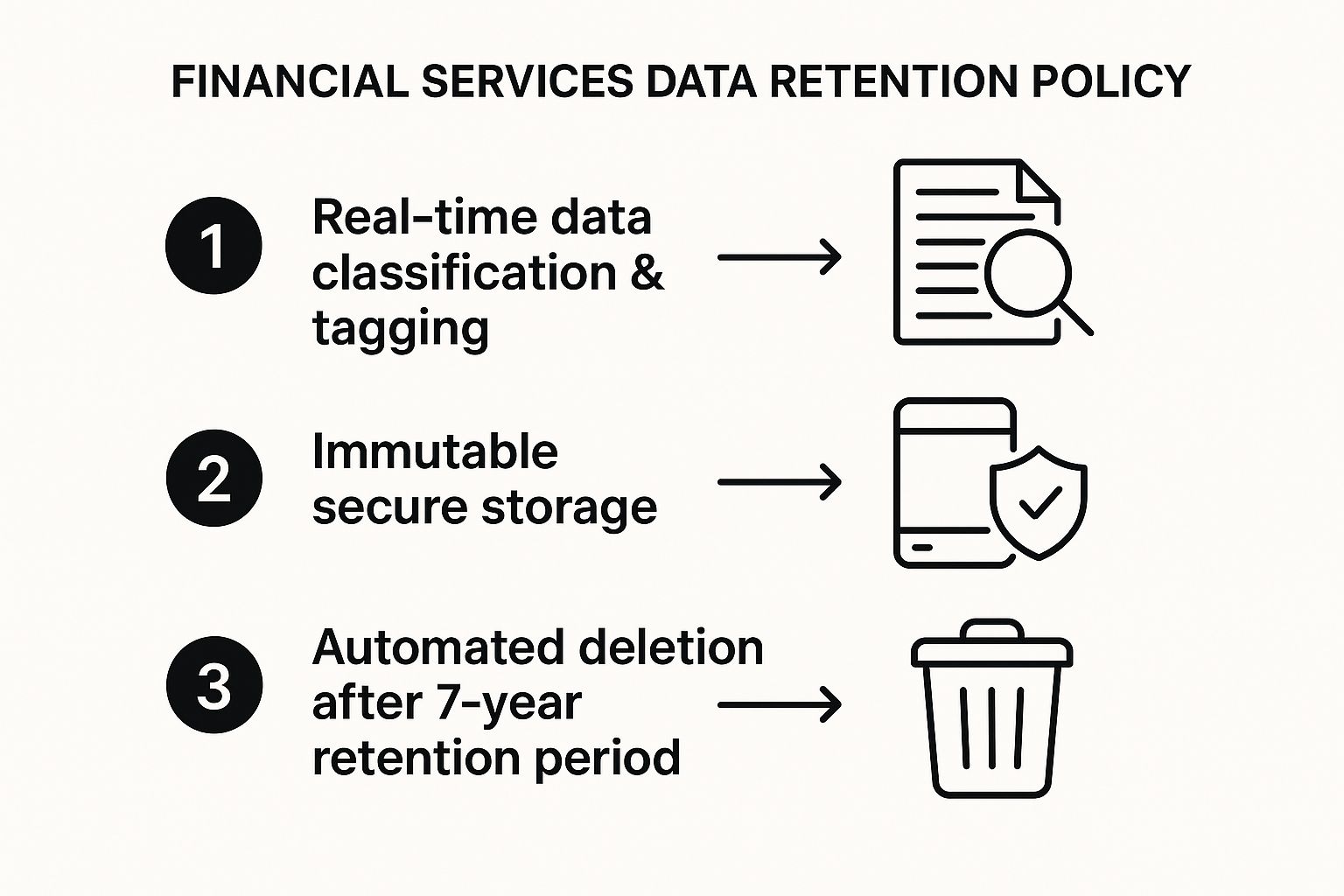
This process shows why it's so important to have an automated system that sorts data when it's created, stores it safely, and gets rid of it on a strict, pre-set schedule.
Strategic Analysis & Examples
The benefit of a special financial data policy is that it turns a confusing web of rules into a clear, simple process. It lowers your legal risk, protects you in lawsuits, and makes sure data is ready for audits without being kept too long. This also reduces storage costs and security risks.
- JPMorgan Chase: The firm uses a powerful system that records and keeps trade data for years. This not only meets SEC rules but also helps them spot illegal activity, turning a required cost into a tool for managing risk.
- Goldman Sachs: Their system for saving client communications is a great example of being proactive. It saves all electronic messages (like emails and chats) in a way that can't be changed. This makes them ready for any review and shows the company is committed to being open.
- Fidelity Investments: Fidelity keeps customer account histories for many decades, much longer than some rules require. This helps them maintain long-term customer relationships, assist with estate planning, and resolve any future disagreements.
Actionable Takeaways
You can use a similar approach by focusing on automation, security, and clear rules. The key is to create a system that follows the law and works well for your business.
- Create a Master Retention Schedule: Put all the rules you have to follow (from the SEC, FINRA, etc.) into one main document. This schedule should be your final guide for how long to keep each type of data.
- Use Immutable Storage: For records that must not be changed, like trade confirmations, use "Write-Once-Read-Many" (WORM) storage. This is a must-have for proving your data is accurate to auditors.
- Automate Data Classification: Use tools that automatically sort and tag data as it's made. This makes sure records are put under the right retention rule right away, reducing human mistakes.
- Establish Clear Governance: Give specific people clear roles for data retention. Everyone, from your IT staff in Monterey to your compliance officers, must know who is in charge of managing the policy. These ideas also highlight the need for secure backup solutions for small businesses that protect your vital data.
4. E-commerce Customer Data Retention Policy
An e-commerce customer data retention policy is a plan designed for online sellers. It focuses on balancing the need to offer a personal shopping experience with a strong commitment to customer privacy. This policy covers data like purchase history, browsing habits, and marketing choices. For online shops in Salinas or hospitality businesses in Carmel that sell online, this approach is key to building a loyal customer base that trusts you with their information.

Using one of these customer-focused data retention policy examples means creating a tiered system. This system keeps essential transaction data for legal and financial reasons. But it also gives customers clear control over their marketing and browsing data. It's a proactive way to respect privacy while still using data to grow your business.
Strategic Analysis & Examples
The strategic benefit of this policy is how it directly builds customer trust and loyalty. By being open and giving customers control, you turn data privacy from a legal problem into a reason for people to choose you. It shows customers you value them, which encourages them to come back.
- Amazon: Amazon does a great job of keeping purchase history forever for features like "Buy Again" and personal recommendations. But, it also gives users a full privacy dashboard to manage their browsing history and ad choices, which gives them a feeling of control.
- Shopify: As a platform, Shopify gives its sellers default data tools to help them follow the rules. It keeps merchant data as long as their store is active and handles customer data as the merchant directs.
- eBay: eBay keeps transaction history to manage disputes and seller ratings, which is central to how its marketplace works. This data is needed to protect both buyers and sellers, which is why it's kept for a longer time.
Actionable Takeaways
You can use a similar strategy by focusing on being clear and giving users control. Your goal is to make customers feel safe sharing their data with you.
- Provide Clear Value: Clearly explain what customers get in return for letting you keep their data, like personal recommendations or faster checkout. This creates a fair and open exchange.
- Create Intuitive Controls: Build an easy-to-use customer dashboard where people can see, manage, and delete their non-essential data. Don't hide these controls deep inside your site.
- Segment Your Policies: Don't treat all data the same. Keep financial transaction records for the legally required time (often 7 years), but let customers delete their browsing history after 90 days.
- Communicate Proactively: Tell your customers about your data practices regularly. This is especially important for businesses that manage remote teams and customer data in different places, where good communication is key. Learn more about how to handle these challenges with our guide to remote work best practices.
5. Government Records Management Policy
A government records management policy is a plan built for openness, responsibility, and historical records. This approach is key for government agencies that handle huge amounts of data while following public access laws like the Freedom of Information Act (FOIA). The main ideas are public accountability (making government actions easy to see), historical preservation (saving records for the future), and legal compliance (following strict rules for archives and access). This policy decides not just how long data is kept, but also how it is sorted, accessed, and finally stored or destroyed.
Using these types of data retention policy examples involves creating a very detailed system for classifying and scheduling records. For public groups in Monterey County, from the city government in Salinas to schools in Monterey, this plan is essential for keeping public trust and following the law. It requires a step-by-step approach to make sure records are both secure and available when the public asks for them.
Strategic Analysis & Examples
The big advantage of a government-style policy is its focus on long-term data quality and access, which is crucial for legal and historical reasons. It forces an organization to think about data not just for today's work but for its value as a permanent record. This is a key part of effective business continuity solutions.
- U.S. National Archives and Records Administration (NARA): NARA’s digital preservation work sets the standard. They have detailed rules for how to label files to make sure that digital records made today can still be read decades from now.
- UK Government Digital Service (GDS): GDS provides clear, public guides on how different government departments should manage their data. Their approach focuses on being user-friendly, making it easy for the public to find and understand their policies.
- Government of Canada's Open Data Portal: This platform gives the public access to large sets of data and includes the retention schedules for those records. This openness shows they are committed to being accountable and lets citizens see exactly how long their government keeps information.
Actionable Takeaways
You can use the ideas from this strong plan for your own business, even if you are not a government group. The focus on structure and responsibility is good for everyone.
- Establish Clear Roles: Choose a specific person or team to be the "records manager." They will be in charge of overseeing the policy, answering questions, and making sure everyone follows it.
- Implement Metadata Standards: For your most important data, create a standard for how it is tagged and described. This makes information easier to find, get, and manage over time.
- Plan for Technology Migration: Don't let your data get stuck in old software. Your policy should include a plan for moving important records to new formats or systems as technology changes.
- Conduct Regular Training: Make sure your staff understands their duties. Regular training on how to sort documents, handle sensitive information, and follow retention rules is key to success.
6. Educational Institution FERPA-Compliant Policy
A FERPA-compliant data retention policy is a plan made for schools to manage student records according to the Family Educational Rights and Privacy Act (FERPA). This federal law protects the privacy of student education records. It gives parents certain rights that pass to the student when they turn 18. The policy's main job is to balance following the law with the need to support student success, research, and school operations. It requires a careful approach to sorting student data and deciding how long each type of record is kept.
This type of policy sets different time limits for everything from school transcripts to discipline files and financial aid information. For schools in Monterey County, like Hartnell College in Salinas or CSU Monterey Bay in Seaside, using one of these specialized data retention policy examples isn't just about following rules; it's about honoring the trust of students and their families. This plan makes sure sensitive data is protected but still available for valid educational needs.
Strategic Analysis & Examples
The advantage here is twofold: it ensures you follow a complex federal law, avoiding big fines, and it builds a strong reputation as a safe, trustworthy school. A clear policy also makes administrative work smoother, making it easier to handle record requests and manage data over time.
- Harvard University: The university’s data governance program is a great model. It provides clear, public policies that separate different types of student data. For example, academic records are often kept forever, while application data for students who don't enroll is destroyed after a set time.
- University of California System: The UC system uses a single policy across all its campuses. This makes things consistent and simplifies following the rules. It sets specific timelines for records like financial aid documents (often 7 years after graduation) and health records, which might also be covered by HIPAA.
- Student Information Systems (SIS): Platforms like Banner and PeopleSoft are often set up to support FERPA rules. They let schools control who can access what and automate retention schedules. This ensures only the right people can access specific student data for good educational reasons.
Actionable Takeaways
You can create a FERPA-compliant plan by focusing on classification, access control, and communication. The key is to be intentional about every piece of student information you handle.
- Separate Retention Schedules: Create different schedules for different record types. Academic transcripts might be permanent, while disciplinary records could be destroyed a few years after graduation. This stops you from keeping sensitive information too long.
- Implement Strong Access Controls: Use your IT systems to limit access to student data to only those who "need-to-know." A faculty advisor doesn't need to see a student's health records, and your policy should enforce that.
- Clearly Communicate Student Rights: Make your data policies and student rights under FERPA easy to find in student handbooks and on your website. Being transparent is key for building trust and staying compliant.
- Train Faculty and Staff: Hold regular training sessions to make sure everyone who handles student data, from administrators in Monterey to teachers in Pacific Grove, understands their duties under FERPA and your school's specific policies.
Data Retention Policy Comparison Matrix
| Policy Title | ⭐ Expected Outcomes | 🔄 Implementation Complexity | ⚡ Resource Requirements | 💡 Ideal Use Cases | 📊 Key Advantages |
|---|---|---|---|---|---|
| GDPR-Compliant Data Retention Policy | Ensures legal compliance, builds trust, reduces costs | High – legal expertise and ongoing monitoring needed | Medium-High – audits, training, automated deletion | Organizations handling EU citizens' personal data | Avoids GDPR fines, accountability, transparency |
| Healthcare HIPAA Data Retention Policy | Protects patient privacy, supports care continuity | High – federal/state complexity, long retention | High – secure storage, destruction, audit trails | Healthcare providers managing PHI | Compliance with HIPAA, malpractice protection, research |
| Financial Services Data Retention Policy | Meets multi-regulatory needs, supports fraud detection | High – complex infrastructure, overlapping rules | High – secure, immutable storage, automation | Financial institutions under regulations (SOX, FINRA) | Regulatory compliance, audit readiness, fraud prevention |
| E-commerce Customer Data Retention Policy | Enhances personalization, reduces storage costs | Medium-High – technical across systems, consent mgmt | Medium – self-service portals, automation | Online retailers balancing privacy & marketing | Personalization, customer trust, analytics support |
| Government Records Management Policy | Ensures transparency, public accountability | High – FOIA, archival standards, multi-agency | High – long-term preservation, classification | Public sector agencies managing diverse records | Transparency, historical preservation, standardized management |
| Educational Institution FERPA-Compliant Policy | Protects student privacy, supports education outcomes | Medium-High – rights transitions, legacy systems | Medium – access controls, audits, staff training | Educational institutions managing student records | Privacy protection, permanent academic records, research |
Let's Build Your Data Retention Plan Together
We've looked at several detailed data retention policy examples, from the strict patient privacy rules of HIPAA to the global reach of GDPR. The main takeaway is clear: one size does not fit all. The best policies are made just for you. They reflect your specific industry, the kind of data you handle, and the laws you have to follow.
For a local business in Salinas or Monterey, this means your policy needs to cover everything from California's CCPA to specific industry rules, whether you're in agriculture, hospitality, or finance. As we saw in the examples, a strong policy isn't just a document. It's a smart tool that protects you from fines, builds customer trust, and makes your business run better.
Your Actionable Next Steps
Ready to turn these examples into your own plan? Here’s a simple guide to get you started on building a solid data retention plan for your business.
- Step 1: Conduct a Data Inventory. You can't protect what you don't know you have. Start by listing all the data your business collects, where it’s stored (on your own servers, in the cloud, etc.), and who can access it.
- Step 2: Identify Applicable Regulations. Figure out which local, state, federal, and industry-specific laws apply to your business. This could include HIPAA, FERPA, CCPA, or financial rules. This step is key for setting your time limits.
- Step 3: Define Retention Periods for Each Data Type. Based on the rules you found, give specific time limits to different types of data. For example, employee records will have a different timeline than customer purchase data.
- Step 4: Create Your Disposal Protocol. A core part of any data policy is the safe and permanent deletion of data once its time is up. This process should be automated when possible to keep things consistent and avoid accidentally keeping data too long.
- Step 5: Document and Train. Write down your policy in a clear, easy-to-understand document. Most importantly, train your whole team on their responsibilities. A policy only works if your people follow it.
The Foundation of Strong Data Management
In the end, a data retention policy is one piece of a bigger strategy. For complete data management, following data governance best practices for cloud success is essential to handling information well and legally. This ensures your data is not only stored for the right amount of time but is also safe, correct, and available when you need it.
Getting your data retention strategy right offers huge benefits. It lowers your legal risk, cuts data storage costs, and shows a commitment to privacy that customers in communities like Carmel and Pacific Grove really value. It’s a proactive step that turns data from a possible problem into a well-managed asset, giving you an edge over the competition and peace of mind.
Ready to create a data retention policy that’s built for your business? Adaptive Information Systems specializes in providing enterprise-level IT strategy and support tailored for local SMBs across Monterey County. Let us help you navigate the complexities of compliance and build a secure, automated data management plan that protects your business for years to come.
Adaptive Information Systems
380 Main St, Salinas CA 93901 | 831-644-0300 | hello@adaptiveis.net