
Direct Answer: Starting January 1, 2027, California sales tax applies to prewritten and remotely accessed software. Your subscriptions work the same. The invoice total goes up by your city’s combined sales tax rate.
Most business owners in Monterey County will learn about this change the same way: a renewal invoice shows up in January with a tax line that was never there before. Nothing about the software changed. The bottom number did.
California SB 122 was signed on June 29, 2026 and takes effect January 1, 2027. It extends state sales and use tax to prewritten software and software you access remotely, which is the legal way of describing almost every monthly subscription a 25-person office already pays for.
Our position is simple and it is a planning point, not an alarm. When you build your 2027 software line this fall, build it off a 2027 invoice, not a 2026 one, because the last three months of this year will not show you the real number.
Which recurring bills this actually touches
Before any discussion of tax law, look at what leaves your account every month. These are the charges most likely to pick up tax:
- Microsoft 365 seats for email, Word, Excel, and SharePoint
- Hosted VoIP licenses for your phone system
- Cloud backup and archiving subscriptions
- Antivirus and endpoint protection tools
- Most line-of-business apps: practice management, case management, ag production and food safety software, donor databases, payroll add-ons
The software keeps working exactly as it does today. Your logins, your data, your support are unchanged. Only the invoice total moves.
Two carve-outs matter. Custom software written for one customer stays exempt, so a one-off application built for your operation is treated differently than a product sold off the shelf to thousands of businesses.
And proposed regulation language from the California Department of Tax and Fee Administration would exclude cloud infrastructure that a business uses to run its own applications. That distinction is still being drafted, which we will come back to.

Why this lands in the worst month of the budget cycle
Local budget conversations firm up in October and November. Growers, nonprofits, law offices, and clinics around the Monterey Bay are pricing out next year right now, using invoices that still reflect the old rules.
That gap is the whole problem. A technology budget built on fall 2026 invoices will be slightly short every single month of 2027, and nobody notices until the variance report in April.
The local backdrop makes a small miss sting more than usual. Monterey County agriculture produced $4.82 billion in gross value in 2025, down 3 percent from the prior year’s record, with the Agricultural Commissioner pointing to shifting tariff policy that raised equipment and fertilizer costs and contributed to a 25 percent drop in export volume.
When every other input is already up, the fix here is cheap: adjust the line before you lock the budget, not after. Capital hardware is a separate conversation we covered in laptop and server prices jumping in 2026, and this one is strictly about the recurring subscription side.
How different charges may be treated
Final guidance is still pending, so treat this as a conversation starter with your accountant rather than a ruling.
| Recurring charge | Likely treatment as drafted | What to ask about |
|---|---|---|
| Microsoft 365 seats | Prewritten software, likely taxable | Whether the tax applies per seat and when it first appears |
| Hosted VoIP licenses | Likely taxable software component | How the vendor splits license from service on the invoice |
| Cloud backup and endpoint tools | Likely taxable as remotely accessed software | Whether storage and software are billed separately |
| Software built only for your business | Custom software exemption should apply | Written confirmation that the build qualifies |
| Cloud servers running your own apps | Proposed language would exclude infrastructure | Where your specific setup falls under final rules |
| Bundled managed service invoice | Unclear, depends on how it is itemized | Whether software can be broken out as a line item |
A five-step subscription inventory you can finish in an afternoon
Most small offices do not have a current list of what software they pay for. This is the order we would work it.
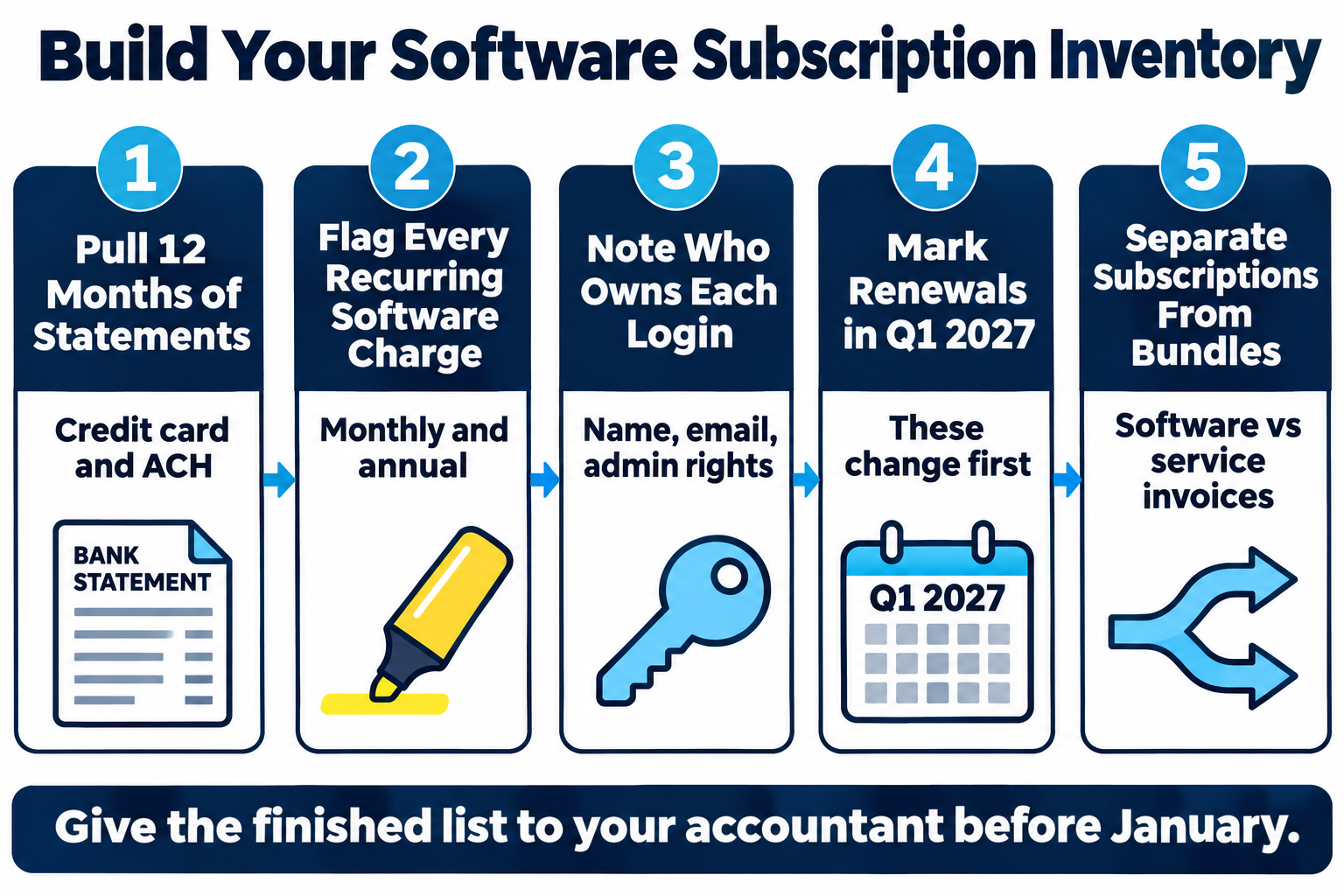
The inventory most offices have never actually done
We run into this constantly. An office manager inherits a pile of auto-renewing subscriptions from whoever handled technology before them, and nobody can say what renews when or who holds the admin account.
One innkeeper in the area reached out after their longtime technology person passed away. They had the login to the wireless controller and no idea what to do with it. That is a common situation, not an unusual one, and we wrote more about it in what happens when your IT person is gone.
The exercise is straightforward:
- Pull twelve months of credit card and ACH statements
- Highlight every recurring charge that looks like software
- Write down the owner of each login and whether anyone else has admin access
- Mark which ones renew in Q1 2027, since those invoices change first
- Separate true subscriptions from software that rides inside a larger service invoice
That last line is the one people skip. If your phone system, backup, and security tools are bundled into a single monthly bill, you cannot tell what portion might be taxed until someone itemizes it.
The details are still being written, and that is worth knowing
Pretending this rule is settled would be inaccurate. CDTFA held a digital products workshop on July 21, 2026, published a discussion paper on September 1, and held a second interested-parties meeting on September 10 while drafting emergency regulations.
At that September meeting, participants kept asking the same thing: where exactly is the line between taxable remotely accessed software and excluded digital infrastructure like cloud storage and AI-enabled tools. The department acknowledged more examples may be needed. Earlier coverage of the July workshop reported the department saying plainly that many issues would get resolved through rulemaking, legal opinions, and eventually litigation. You can follow the official rulemaking activity through CDTFA.
Three questions worth emailing your software vendors before January:
- Will California sales tax appear on our invoice starting with the January 2027 billing cycle?
- How will you itemize software separately from service on bundled invoices?
- How is tax sourced when our staff access the subscription from home or from out of state?
One more goes to your accountant, not your technology provider. A tax question is a CPA question. We can tell you what each subscription is and how it is delivered. We cannot tell you how it should be taxed, and you should be skeptical of any IT company that says otherwise.
Sizing the hit without inventing a number
Nobody should publish a scary figure here, because the tax applies to a slice of technology spend rather than all of it. Combined state and local sales tax rates also vary by city, so a Salinas office, a Carmel inn, and a Watsonville packing operation will not land in the same place.
Do the arithmetic in words. Take your annual prewritten software and SaaS spend, apply your city’s combined rate, and treat the result as a planning estimate your accountant confirms.
Two timing questions deserve attention rather than assumption. Annual prepayments made before January 1 and renewals after it may be treated differently, and the answer could shift what you prepay in December. Ask before you move money.
If your software spend per head is fuzzy to begin with, our breakdown of what IT support costs per employee for a 25-person Salinas office gives you a baseline to work from. The same logic applies to phone systems, which we covered in what businesses get wrong when buying a phone system.
This kind of thing tends to surface early in strategic technology planning work, where systems inventory and budget forecasting are part of the job instead of an afterthought. One local client put the value of that approach plainly in a review: “Adaptive Information Systems created a plan tailored to our size and budget, responds quickly to our requests, and provides peace of mind with reliable system security.”
Frequently Asked Questions About California’s SaaS Sales Tax
Does my Microsoft 365 bill go up on January 1?
Most likely, yes. Microsoft 365 is prewritten software sold to many customers, which is squarely what SB 122 covers. The seat price itself is not changing, but your invoice would pick up your local combined sales tax rate starting with the first 2027 billing cycle. Confirm the exact handling with your vendor and your accountant.
Is software built specifically for my business taxed too?
No. Custom software written for one customer stays exempt under the law as signed. The gray area is software that started custom and has since been sold to other businesses, so get written confirmation from the developer about how they classify it.
If I prepay a year in December, do I skip the tax?
Maybe, and this is one of the better questions to ask early. Prepayments made before January 1 and renewals after it may be treated differently, but the final rules were still being drafted as of fall 2026. Your CPA should make that call before you commit cash.
What about cloud servers and storage?
Proposed CDTFA regulation language would exclude cloud infrastructure that a business uses to run its own applications. That boundary was the single most debated item at the September 2026 interested-parties meeting, and the department said more examples may be needed. Treat it as unsettled.
Can my IT provider tell me what is taxable?
We can tell you what each subscription is, who the vendor is, how it is delivered, and whether it is bundled with a service. The taxability determination belongs to your accountant. The most useful thing a technology partner does here is hand your CPA a clean, current inventory so they are not guessing.
Planning your 2027 technology budget?
If you want a second set of eyes on your software inventory before the 2027 budget is locked, our team at 380 Main St. in Salinas works with businesses across Monterey County on exactly that kind of planning. Reach Adaptive Information Systems at (831) 644-0300 or adaptiveis.net.