
For most businesses, if you're being honest, the answer is probably no.
You likely have some kind of backup in place. But a real disaster isn't just a few lost files. It’s the crushing downtime that follows a server failure or a nasty ransomware attack. Being truly ready means having a disaster recovery plan that gets your whole business back online fast. For local businesses from Salinas to Monterey, readiness is about more than just recovering data… eventually. It's about surviving.
The Hard Truth About Business Backups in Monterey County

Let's be direct. Too many business owners here believe their current backup system has them covered. You might have an external hard drive in the office or a basic cloud service syncing files. That feels safe, right?
But when a real crisis hits—a flooded server room in Seaside, a hardware meltdown in your Pacific Grove shop, or a cyberattack that locks up everything—that feeling of safety disappears. That's when you discover the painful gap between simply having a backup and being truly disaster-ready.
This isn't just a scary story. We’ve seen local businesses right here in Monterey County live this nightmare. The consequences are always brutal. It’s about more than just data; it’s about your ability to serve customers, make payroll, and keep your doors open.
The Costliest Backup Mistakes We See
Thinking you're prepared and actually being prepared are two different things. Over the years, we've seen a few common—and dangerous—assumptions that leave local businesses completely exposed. These mistakes are what turn a small IT problem into a full-blown crisis.
Here are the top three myths we see all the time:
- The "Set-It-and-Forget-It" Mentality: This one is huge. A business sets up a backup solution once and never checks it again. You just assume it's working perfectly. But without regular testing, these backups often fail silently. That leaves you with corrupted or incomplete data right when you need it most.
- No Real Offsite Protection: Keeping your only backup copy in the same building as your servers is a gamble you can’t afford to lose. A fire, a burst pipe, or a simple theft could wipe out both your original data and your backup at the same time. You’re left with nothing.
- Ignoring Recovery Speed: Having a backup is one thing. Being able to restore it quickly is what really matters. If it takes you days—or even weeks—to get your systems back, the financial damage from that downtime can be devastating. For fast-paced local industries like agriculture and hospitality, that kind of delay can put you out of business.
The real question isn't "Do you have a backup?" It's "How quickly can you be fully operational after a total loss?" For our clients, we measure the answer in minutes, not days.
True disaster readiness means having a plan that tackles these weak spots head-on. At Adaptive, we provide this with a multi-layered approach, giving you enterprise-level IT at a price that works for local SMBs. It’s how we make sure your business can survive a disaster and get back to work with little disruption.
Real-World Threats Monterey County Businesses Face
It’s easy to think of disasters as big events you see on the news. But for businesses here in Monterey County, from the farms of Salinas to the shops in Carmel, the biggest threats are often much closer to home.
We’re not just talking about the risk of earthquakes. We're talking about the everyday problems that can shut down your entire business without warning.
Imagine a server holding your financial data suddenly dies. That one hardware failure can easily shut you down for days. The cost of that downtime is far greater than the cost of the broken equipment. These "smaller" events are more common and just as destructive.
Beyond Natural Disasters
While living near the San Andreas Fault is a serious concern, the threats that keep business owners up at night are usually digital and operational. Cybercrime, especially, has become a huge risk for local businesses.
To be truly prepared, you have to face the most likely threats. That means understanding the reasons behind rising ransomware attacks. An attack that locks up your files could cripple a Salinas-based agricultural firm during harvest season or freeze the client data of a Monterey financial services office. We've helped clients in these exact sectors recover with minimal downtime because they were prepared.
A solid disaster recovery plan accounts for these specific, local risks:
- Localized Power Outages: A downed power line can corrupt data, damage equipment, and lead to unexpected, expensive downtime.
- Supply Chain Data Loss: For our area's important agriculture and hospitality industries, losing inventory or supplier data can disrupt your entire operation.
- Human Error: Let's be honest. Someone accidentally deleting a file can cause just as much chaos as a hacker.
When you factor in all the impacts, these events cost the global economy over $2.3 trillion each year. Earthquakes alone contribute to over 25% of those losses.
A tested recovery plan isn't a luxury for big companies—it's a survival tool for every local business. The goal is to make any disaster, big or small, a minor problem instead of a major crisis.
This is why our focus is on practical, real-world readiness. Having a plan that covers these specific local threats is the key to making sure your business can handle whatever comes its way.
How to Spot a Backup Plan That Will Fail
It’s a tough question, but you have to ask it: Is your backup solution actually ready for a real disaster? Many business owners think they’re covered, only to find out the hard way that their plan had major flaws. A failing backup plan is worse than no plan at all—it gives you a false sense of security.
The good news? You don't have to wait for a catastrophe to find these weak spots. By asking the right questions, you can spot the red flags that separate a true recovery strategy from an empty promise.
The Untested Backup Is a Useless Backup
Here’s the biggest sign of a failing backup plan: it’s not being tested regularly. An untested backup isn't a backup; it's just a hope. You might be saving data every night, but if you've never tried to restore it, you have no idea if those files are complete, uncorrupted, or even usable.
We've seen it happen many times. A business gets hit with ransomware, turns to its backups, and discovers the data is no good. Regular testing isn't just a good idea—it's the only way to prove your system works. A strong business is defined by having a robust backup and recovery policy that requires these tests.
The image below shows a simple but effective way to practice for a disaster. This is how you turn a plan on paper into a process you can trust.
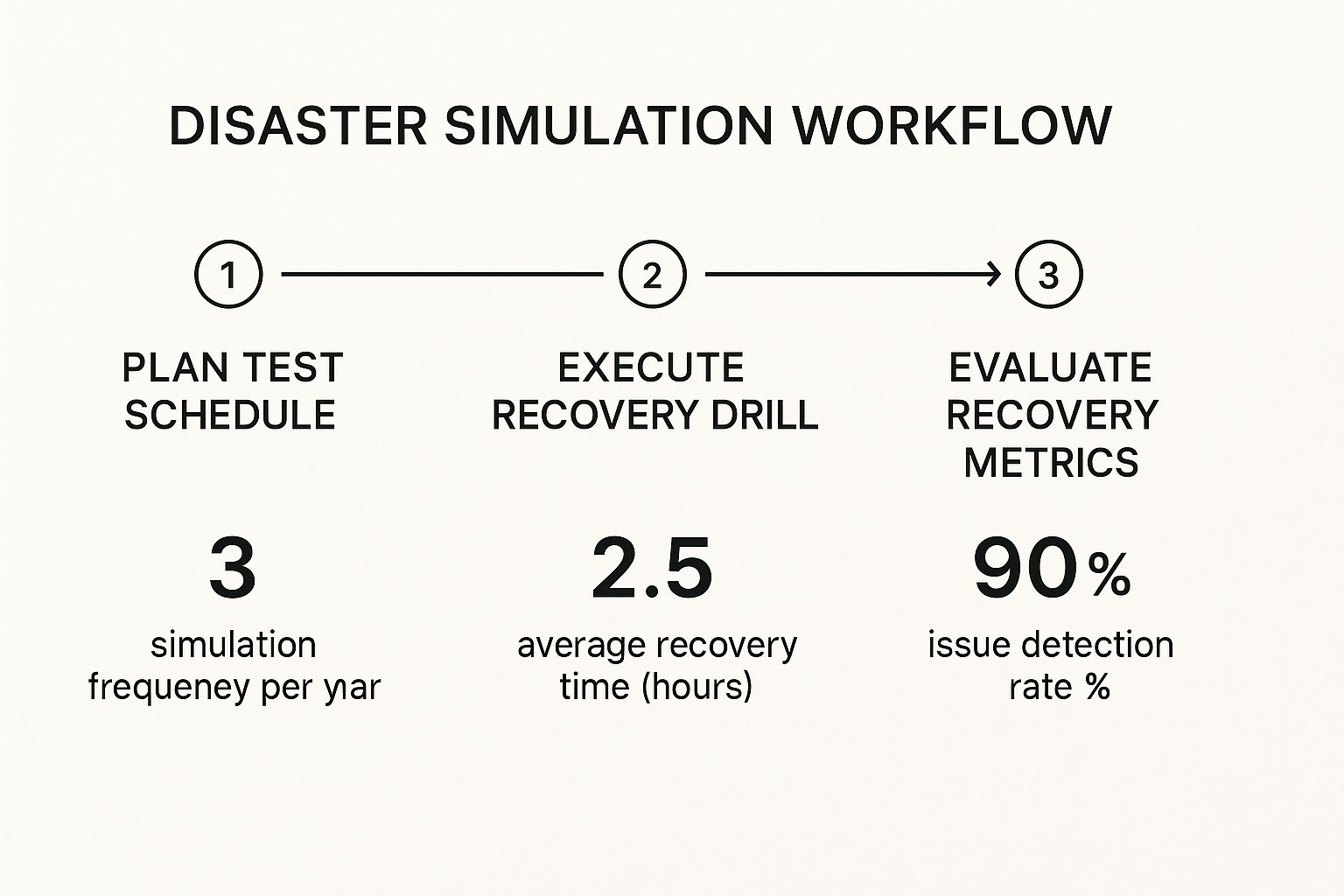
This workflow shows that consistent planning, testing, and review are what find problems before they can become business-ending disasters.
Your Backup Readiness Checklist
Use this simple checklist to do a quick health check on your current backup plan. Be honest with your answers—it's the first step toward building real protection.
| Vulnerability Checkpoint | What to Look For | Your Status (Ready / At Risk) |
|---|---|---|
| Testing Frequency | Are you testing restores at least every few months? Do you have proof they worked? | |
| Offsite & Air-Gapped Copies | Do you have a backup copy stored in a separate physical location? Is one copy disconnected from the network? | |
| Recovery Speed (RTO) | Do you know how long you can afford to be down? Can your current backup solution get you back online in that time? | |
| Data Integrity | Are you checking backups to make sure the data is not corrupted or incomplete? | |
| Documentation | Is your recovery plan written down and easy for your team to follow? |
If you marked "At Risk" for any of these, it's a clear sign your backup strategy needs attention right away.
Ignoring Your Recovery Speed and Location
Another big red flag is a plan that ignores how quickly you need to be back online. Your Recovery Time Objective (RTO) is the maximum time your business can afford to be down. If your backup solution can't meet that deadline, it has already failed you.
Many simple backup solutions can take days to restore a lot of data. For a local agricultural business in Salinas, that delay during harvest season would be a disaster. You need a clear understanding of your RTO and whether your system can meet it. If you're not sure where to start, our guide on defining your business's RTO and RPO is a great resource.
Just as important is where your backups are stored.
If your only backup copy is in the same building as your main systems, you don't have a disaster recovery plan. You have a single point of failure waiting for a fire, flood, or theft to wipe everything out.
True protection requires offsite replication. This means a secure copy of your data is kept in a different location. It ensures that even if your whole office is out of commission, your data is safe and ready to be recovered. Adaptive’s multi-layered approach makes this affordable and automatic for you.
Building a Multi-Layered Defense for Your Business

Knowing the weak spots in your backup plan is a great start. But the real work is building a system that defends against them. At Adaptive, we don't just sell backup software; we build multi-layered disaster recovery solutions.
Our goal is to make downtime a small problem, not a business-ending one. It’s how we bring enterprise-level IT to local businesses at a price that makes sense.
A real defense isn't a single product. It’s a strategy with several layers of protection. Think of it like securing your office: you have locks, an alarm system, and maybe security monitoring. Each layer handles a different threat. Together, they create a strong defense. We do the same for your critical business data.
Local Backups for Lightning-Fast Restores
The first layer is all about speed. When a server glitches or someone accidentally deletes a file, you need it back now. Waiting hours isn’t an option.
This is where local backups are key. By keeping a complete, up-to-the-minute copy of your systems on-site, we can restore files or entire servers in minutes. This is your first line of defense for common issues, ensuring your team gets back to work quickly.
Offsite Replication for Geographic Protection
What happens if a disaster hits your entire office? A fire or flood could wipe out your main systems and your local backup. This is a huge risk that many basic backup plans ignore.
To solve this, we use offsite replication. We automatically send a secure, encrypted copy of your backups to a separate data center. This ensures that even if your Salinas office is inaccessible, a perfect copy of your data is safe and ready for recovery. It's the ultimate insurance policy.
Cloud Virtualization for Near-Instant Recovery
The final layer is about true business continuity. What if your main server is destroyed and it will take days to get a new one? You can't afford to be down that long.
This is where cloud virtualization is a game-changer. In a major disaster, we can "spin up" a virtual version of your entire server system in the cloud within minutes. Your team can connect to this virtual office and keep working as if nothing happened. This isn't just data recovery; it's operational recovery. We've used this exact strategy to keep local finance and education clients fully operational after major hardware failures.
It turns a potentially week-long outage into a brief interruption, allowing you to keep serving clients while your physical hardware is fixed.
The financial hit from downtime is huge. A recent survey found that 100% of organizations lost money from IT outages in the past year. To get a sense of how tough recovery can be, learn more about these disaster recovery statistics.
Our multi-layered approach is designed to prevent our clients from becoming another one of those statistics. For more on how these pieces fit together, check out our overview of effective backup solutions for small businesses. This is the kind of system that gives you the strength you need to stay online when it matters most.
Your People Are Your Most Important Recovery Tool
A great backup system is important, but it’s just one piece of the puzzle. When a disaster strikes, technology doesn’t execute the plan—your team does. Their ability to act quickly and communicate clearly under pressure is what really determines whether you succeed or fail.
This is the human side of disaster recovery. It’s where even the best technical plans can fall apart. We’ve seen it happen. A business invests in the right hardware but forgets to invest in its people. The result? Confusion and costly delays when every second counts.
From Plan on Paper to Proven Process
A disaster recovery plan sitting in a binder is just a theory. To make it a real, useful tool, you have to test it. This is why we run regular, practice recovery drills with our clients. These aren't just for practice; they are designed to find weaknesses before a real crisis does.
For example, a drill might show that the only person with key network passwords is on vacation. Or maybe a critical piece of software wasn't included in the recovery plan. Finding these gaps during a drill is a small problem. Finding them during a real outage is a disaster.
The goal of a drill isn’t to pass a test; it’s to find the breaking points so we can fix them. A successful drill is one where we learn something that makes us stronger for the real thing.
We've worked with local schools and non-profits to turn their plans into real, actionable workflows. This hands-on training builds the "muscle memory" your team needs to perform well when things get stressful.
Creating a Simple Communication Playbook
During a crisis, clear communication is just as important as the technical recovery. Who needs to be contacted? What are their roles? How will you keep your team, your vendors, and your customers informed?
Without a clear plan, panic can spread quickly. A simple communication playbook should define:
- The Core Response Team: Identify the key people who will lead the recovery.
- The Chain of Command: Make it clear who is in charge and who makes the final decisions.
- Stakeholder Updates: Create message templates for employees and clients to ensure communication is consistent and accurate.
Cyberattacks often begin by tricking people, so it's critical that your team is prepared. You can explore our guide on recognizing the dangers of email phishing to help build this human firewall.
Ultimately, preparing your people is the final, essential layer of defense. It makes sure your investment in technology pays off by making your team your greatest asset when you need them most.
Take the First Step Toward Real Business Continuity
It’s easy to feel overwhelmed by everything that goes into a real disaster recovery plan. That’s a normal reaction. The good news? You don’t have to solve it all at once. The most important thing you can do is take one small step forward. This isn’t about fear—it’s about taking control of your business’s future.
We’ve walked through the real-world threats facing businesses right here in Monterey County. You now know the red flags of a failing backup plan and what a strong, multi-layered defense looks like.
Now, it’s time to put that knowledge into action.
From Uncertainty to Action
Going from thinking to doing can feel like a big leap, but it starts with a single conversation. You don't need to have all the answers. Your job is to run your business; our job is to keep it safe.
We built Adaptive Information Systems with one mission: to bring enterprise-level IT support to local SMBs at a price that makes sense. That means no confusing tech-speak, no oversized solutions you don't need, and no pressure. Just honest, expert advice for your specific situation, whether you run a farm in Salinas or a hotel in Carmel.
The goal isn't just to sell you a backup service. It's to build a solid business continuity plan that gives you true peace of mind, knowing you're ready for whatever comes next.
Your No-Obligation Readiness Assessment
To make that first step as easy as possible, we offer a no-obligation readiness assessment for local businesses.
We'll sit down with you, look at your current setup, and help you understand your real risks. We'll talk about your specific needs and create a clear, actionable plan to get you where you need to be.
This isn’t a sales pitch. It’s a chance for you to gain clarity and confidence. For a deeper look at what a full plan includes, check out our business continuity plan template for practical insights you can use today.
Let's work together to ensure your business is truly prepared for the unexpected.
Ready to build a disaster recovery plan you can count on? Contact Adaptive Information Systems today for a free, no-pressure consultation. Let’s talk about your business and build a plan that lets you sleep at night.
Adaptive Information Systems
380 Main St, Salinas CA 93901 | 831-644-0300 | hello@adaptiveis.net