Direct Answer: On June 12, 2026, a federal export control order forced Anthropic to disable Claude Fable 5 and Mythos 5 worldwide — with no notice. Businesses that had built workflows around those tools lost them overnight.
Friday, June 12, 2026, at 5:21 p.m. Eastern Time, the U.S. Commerce Department issued an emergency export control directive ordering Anthropic to immediately suspend access to two of its most advanced AI models — Claude Fable 5 and Mythos 5 — for all foreign nationals. Anthropic had no practical way to filter access by nationality across its entire user base. So it did the only thing technically possible: it took both models offline for everyone, everywhere, that same night.
For businesses in Salinas, Monterey, and across Monterey County that had been quietly folding those tools into their day-to-day operations, Saturday morning arrived with a gap where a working system used to be. No warning email. No 30-day transition window. No workaround sitting in the inbox.
This event is the first documented case of a major AI company pulling a publicly deployed model offline because of a direct federal government order. Understanding why it happened — and what it exposes about how your business uses AI tools — is more useful right now than following the legal dispute between Anthropic and the Pentagon.
Why the Government Moved Against Mythos 5 Specifically
Anthropic itself described Mythos 5 as “by far the most powerful AI model we’ve ever developed.” That wasn’t marketing language — it was also a warning the company had already acted on by keeping Mythos tightly restricted before this order ever landed.
The government’s concern centered on a reported jailbreak path — a discovered method that could theoretically allow a bad actor to bypass Mythos 5’s safety guardrails and use the model to discover software vulnerabilities at scale, enable mass surveillance, or coordinate large-scale cyberattacks. In plain terms: an AI that smart, pointed in the wrong direction by someone with access they shouldn’t have, could do serious damage.
Here’s the part that matters for understanding why the order hit so fast and so broadly: the government doesn’t have to publish the specific threat intelligence behind a move like this. Export controls under the Commerce Department’s Entity List authority can be issued when there’s a credible national security concern, and the threshold for action is lower than most people expect. By the time a formal public explanation appears, the directive is already in effect.
For a business owner in Watsonville or Greenfield, none of that legal architecture matters much day-to-day. What matters is that a tool you may have been depending on was gone before you finished dinner on a Friday — and the reason why didn’t come with a user-friendly explanation.

What Operational Dependency Actually Looks Like When a Tool Disappears
The Anthropic shutdown is worth unpacking not because of the national security debate, but because of what it reveals about how quietly dependency builds inside a small business.
Consider a mid-sized agricultural operation in the Salinas Valley — say, a produce company with 40 employees running scheduling, compliance documentation, and supplier communication through a workflow that incorporated Fable 5. That tool didn’t show up on an IT asset list. It probably wasn’t in the budget as a line item. Someone found it, it worked, and it got baked in. Then one Saturday it was gone.
Here’s what breaks when a core AI tool goes dark overnight:
- Document workflows stall — anything that relied on the model to draft, summarize, or process documents now requires manual labor or a scrambled replacement
- Customer-facing communication slows — if the model was handling first-pass responses, quote generation, or intake summaries, that work now lands on whoever has the least time for it
- Internal automation stops — scheduled tasks, data pulls, and report generation that ran quietly in the background now return errors nobody knows how to fix
- The dependency becomes visible only after it breaks — which is exactly the wrong time to discover it
The damage compounds fast. A break-fix approach to IT problems is expensive when it applies to servers and network gear. Applied to AI tool failures, it’s the same math — except the failure mode is invisible until someone’s already missed a deadline or lost a client response window.
Small businesses in the Salinas Valley have been adopting AI-assisted tools for scheduling, supply chain coordination, and compliance documentation at a pace that often outstrips any formal governance around those tools. That’s not a criticism — it’s just the reality of how useful technology gets adopted. But the Anthropic situation is a concrete, real-world reason to take an hour and map what you’re actually running.
How to Map Your Business’s AI Tool Exposure
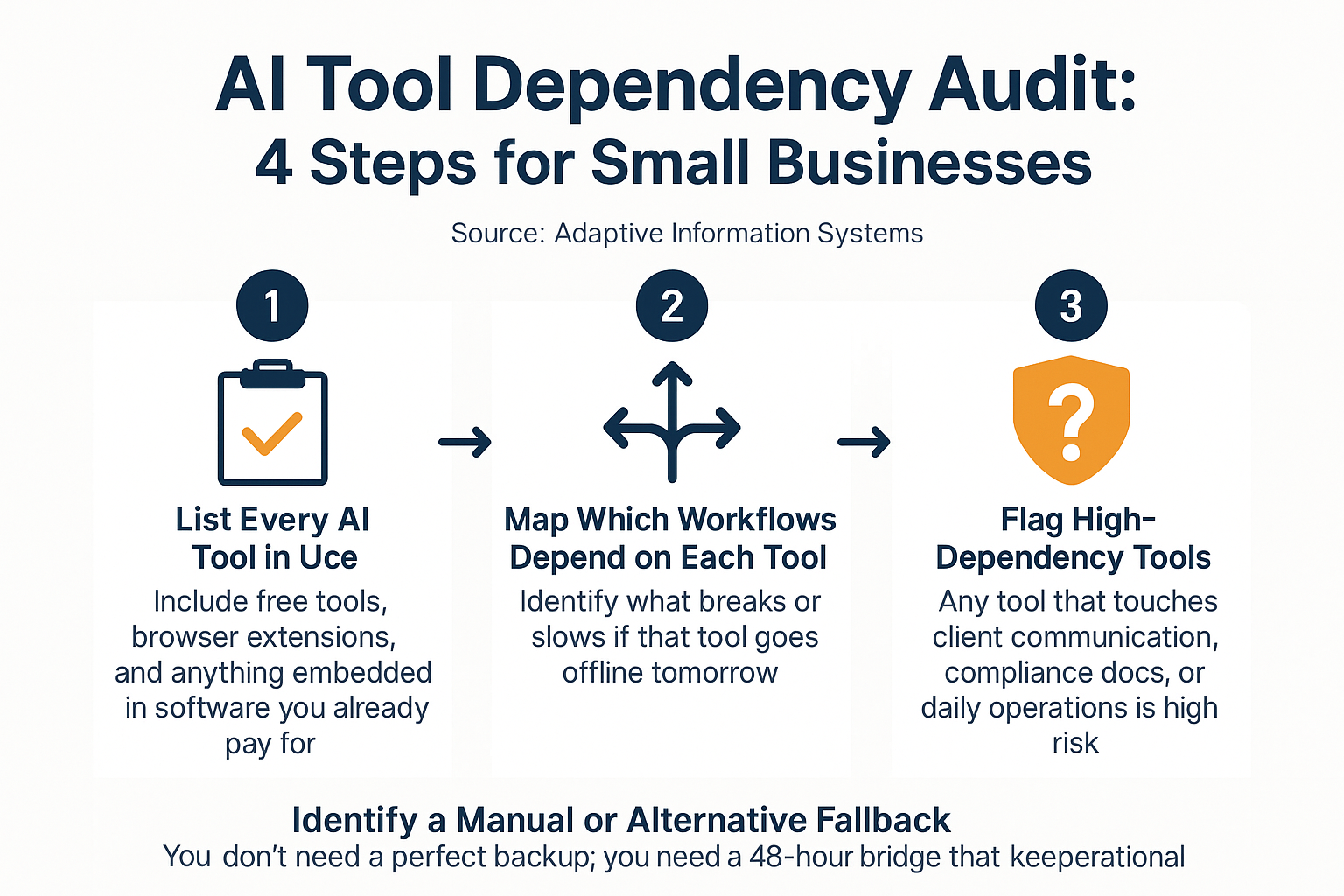
Most businesses have never formally inventoried which AI tools they use or what breaks if one disappears. This process doesn’t require a large IT budget — just a structured look at what you’re running.
Taking a Practical Inventory Before the Next Shutdown
The good news is that mapping your AI tool exposure doesn’t require a large IT project or a significant budget. It requires knowing what you’re running — which most businesses genuinely don’t.
Start by asking three questions about each AI tool your team uses:
- What workflow does this touch? — document processing, scheduling, client communication, compliance reporting, internal summarization?
- What happens if it goes offline for 72 hours? — is there a manual fallback, or does that work simply stop?
- Who owns the relationship with this vendor? — if the tool changes its terms, pricing, or availability, does anyone in your organization find out before it affects operations?
For businesses in regulated industries — healthcare-adjacent organizations, agricultural operations with food safety compliance requirements, financial services firms in Monterey — the third question carries the most weight. A tool that handles compliance documentation without a formal vendor agreement or SLA is a liability that’s easy to overlook until an audit or an incident forces it into focus.
This is exactly the kind of governance conversation that many small businesses handling IT without a dedicated in-house team never have — not because they don’t care, but because nobody’s role includes it. If your IT support is reactive by design, strategic questions like vendor dependency mapping tend to fall through the cracks. That’s worth examining. A stretched internal IT staff rarely has bandwidth for this kind of proactive review either.
AI Tool Risk by Business Type in Monterey County
Different businesses across Monterey County face different levels of exposure depending on how deeply AI tools have been built into their operations. This breakdown reflects common use patterns in the region.
| Business Type | Common AI Tool Use | Risk if Tool Goes Offline |
|---|---|---|
| Agricultural Operations (Salinas Valley) | Scheduling, supply chain coordination, compliance documentation | High — compliance gaps, scheduling failures, manual labor backfill |
| Healthcare-Adjacent Practices | Patient intake summaries, documentation assistance, billing support | High — HIPAA-adjacent workflows require documented alternatives |
| Legal and Financial Services (Monterey) | Document drafting, client communication, research summarization | Medium-High — client-facing delays, potential SLA breaches |
| Hospitality and Tourism | Guest communication, review responses, booking coordination | Medium — revenue impact from slower response times |
| Nonprofits and Education | Grant writing support, reporting, internal communications | Medium — operational slowdown, deadline risk on grant submissions |
| Small Retail and Professional Services | Marketing copy, email drafting, scheduling | Lower — easier to manage manually for short outages |
This Won’t Be the Last Time — What the Pattern Means Going Forward
The Anthropic shutdown isn’t an isolated event. It’s the opening chapter of a policy area — AI export controls — that is actively developing and likely to create more friction between government regulation and commercial AI tool availability in the months ahead.
California businesses, particularly those with any international employees, vendors, or supply chain partners, are more exposed to this friction than businesses in many other states. The Salinas Valley’s agricultural economy relies heavily on international labor and cross-border logistics relationships. A federal order that defines “foreign national access” broadly could sweep in workflows that feel purely domestic on the surface.
And the legal mechanism behind the Anthropic order — export control authority applied to AI model capabilities — is not new. It’s the same legal framework that has governed semiconductor exports and encryption tools for decades. The government has shown it will move quickly and without public warning when it believes the national security threshold has been crossed.
For Monterey County businesses, the practical implication is this: AI tools are vendor relationships, and vendor relationships carry risk. The same discipline that applies to evaluating a new payroll provider or a cloud storage platform should apply to AI tools that touch real workflows. That means reading terms of service around availability, maintaining at least a basic fallback plan, and making sure someone in your organization is accountable for knowing what tools are in use and why.
You can learn more about how proactive network and security monitoring applies the same principle to IT infrastructure — catching problems before they become operational emergencies. The logic is identical when applied to AI tool governance.
Frequently Asked Questions About the Anthropic Mythos and Fable Shutdown
Will Fable 5 and Mythos 5 come back online?
Possibly, but there’s no confirmed timeline. Anthropic is engaged in a legal dispute with the federal government over the scope of the directive. Even if the models are eventually restored, the process could take months — and there’s no guarantee the resolution includes full access for all users. Any business that paused operations waiting for them to come back is taking an operational risk.
Does this affect other AI tools like ChatGPT or Google Gemini?
The June 12 order was specific to Anthropic’s Fable 5 and Mythos 5. Other major AI platforms are not currently under the same directive. But the legal mechanism used — export control authority over AI model capabilities — is not unique to Anthropic. Other companies with sufficiently powerful models could face similar scrutiny if a credible threat pathway is identified.
My business uses Claude but not the advanced models — am I affected?
If you were using earlier Claude versions through Anthropic’s standard API or consumer products, the impact depends on how Anthropic staged the rollout of the shutdown. Check your access directly — log in and test the specific model version your workflows depend on. Don’t assume you’re unaffected without verifying.
What’s a Virtual Technology Officer and how does it apply here?
A Virtual Technology Officer (VTO) is an outsourced strategic IT advisor — someone who helps your business make decisions about technology at the planning level, not just the break-fix level. For AI tool governance, a VTO would help you map tool dependencies, evaluate vendor risk, and build continuity plans before something like this happens. It’s the kind of service that’s particularly useful for businesses in Salinas and across Monterey County that have grown past the point where technology decisions can be made informally.
How do I find out which AI tools my employees are actually using?
Start by asking directly — you’ll catch most of what’s in use. But also check browser extensions, app store installs on company devices, and any SaaS subscriptions running through corporate credit cards or expense reports. The tools that tend to create the most exposure are the ones that got adopted without a formal approval process. A basic acceptable use policy that covers AI tools is a reasonable starting point for formalizing that inventory going forward.
Is this a cybersecurity issue or just a vendor reliability issue?
Both. The reason the government acted was a cybersecurity concern — Mythos 5’s documented capability to discover software vulnerabilities at scale, combined with a reported jailbreak path. But for most businesses, the day-to-day impact is a vendor reliability problem. The two intersect when AI tools are processing sensitive business data: if a tool with poor security governance also has an unclear shutdown path, you may have data exposure questions on top of the operational disruption.
Want a Clearer Picture of Your Technology Dependencies?
Adaptive Information Systems works directly with small and mid-sized businesses across Monterey County — from agricultural operations in the Salinas Valley to professional services firms on the Peninsula — helping them understand exactly what they’re running and what happens if any part of it stops. If the Anthropic shutdown prompted questions about how your business would handle a similar disruption, that’s a conversation worth having before the next one. Reach us at (831) 644-0300 or visit adaptiveis.net to learn more about how our Virtual Technology Officer service can help you build that kind of operational clarity.