
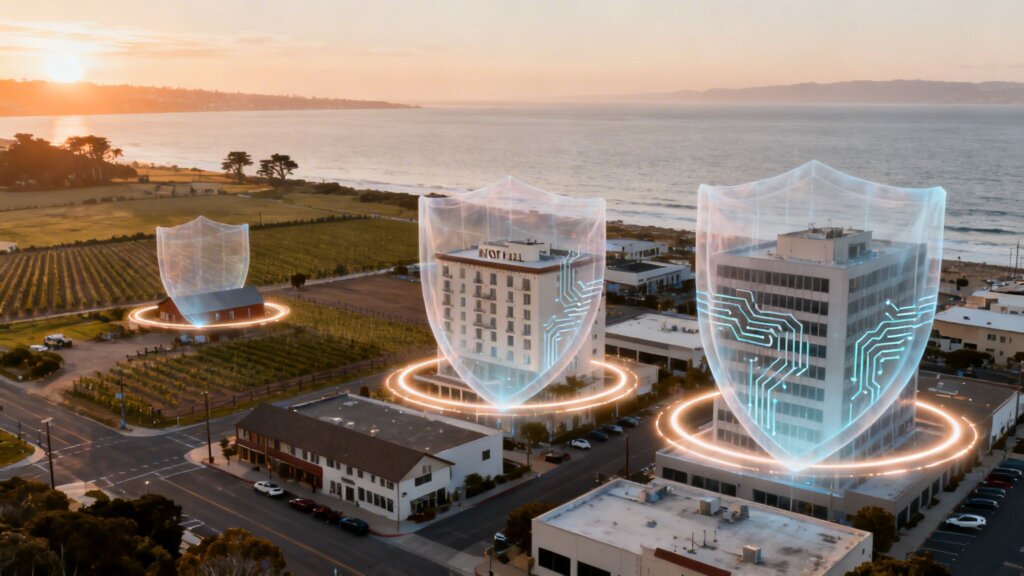
If you own a business in Salinas or anywhere across Monterey Bay, you’ve probably heard the standard advice: get a good firewall and some antivirus software, and you're secure. Today, that advice is dangerously out of date and ignores the realities of running a small business here.
Real cybersecurity for your local business means going beyond firewalls. It means building a smart defense plan that understands local threats, respects your budget, and protects what you’ve worked so hard to build. That’s how we deliver on our mission of “enterprise-level IT at an affordable price for local SMBs.”
Why Your Firewall Is Not Enough for Monterey Bay Cybersecurity

For a long time, the security playbook for local businesses was simple: install a firewall, run antivirus, and call it a day. But today's cyber threats are designed to slip right past those basic defenses.
This old advice is a generic checklist that misses the specific risks facing our community. IT providers often fail to address how cybersecurity actually works for a small local business. They skip local threat patterns, ignore your resource limits, and don’t explain how things like compliance or ransomware hit specific sectors like Salinas Valley agriculture or Carmel’s hospitality industry.
The New Reality of Cyber Threats
Cybercriminals don't just knock on the front door anymore. They look for unlocked side windows or trick your employees into letting them in. Your firewall can’t stop a threat that an employee clicks on in an email or one that uses deception to get inside.
The numbers show a clear danger for business owners like you.
A recent study found that 47% of small firms were hit by ransomware last year. Even more alarming, 75% of them couldn't continue operating afterward.
For the agriculture, hospitality, and professional services firms that are the backbone of Monterey Bay, these aren't just statistics. They are a real threat to your business. This demands more than passive protection—it requires an active, region-aware strategy.
Old vs. Modern Cybersecurity Approach
This chart shows why relying on just a firewall is an old strategy and what a modern, multi-layered approach includes for your business.
| Security Element | Firewall-Only Approach (The Old Way) | Modern Cybersecurity (The Right Way) |
|---|---|---|
| Network Security | A single firewall at the edge of the network. | Firewall plus internal network segmentation and intrusion detection. |
| Email Security | Basic spam filtering, if any. | Advanced threat protection that blocks phishing, malware, and impersonation attempts. |
| Device Security | Basic antivirus on desktops only. | Endpoint Detection and Response (EDR) on all devices (laptops, servers, phones). |
| Threat Management | Reactive—cleans up after an infection is found. | Proactive 24/7 monitoring and threat hunting to stop attacks before they cause damage. |
| Human Element | Employees are seen as the weakest link. | Ongoing employee security training turns your team into a line of defense. |
| Data Protection | Relies on users to manually back up files. | Automated, tested backup and disaster recovery plan for business continuity. |
The takeaway is clear: the old "set-it-and-forget-it" method leaves you exposed. A modern approach actively protects your business from every angle.
From a Single Wall to a Layered Fortress
True cybersecurity today is all about “defense-in-depth.” Think of it like securing a building. Your firewall is the outer wall, but you also need locks on individual doors, security cameras, and a monitored alarm. Each layer provides backup protection if another one fails.
This modern approach adds key defenses a firewall alone can't offer:
- Advanced Email Security: Blocks the tricky phishing scams designed to fool your team.
- Endpoint Protection: Secures every device—laptops, phones, tablets—that connects to your network.
- 24/7 Monitoring: Actively hunts for suspicious activity and stops threats before they can lock up your files.
- Employee Training: Turns your team from a risk into your first line of defense.
When security is tailored to your business and industry, you avoid overpaying for tools you don’t need—and protect the assets that actually matter. With expert monitoring and real risk mitigation, you don’t just check boxes—you stay operational and insurable. To see how a partnership can transform your IT, you might be interested in exploring what managed IT support services in Monterey can do for you.
The Evolving Threats Targeting Salinas and Monterey Businesses
Today’s cyberattacks are far more advanced than the clumsy scams of the past. Using artificial intelligence (AI), criminals now create attacks so convincing they can fool your sharpest employees. They aren't just rattling the gates; they're getting invited inside.
For businesses here in Salinas, Monterey, and across the bay, this means the old "set it and forget it" approach to security is a recipe for disaster. You have to understand the specific threats trying to get into your company.
More Than Just Spam: Phishing and Ransomware
Remember old-school spam? It was like digital junk mail—easy to spot. Modern phishing is completely different. It’s like a criminal showing up in a flawless delivery driver uniform, using a trusted appearance to trick your receptionist into giving them access.
Today's phishing emails look identical to messages from your bank, a key vendor, or even your own CEO. Their goal is to convince someone on your team to click a bad link, open a malicious attachment, or give up their password.
Once they're in, the damage can be huge:
- Ransomware: This is like an attacker changing the locks on your entire building and demanding a fortune for the new key. For a Salinas ag-tech firm, an attack during harvest could grind business to a halt.
- Business Email Compromise (BEC): A criminal gains access to an executive's email, learns how they talk, and then impersonates them to trick your finance team into wiring money to a fraudulent account.
- Data Theft: Imagine a phishing scam that tricks your front desk staff at a Carmel hotel. The goal? To steal booking information and sensitive guest credit card data, leading to massive fines and shattering your reputation.
The AI-Powered Threat Accelerator
The reason these attacks are so effective is AI. In fact, 83% of SMBs say AI has raised the cybersecurity threat level. Attackers are using it to launch campaigns at a scale that was once unimaginable.
Today, AI helps criminals send over 3.4 billion phishing emails every single day. These attacks aren't just more convincing; they can adapt on the fly, making them much harder for basic security filters to catch.
This isn't about fear; it’s about understanding the modern battlefield. Recognizing how these threats work is the first step toward building a defense that actually works. A proper cybersecurity risk assessment is the best way to understand the specific risks your business faces.
Why Local Monterey Bay Industries Are Prime Targets
Cybercriminals know which industries in our region handle the most valuable data. They aren't casting a wide net; they're aiming their spears.
- Agriculture: Ag-tech companies in the Salinas Valley depend on sensors, drones, and automated systems. A single breach could corrupt vital crop data or halt operations during a critical harvest.
- Hospitality: Hotels and restaurants in Monterey and Pacific Grove are goldmines for data thieves. They process a huge volume of credit card transactions and guest information.
- Education: Our local school districts in places like Seaside and Marina are responsible for sensitive student and faculty data. Phishing threats are constantly evolving to target faculty with access to these systems, creating major privacy risks.
These attacks are tailored to exploit your industry's unique operations. Protecting your business requires a security strategy built on a deep understanding of real-world, local risks. You can read more about why SMBs need smarter network security in our detailed article.
Building a Multi-Layered Security Plan for Your Business
Think about securing your office. A strong firewall is like the main gate—it’s your essential first line of defense. But real security doesn't stop there. What about individual office door locks, security cameras, or a monitored alarm? This is the core idea behind defense-in-depth.
If an attacker gets past your first wall, another layer of security needs to be there to stop them. This is how you build a strong defense that works for a small business. It’s not about buying the most expensive tools; it’s about creating a smart, layered plan that tackles real-world threats without breaking your budget.
This diagram shows how attackers are now using AI to power more sophisticated phishing and ransomware campaigns.

The key takeaway is that attacks are complex and interconnected. They demand more than a single wall to keep them out.
Your First Line of Defense Beyond the Firewall
While your firewall guards the network’s edge, many of today’s biggest threats are designed to sidestep it. They often come straight for your employees. That's why your plan must include layers that protect your people, their accounts, and the devices they use.
Here are the essential pieces every Monterey Bay business should have:
- Multi-Factor Authentication (MFA): This is one of the most effective security steps you can take. Think of it like needing both a keycard and a PIN to get into a secure room. Even if a hacker steals a password, they’re still locked out without that second code from the user's phone.
- Advanced Email Filtering: Since most cyberattacks start with a phishing email, basic spam filters aren't enough. You need a modern solution that can spot and block bad links and fake attachments before they reach your team.
- Endpoint Protection: Every device that connects to your business data—laptops, desktops, and even smartphones—is an "endpoint." Modern endpoint protection goes beyond traditional antivirus to actively hunt for suspicious behavior and stop threats like ransomware.
The Human Layer: Security Awareness Training
Technology alone is not enough. Your employees are on the front lines every day. They can be your biggest weakness or your strongest defense. This is where security awareness training becomes critical.
A well-trained team is a human firewall. By teaching employees how to spot and report suspicious emails, you empower them to become an active part of your defense.
Effective training is not a one-time event. It should be an ongoing program with regular, short lessons and practice phishing tests. This keeps security top-of-mind and ensures your team can identify the latest scams.
This layered approach is the foundation of the Zero Trust security model, a modern strategy built on the principle of "never trust, always verify." You can dive deeper into this concept by checking out our guide on how to implement Zero Trust security.
By building multiple layers of defense, you create a security plan where one failure doesn't lead to a disaster. This is how you get real protection at a price that makes sense for a local business.
Protecting Your Most Valuable Asset: Your Data
For any business here in Monterey Bay, whether you’re a law firm in Monterey or an agricultural producer in Salinas, your data is your most critical asset. It’s your client lists, financial records, and operational plans.
Now, ask yourself: what would happen if it all vanished tomorrow?
A server crash, a fire, or a ransomware attack could wipe it all out in an instant. The statistics are sobering: a staggering 47% of small firms were hit by ransomware last year. The aftermath is even more devastating, with 75% of those businesses unable to continue operating. This isn't just an IT problem; it's a business survival issue.
The Difference Between Backup and Business Survival
Many business owners think, "I have a backup, so I'm covered." But a simple data backup is not the same as a true Backup and Disaster Recovery (BDR) plan. A backup is just a copy of your files. A BDR plan is a complete, tested strategy to get your entire business back up and running fast.
A BDR plan doesn't just ask, "Are my files saved?" It answers the question, "How fast can we get back to serving customers if our main systems go down?"
This difference is critical, not just for staying open but for staying insurable. Cyber insurance providers want to see a tested, workable recovery plan, not just a backup drive in a closet.
The 3-2-1 Rule of Modern Data Protection
A great rule for building a strong backup strategy is the 3-2-1 Rule. It's a simple framework that protects your data from almost any single point of failure.
Here’s how it works:
- Three Copies of Your Data: Keep three separate copies of your data (your main "live" data plus at least two backups).
- Two Different Media Types: Store your backup copies on at least two different types of storage, like a local device and the cloud.
- One Copy Offsite: At least one backup copy must be stored offsite. This protects you from a fire, flood, or theft at your Salinas or Monterey office.
This simple rule is the foundation of a strong data plan. If a local file gets corrupted, you have another copy. If your whole office is unavailable, your offsite copy ensures your business can recover. Wondering if your current cloud solution is enough? You can learn more by exploring whether your cloud backup is enough to protect your business.
Your Recovery Plan is Just as Important as the Backup
Having backups is only half the battle. If you've never tried to restore from them, you don't have a recovery plan—you have a recovery hope. A tested plan tells you exactly how long it will take to get systems back online and confirms the data is usable.
For worst-case scenarios where backups fail, having access to professional data recovery services is a vital last line of defense. A true BDR solution makes sure your business can recover and keep operating, no matter what happens.
Why a Local IT Partner Is Your Best Defense

You’re an expert in your field. Whether you're growing produce in the Salinas Valley or running a hotel in Carmel, your energy belongs to your business—not to becoming a cybersecurity specialist.
The reality is that building and maintaining a modern security plan is a full-time job. It’s almost impossible for a business owner to keep up with the latest threats. This is where partnering with a local IT expert becomes your greatest advantage. It's the most practical way to get real smb cybersecurity for Monterey Bay.
The Local Advantage: Beyond a Helpdesk Ticket
Working with a big, national provider might seem okay, but they will never understand our local economy. They don't know the specific challenges ag-tech firms here face or that hospitality businesses see big seasonal risks.
A local partner gets it. We’re your neighbors, right here in Salinas, and we’re invested in the success of our community. This means you get a partner who:
- Understands Local Industry: We know the rules for agriculture and the data privacy needs of hospitality because we work with those businesses every day.
- Provides Proactive Monitoring: We don't just wait for something to break. Our team provides 24/7 monitoring to hunt for threats and stop them before they cause downtime.
- Offers On-Site Support: When a problem needs hands-on help, we're just a short drive away, not a time zone away.
This local-first approach ensures your security strategy is built for how your business actually operates.
In-House IT vs. Managed IT Services
For many small businesses, the choice is between hiring an IT person or outsourcing to an expert team. Here’s a clear breakdown of how the two approaches compare.
| Factor | DIY / In-House IT | Partnering with a Local MSP |
|---|---|---|
| Cost Structure | High fixed costs (salary, benefits, training) for one person. | A predictable, flat monthly fee for an entire team of specialists. |
| Expertise | Limited to the knowledge of your one employee. | Access to a deep bench of certified experts in security, networking, and cloud. |
| Availability | Limited to business hours. What happens if an attack hits at 2 AM? | 24/7/365 monitoring and support to handle emergencies anytime. |
| Tools & Technology | Very expensive to buy and maintain enterprise-grade security tools. | Access to a best-in-class technology stack is included in the service. |
| Focus | Your IT person is often stuck putting out fires. | The goal is proactive—preventing problems and optimizing systems. |
A partnership lets you stop worrying about technology and get back to what you do best: running your business. You get the confidence that comes from knowing your network is protected by a team that understands both cybersecurity and the Monterey Bay business landscape.
If you're wondering what this kind of partnership feels like, you can learn more about what you should expect from a reliable IT support company in our detailed guide.
Your Action Plan for Real Cybersecurity
Feeling overwhelmed by all the security talk? You're not alone. But turning knowledge into a real-world defense is what actually protects your business. Let's build a practical roadmap that fits your Monterey Bay business.
This isn't another generic checklist. It's a step-by-step approach designed for a busy owner who needs real results. The goal is to give you control, making your security plan as practical as it is powerful.
Step 1: Start with a No-Cost Risk Assessment
You can't build a smart plan without knowing where you stand. The most important first step is a professional risk assessment. This is an objective look at your technology, processes, and potential blind spots.
A proper assessment should:
- Identify Critical Assets: Pinpoint the data and systems that are most valuable to your business.
- Find Hidden Vulnerabilities: Uncover weaknesses in your network and software you might not know exist.
- Clarify Real-World Risks: Translate technical jargon into clear business terms, showing you where you are most exposed to threats.
Think of it as getting a detailed inspection before you renovate a house. At Adaptive IS, we offer this as a no-cost, no-obligation starting point because every local business deserves to know their true security position.
Step 2: Implement Foundational Security Controls
Once you know your risks, you can build your defenses where they matter most. This step is about putting "must-have" security layers in place.
Your first priorities should be:
- Enforce Multi-Factor Authentication (MFA): This is non-negotiable. Turn on MFA for every critical application, especially email. It is one of the best ways to stop account takeovers.
- Deploy Advanced Email Security: Most attacks start with a phishing email. You need a modern filter that can catch malicious links and attachments before they reach your team.
- Launch Security Awareness Training: A trained team is your "human firewall." Start a simple, ongoing training program that teaches employees how to spot and report suspicious activity.
These three steps will dramatically strengthen your business against the most common cyber threats.
Step 3: Advance to Proactive Defense and Monitoring
With that foundation in place, you can move from a defensive to a proactive plan. This is where you gain the ability to spot and stop an attack in its earliest stages.
This final phase is called managed detection and response (MDR). Think of it as having a 24/7 security team watching your network, actively hunting for threats, and responding instantly to shut them down.
This isn't just passive protection—it's about having active, region-aware strategies that require expert oversight. When you partner with a local expert who provides this service, you’re making a strategic decision to keep your business operational, profitable, and insurable.
If you're a business owner in Salinas or anywhere in Monterey Bay and you're ready for a security plan that actually works for your business, let's talk. Adaptive Information Systems brings both deep local knowledge and proactive defense. Let’s make your cybersecurity a reality.
Cybersecurity Questions from Monterey Bay Business Owners
We know you still have questions. These are the real, practical concerns we hear every day from business owners right here in Monterey Bay. We've got straight-to-the-point answers for you.
My Business Is Small. Are We Really a Target?
Yes, absolutely. It's a myth that hackers only go after big companies. In reality, they often see small businesses as the easiest targets because they assume your security isn't as strong.
They aren't picking you out by name. They're using software to scan thousands of businesses for weaknesses. Your size doesn't matter. Your data has value, and your connection to larger clients could make you the perfect entry point for a bigger attack.
Isn't Professional Cybersecurity Too Expensive?
This is a common concern. It’s a case of looking at the cost but not the value. The real expense isn't proactive security—it's the huge cost of a data breach.
Think about the price of downtime, recovery fees, fines, and the damage to your reputation. Our entire mission is built on providing ‘enterprise-level IT at an affordable price.’ We build a security plan that respects your budget while tackling your most critical risks first.
We Use Microsoft 365. Isn't That Already Secure?
While a platform like Microsoft 365 has great security built-in, it uses a 'Shared Responsibility Model'. This means Microsoft secures its cloud, but YOU are responsible for securing your data and managing who can access it.
Relying on the default settings is like leaving the front door of a brand-new, secure house unlocked. It exposes you to major risks like phishing and account takeovers.
If you're in Salinas or anywhere in Monterey Bay and want network security that actually fits your business, Adaptive Information Systems brings both local knowledge and proactive defense. Let’s work together to make your cybersecurity plan as practical as it is powerful.
Adaptive Information Systems
380 Main St, Salinas CA 93901 | 831-644-0300 | hello@adaptiveis.net