
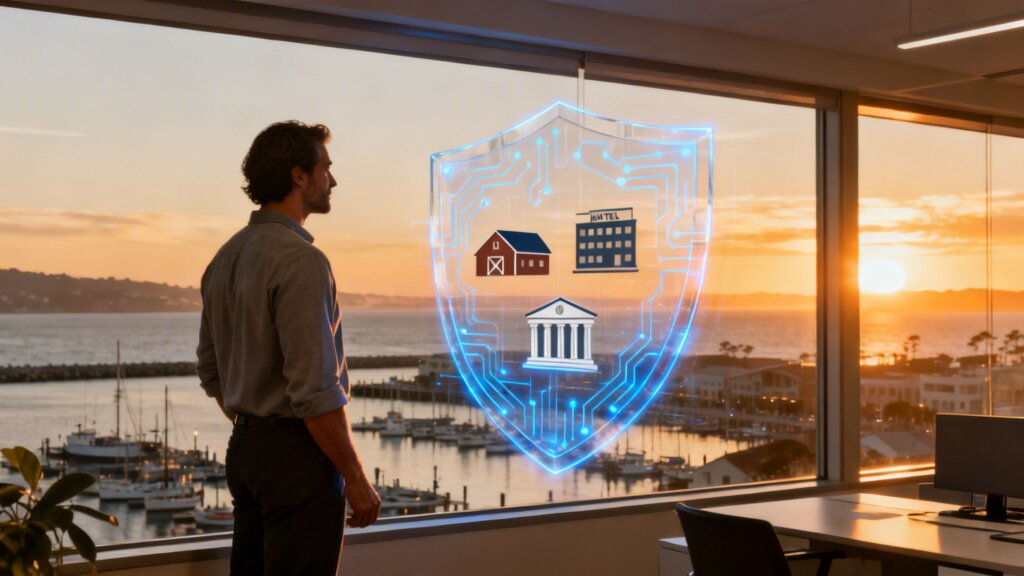
If you run a business in Salinas or anywhere in the Monterey Bay area, it’s easy to think you’re flying under the radar of cybercriminals. This is one of the most common—and costly—mistakes a local business owner can make. Smart cybersecurity isn't about following generic national advice; it's about building a security plan that understands your specific industry, your location, and the real-world threats you face right here.
Why Your Salinas Valley Business Is a Bigger Target Than You Think

It’s tempting to believe cyberattacks are a problem for big-city corporations. But the truth is, attackers are now focusing on small and mid-sized businesses (SMBs) in communities just like ours. The reason is brutally simple: you’re often seen as an easier target.
Cybercriminals aren't lone hackers anymore. They are organized groups looking for the best return on their effort. They know you have valuable data—customer lists, financial records, business secrets—but likely have fewer security resources than a giant company. This makes you a very attractive and profitable target.
This isn’t just a theory; it’s a real risk. Recent data shows 47% of small businesses were hit by ransomware in the past year. Even more concerning, 83% of SMBs say AI has made cyber threats more dangerous. For our local economy’s pillars like agriculture, hospitality, and education, these numbers should be a wake-up call. Many businesses hit by these attacks don't survive without professional help because they thought basic protection was enough.
Moving Beyond "Good Enough" Security
Many business owners think a basic firewall and a standard antivirus program are enough. A few years ago, they might have been right. Today, that’s like putting a simple padlock on a bank vault. Cyberattacks have become much smarter, with criminals using AI to create perfectly convincing fake emails or automatically scan your network for a single weak spot.
It's vital to understand why standard security advice often falls short for businesses in our unique region. Generic, one-size-fits-all checklists don't account for the specific industries, local regulations, and business models we have here. Adaptive IS fills that gap by delivering security plans tailored for businesses in Salinas, Monterey, and Watsonville. Our solutions go beyond firewalls—they include compliance mapping, employee training, and local threat modeling.
Basic Security vs. Smart Security for Monterey Bay Businesses
| Security Measure | Basic Approach (The National Standard) | Smart Approach (The Monterey Bay Reality) |
|---|---|---|
| Threat Focus | Protects against generic malware and spam. | Defends against targeted ransomware aimed at Ag-tech and data theft from hospitality booking systems. |
| Compliance | Mentions general data privacy laws like GDPR. | Addresses specific California laws (like CCPA/CPRA) and rules for local financial firms or healthcare providers. |
| Technology | Standard antivirus and a simple firewall. | Managed threat detection, secure networks for business tech, and employee phishing training. |
| Risk Analysis | "All businesses need to protect data." | "A ransomware attack during harvest season could shut down a Salinas farm; a data breach could ruin a Carmel hotel's reputation." |
| Response | Recover from a backup (if one exists). | A managed incident response plan with local support to restore operations, handle PR, and meet legal notice rules. |
As you can see, what's considered "good enough" nationally leaves big gaps when applied to our local economy. A smart approach isn't just about better tools; it's about a deeper understanding of what you're protecting and why.
These modern threats are made to walk right past traditional defenses. That’s why a proactive, localized cybersecurity strategy is no longer a luxury. For any business in Monterey County, it’s now a fundamental cost of doing business and staying competitive.
Your Industry Puts a Target on Your Back
Think about the industries that drive our local economy. Each one holds unique data that criminals are after:
- Agriculture: Our farms in Salinas and Watsonville rely on "Ag-tech" for everything from irrigation to supply chain management. A ransomware attack could freeze operations during a critical harvest, causing huge losses.
- Hospitality: Hotels and restaurants in Monterey and Carmel process thousands of credit card transactions and store guest information, making them prime targets for data theft.
- Finance & Education: Local banks, credit unions, and schools manage incredibly sensitive personal and financial data. This information is highly regulated and very valuable on the dark web.
Standard security advice completely misses these details. A generic plan won’t do a thing to protect a grower’s connected tractors or a Pacific Grove bed & breakfast’s online booking system. As we explain in our article on why hackers love small businesses, this oversight is exactly what criminals count on. Real security demands a strategy built for your business reality, right here in the Monterey Bay.
How Generic Security Advice Fails Monterey Bay Businesses
We’ve all seen the articles. They’re plastered across the internet, full of well-meaning but generic cybersecurity tips: use strong passwords, enable a firewall, install antivirus software. While none of that advice is technically wrong, for a business operating in the Monterey Bay Area, it's dangerously incomplete.
Copy-and-paste security advice designed for a national audience just doesn't cut it here.
Think about it this way: does a small law firm in Carmel really face the same digital threats as a large-scale agricultural operation in Salinas? Of course not. But a generic security checklist treats them as if they do. It ignores the unique threats, local industry pressures, and specific regulations that define our business community. This one-size-fits-all approach creates a false sense of security, leaving your business exposed where it's most vulnerable.
This is exactly what cybercriminals are counting on. They know a basic firewall won't protect a grower's smart irrigation system from being held for ransom. They also know that standard antivirus isn't designed to stop a targeted attack on a Monterey hotel’s booking database right before Car Week.
The Local Threat Landscape
Generic security advice fails because it doesn't understand your specific work environment. To actually protect your business, you need a strategy built on local threat modeling—an approach that analyzes the real-world risks found right here in Monterey County.
This means asking the kinds of questions that national guides completely overlook:
- For Agriculture in Salinas: What are the biggest risks to your agricultural supply chain? A ransomware attack during harvest season could bring operations to a dead halt, snarling logistics and leading to catastrophic financial losses.
- For Hospitality in Monterey: How are you protecting sensitive guest data during a major event? A breach of credit card information could trigger massive fines and shatter the reputation you’ve worked so hard to build.
- For Finance and Education: How are you managing the complex compliance burdens that govern your institution? Protecting student or client data isn't just a good idea; it's a legal mandate with severe penalties for failure.
Without thinking through these industry-specific risks, your security plan is just a shot in the dark. It’s like trying to navigate the backroads of the Salinas Valley with a map of Los Angeles—you're going to get lost.
The Compliance Gap in California
Another massive failure of generic advice is its silence on state-specific regulations. As a California business, you operate under some of the strictest data privacy laws in the nation, like the California Consumer Privacy Act (CCPA) and the California Privacy Rights Act (CPRA).
These laws give you very specific duties for how you collect, handle, and protect consumer data. Generic advice from a national provider often glosses over these legal duties, putting you at direct risk of big fines and legal action.
A security plan that isn't mapped directly to California's rules isn't a complete plan. This is a critical detail that most national security checklists miss, yet it's a core part of building smart cybersecurity for Monterey Bay business risks.
The growing gap between security spending and cybercrime losses tells an important story. Businesses are spending more on security tools than ever before, but financial losses from cybercrime continue to soar. For businesses here in Monterey Bay, this proves that just buying more tools isn't the solution. The cost of preventing an attack is tiny compared to the cost of recovering from one.
Ultimately, effective cybersecurity isn't about buying a product off the shelf. It’s about creating a strategy tailored to your specific industry, your location, and your unique business model. As we explore in our guide on how modern cyber threats are evolving, understanding these differences is the first step toward building true digital resilience.
Building Your Human Firewall: The Most Overlooked Asset
You can have the best security software money can buy, but it can all be undone by a single, accidental click. Cybercriminals are experts at this. They know it’s often easier to fool a person than to break through technology. This is where we stop talking about software and start focusing on building a strong human firewall.
Too many business owners think cybersecurity is just about firewalls and antivirus programs. But the real threats today, like fake "CEO" emails and targeted phishing scams, are designed to fool even your sharpest employees. These aren't the clumsy, spammy emails of the past. They are carefully crafted messages that look like they’re from a trusted partner, a bank, or even from you.
The Real Danger of a Simple Click
It’s easy to underestimate the damage a convincing email can do. Scams where criminals pretend to be executives to trick employees into making wire transfers or giving up secret information are a huge and effective threat.
Why do they work so well? It's pure psychology. Criminals know that people tend to act quickly when an email looks like it's from their boss. The consequences are devastating: a single mistake can lead to massive financial loss and shatter the trust you've built with your clients.
This is a critical piece of smart cybersecurity for Monterey Bay business risks. Your team is your first and last line of defense. A well-trained employee who spots a suspicious email is more powerful than any piece of software.
Why Annual Training Videos Fail
If your idea of security training is making everyone watch a generic video once a year, you’re leaving your front door wide open. That old "check-the-box" approach simply doesn't stick. People forget what they learned, the threats change faster than the videos are updated, and the training rarely feels relevant to their actual jobs.
A true human firewall isn't built in a single afternoon. It's created through a continuous cycle of education, testing, and empowerment.
Engaging, Ongoing Education: Ditch the long, boring annual session. Instead, provide short, regular training moments. Focus on real-world examples that an employee in your Monterey office or a field manager in Watsonville might actually see.
Simulated Phishing Tests: The best way to teach someone to spot a fake email is to send them one. Regular, unannounced phishing tests show you who is most vulnerable and where you need to focus your training. It turns theory into a practical, memorable lesson.
Clear Security Protocols: Make it incredibly easy for employees to report suspicious activity without any fear of blame. Create a simple, clear process for them to ask, "Does this look right to you?" This empowers your team to become active partners in your defense, not just potential victims.
By taking these steps, you start to build a security-first culture. You turn your employees from potential targets into an active line of defense—a team that understands their role in protecting the business. For a deeper dive into local defense strategies, consider reading our advice from Salinas cybersecurity professionals. The goal is to make security a shared responsibility, not just another problem for the IT department.
Your Step-by-Step Risk Reduction Playbook
All this talk of threats can feel overwhelming. It’s easy to get stuck in theory, but now it's time to turn that worry into action. This is your practical playbook for reducing your business risk, one step at a time.
We're moving beyond the basics to build a strong defense for your company. Each step adds another layer of protection. Let's build your security roadmap.
Step 1 Start with Compliance Mapping
If your business is in a regulated industry, like healthcare or finance, compliance is your starting point. Think of rules like HIPAA as a non-negotiable blueprint for your security. Ignoring that blueprint can lead to huge fines and a complete loss of client trust.
Compliance mapping is the process of matching your security controls directly to those legal requirements. For a medical clinic in Monterey, this means proving that patient data is encrypted and access is strictly logged. It's not just about saying you protect data; it's about being able to prove it.
Step 2 Deploy Advanced Endpoint Protection
Your employees’ devices—laptops, phones, and tablets—are the doors and windows to your company network. A standard antivirus is like a simple lock on those doors, but today’s attackers know how to pick those locks. This is where Advanced Endpoint Protection, also called Endpoint Detection and Response (EDR), comes in.
Think of EDR as a modern alarm system that doesn't just go off when a window is broken; it tracks the intruder's every move inside the house. This is critical for any business with employees working from home or in the field, like a sales team visiting farms across the Salinas Valley. EDR constantly watches for suspicious activity, giving you the power to stop an attack before it can spread. This also applies to old devices; understanding the security risks of delayed data destruction is a key part of protecting data from start to finish.
Step 3 Implement Network Segmentation
Imagine your entire business network is one massive, open-plan office. If a fire starts in the corner, it can engulf the whole space in minutes. Network segmentation is like building firewalls between departments. It divides your network into smaller, isolated zones.
This simple concept has a huge impact. For instance, you can create a separate network zone for your public guest Wi-Fi, completely isolating it from the network that handles your financial records. If a guest’s infected phone connects to your Wi-Fi, the attack is contained and can’t reach your critical systems. This is especially vital for hospitality businesses in tourist hubs like Carmel or Pacific Grove.
By containing a breach to a small section of your network, you can turn a potential disaster into a minor, manageable incident. This proactive step is fundamental to building true digital resilience.
Step 4 Activate AI-Powered Threat Detection
Cybercriminals are using AI to make their attacks faster and smarter. It’s time to fight fire with fire. AI-powered threat detection uses intelligent systems to actively hunt for threats across your network 24/7. It works by learning what "normal" activity looks like for your business and then instantly flagging anything that looks strange.
This is worlds away from just waiting for an alert that a known virus was found. It can spot the subtle signs of a brand-new attack, like an employee's account suddenly trying to access sensitive files at 3 AM. This kind of active threat hunting is no longer a luxury for giant corporations; it's a necessity for any Monterey Bay business serious about security.
This visual shows the simple but powerful process for turning your team into an active defense: Educate, Test, and Empower.

This process creates a continuous loop that reinforces a security-first mindset, turning your people into your strongest asset. Implementing a structured approach like this is a core part of any strong defense, but it can be a lot to manage on your own. For help getting started, our detailed cybersecurity audit checklist can help you identify where your biggest risks lie.
Planning for Resilience When an Attack Succeeds

Here’s an uncomfortable but critical truth: no defense is perfect. Even with the best security money can buy, a determined attacker might eventually find a way through. The real difference between a minor disruption and a business-ending disaster is how you respond in the moments that follow.
This is where planning for resilience comes in. It’s about accepting that an attack is a real possibility and building a rock-solid plan to ensure your business can withstand the hit, recover quickly, and get back to serving your customers.
Beyond Backup: A True Recovery Plan
Many business owners mistakenly believe that having a data backup is the same as having a recovery plan. It isn't. A backup is just a copy of your files—think of it like having a spare key to your office. It's essential, but it won’t tell you what to do if the entire building has burned down.
A true recovery strategy has two connected parts:
- Disaster Recovery (DR): This is the technical playbook. It’s the step-by-step guide for getting your IT systems back online, detailing how to restore servers, data, and network connections.
- Business Continuity (BC): This is the operational playbook. It answers the key question, "How do we keep the business running while IT is being fixed?" This covers everything from setting up a temporary workspace to communicating with clients and processing orders manually.
Together, these form a complete roadmap for getting back to business, not just getting your files back. Without one, you’re left improvising during a crisis—a recipe for chaos and costly mistakes.
What Goes Into an Incident Response Plan
When an attack hits, panic and confusion are your worst enemies. A formal Incident Response (IR) plan is your guide through the storm. It’s a pre-approved set of steps that eliminates guesswork and allows for a swift, controlled, and effective response.
An effective IR plan clearly defines:
- Who to Call: It sets up a clear chain of command and contact list. This should include your IT provider, legal counsel, and key internal decision-makers. No time is wasted figuring out who's in charge.
- What Steps to Take: It details the immediate actions required, such as isolating affected systems to stop an attack from spreading and saving evidence for an investigation.
- How to Communicate: The plan provides guidelines and even pre-drafted messages for communicating with employees and customers. This helps you control the story and maintain trust.
A tested IR plan is the ultimate tool for damage control. It turns a chaotic, high-stress event into a methodical process, minimizing downtime and protecting the reputation you've worked so hard to build.
A Local Scenario: A Ransomware Attack in Pacific Grove
Imagine your hospitality business in Pacific Grove gets hit with ransomware on the Thursday before a major holiday weekend. Suddenly, your booking system is frozen, your guest records are locked, and a ransom demand is on your screen.
Without a plan, you’d be scrambling. With a tested IR plan, your team knows exactly what to do. You immediately contact Adaptive IS, and we execute the plan: infected systems are isolated, clean backups are verified, and the recovery process begins.
Meanwhile, your front desk calmly switches to a manual check-in process defined in your business continuity plan. You use pre-written templates to inform upcoming guests about a "temporary systems outage" while assuring them their reservations are secure.
This controlled response is the core of smart cybersecurity for Monterey Bay business risks. With Adaptive IS, local businesses get true network resilience—not just IT tools, but tested recovery plans and real-time monitoring. Instead of facing days of crippling downtime, you are back online in hours with minimal disruption. That is the power of resilience.
How to Get Enterprise-Level Security on an SMB Budget
Putting advanced, layered security in place often sounds like something only a massive corporation could afford. For most small businesses in Salinas and across Monterey Bay, hiring a full-time, in-house team of cybersecurity experts just isn’t realistic. But that doesn't mean you have to settle for basic, weak protection.
The good news is you don’t need a huge budget to achieve true digital resilience. The secret is a smarter, more cost-effective approach: partnering with a local Managed Services Provider (MSP).
The Value of a Managed Services Partner
Think of an MSP like this: instead of hiring one IT generalist, you get access to an entire team of specialized experts for a single, predictable monthly fee. This model makes enterprise-level IT at an affordable price a reality for local SMBs. It’s the most efficient way to get the tools, talent, and 24/7 monitoring needed to defend against modern threats.
A dedicated MSP like Adaptive Information Systems goes beyond just selling you software. We become your strategic partner. We deliver the region-specific insights and tailored security plans that generic providers miss. This approach bridges the gap between buying security tools and actually having a strong security strategy.
This partnership delivers immediate value:
- Cost Predictability: You get a clear, fixed monthly cost for all your IT security needs. This ends surprise expenses and makes it easy to budget for real protection.
- Access to Expertise: You gain the knowledge of an entire team of specialists in networking, cloud security, and threat response—something impossible to get with a small internal team.
- Proactive Management: We don't just wait for something to break. We actively monitor your systems 24/7, applying patches, updating defenses, and hunting for threats before they can cause damage.
More Than Tools—A True Security Partnership
The core benefit of working with a local MSP is moving beyond a collection of IT tools to build genuine network resilience. This is about having tested recovery plans, industry-specific protections, and real-time monitoring that stops threats before they spread. If you're a small business in the Monterey Bay Area, you shouldn't settle for copy-paste security advice. It's time to work with a partner who can build network protection for your specific risks and recovery needs.
This is the most practical path for smart cybersecurity for Monterey Bay business risks. Instead of you having to become a security expert, you can focus on what you do best—running your business—with the confidence that a local team has your back.
With a managed services model, you effectively rent an entire enterprise-grade security department for a fraction of the cost of buying one. It’s the ultimate force multiplier for SMBs.
This partnership is especially valuable for businesses in our key local industries like agriculture and hospitality. We understand the operational realities of a farm in the Salinas Valley or a hotel in Carmel and build security plans that protect you without disrupting your work.
As you consider your next steps, it's helpful to understand the full scope of what this partnership can offer. You can learn more about how enterprise-level IT support is becoming essential for small businesses and how it delivers a significant competitive advantage. This approach turns cybersecurity from a nagging expense into a powerful business enabler.
Frequently Asked Questions About Smart Cybersecurity
As you start thinking beyond basic security, questions are bound to come up. It's a normal part of the process. Here are some clear, straightforward answers to the concerns we hear most often from fellow business owners right here in the Monterey Bay area.
My Business Is Small. Isn’t a Good Antivirus and Firewall Enough?
While a good antivirus and firewall are essential, they’re really just the starting line. Think of them as a sturdy lock on your front door. It’s a great first step, but modern threats—especially AI-powered phishing and ransomware—are like sophisticated burglars who know how to pick locks or find an unlocked window.
For Monterey Bay businesses, particularly those in sensitive sectors like agriculture or finance, a single breach that bypasses these basic tools can bring operations to a halt. Smart cybersecurity adds the critical layers that basic tools miss, like employee security training, a tested incident response plan, and continuous monitoring. It's about building a complete defensive system, not just a simple gate.
How Much Does Advanced Cybersecurity Cost for a Small Business?
It's much more affordable than you might guess—and it's a fraction of the cost of cleaning up after a data breach. Instead of a massive, one-time investment, partnering with a local managed services provider like Adaptive IS gives you access to an entire team of experts and enterprise-grade tools for a predictable monthly fee.
We tailor the security plan to fit your actual budget and specific risks, so you only pay for the protection you truly need. The cost of being proactive is tiny compared to the financial and reputational damage of downtime, regulatory fines, and lost customer trust. For SMBs looking to get advanced protection without breaking the bank, solutions for Enterprise AI Calling Security can offer a robust defense against today's sophisticated threats.
We Use Cloud Services Like Microsoft 365. Aren’t We Already Protected?
This is a common and dangerous misunderstanding. While cloud giants like Microsoft provide phenomenal security for their own systems, they operate on a “Shared Responsibility Model.”
This means they are responsible for securing the cloud itself, but you are responsible for securing your data and users within it.
This responsibility includes protecting your company from account takeovers that start with a simple fake email, spotting settings that accidentally leave sensitive data exposed, and guarding against insider threats. A properly designed cybersecurity plan makes sure your cloud setup is configured and monitored correctly to close these common gaps and fully address your smart cybersecurity for Monterey Bay business risks.
If you're a small business in Salinas or the Monterey Bay Area, don’t settle for copy-paste security advice. Talk to Adaptive IS about network protection built for your risks, regulations, and recovery needs. Let our local experts provide the enterprise-level security you need at a price that fits your budget.
Adaptive Information Systems
380 Main St, Salinas CA 93901 | 831-644-0300 | hello@adaptiveis.net