As a small business owner in Monterey County, you know technology isn't just a tool—it's the engine that powers your operations. Getting the right tech support for small businesses is more than having a helpline; it's about forming a strategic partnership that ensures your engine runs smoothly, keeping you secure, efficient, and ready for whatever comes next. It’s about having a local ally in Salinas who works proactively to solve problems before they can disrupt your business.
Why Smart Tech Support Is Your Secret Weapon
If you're running a business in Monterey County, you understand the value of being prepared. Think of a Salinas Valley farmer getting their equipment tuned up before harvest season. They don't wait for a tractor to break down in the middle of a field; they do the maintenance ahead of time to guarantee uptime and productivity. Modern IT support does the exact same thing for your business technology.
The old way of doing things—calling a "computer guy" only when something breaks—is obsolete. That reactive approach just leads to expensive downtime, lost revenue, and a ton of frustration. True tech support for small businesses today is proactive. It’s a dedicated service designed to keep your systems online, your data safe, and your team productive, whether you're running a hospitality business in Carmel or a financial firm in Monterey.
The Shift from Reactive to Proactive
Imagine this: it's a busy Saturday, and your entire sales system crashes. With a reactive "break-fix" model, you're now scrambling to find help, losing sales with every minute that ticks by. A proactive partner, on the other hand, would have been monitoring your network from the start. We could have spotted the warning signs and fixed the issue before you even knew there was a problem.
This proactive approach is the core difference between basic IT help and a genuine technology partner. It's the shift from firefighting to fire prevention, giving you the peace of mind to focus on what you do best—running your business.
The goal is to build a technology foundation that doesn’t just support your current operations but also fuels your future growth.
This infographic breaks down the key benefits you get when you invest in a proactive support model.
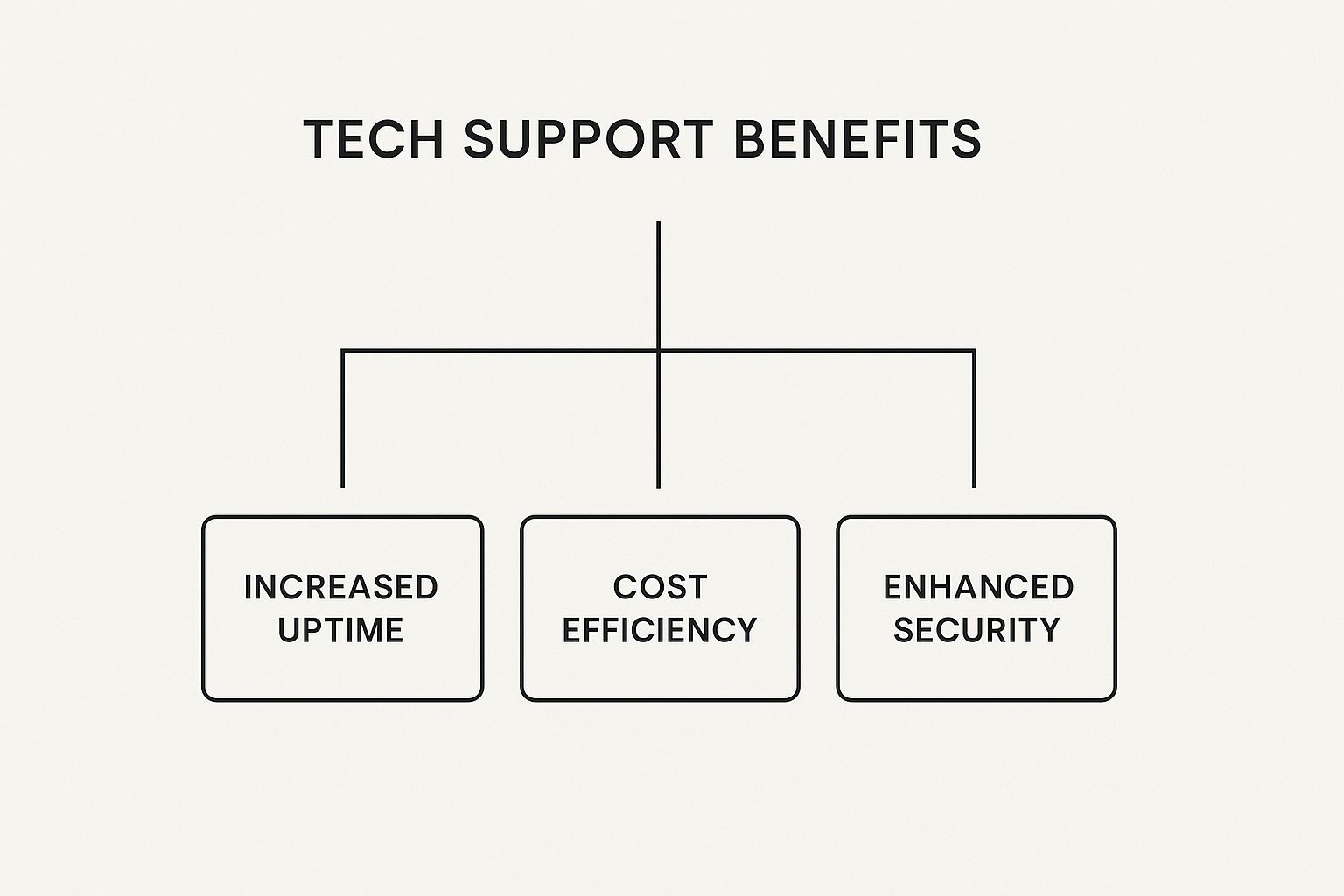
As you can see, these advantages are all connected. Better security and uptime directly contribute to a healthier bottom line and a stronger business.
A Foundation for Local Business Success
Technology is no longer a "nice-to-have"—it's fundamental to staying competitive. The data backs this up: research shows that technology adoption is a critical driver of success, with around 85% of small business owners reporting better outcomes when they fully integrate tech into their operations. On average, small businesses depend on at least four different tech platforms just for daily management, which underscores the need for expert support. You can explore more about these small business trends and their implications.
For your local company, this means your point-of-sale system, customer database, and communication tools all need to work together flawlessly. The right IT support makes sure they do, turning your technology from a potential headache into your most powerful asset. This is how you gain an edge and deliver the kind of reliable service that keeps your customers coming back.
The Core Services Every IT Partner Should Provide

So, you've decided to invest in professional tech support for small businesses. What does that actually mean for your daily operations? It’s important to look beyond vague promises and nail down the specific services that form the bedrock of a solid IT partnership. A great provider doesn't just put out fires; they deliver a whole suite of services designed to keep your business running smoothly, securely, and without hiccups.
Think of these core services like the essential systems in a commercial building. You need reliable plumbing (data flow), strong locks (cybersecurity), a steady power grid (your network), and an emergency plan (backup and recovery). If any one of these fails, the entire structure is compromised.
On-Demand Help Desk Support
This is the most visible piece of the puzzle and your team's direct line to getting problems solved—fast. Help desk support is essentially your on-call team of tech experts, ready to jump on any issue that’s grinding your day to a halt.
Picture this: an employee at your Carmel retail shop can’t get the point-of-sale system to connect on a busy Saturday. Instead of panicking or wasting valuable time fiddling with it, they make a single call. A technician can remotely access the system, find the problem, and get it working again, often in just a few minutes.
Key Takeaway: A responsive help desk isn’t just a nice-to-have; it's a direct driver of productivity. It cuts down on workflow interruptions and lets your staff focus on their real jobs, not on frustrating tech glitches.
A solid help desk should always offer:
- Rapid Response: A clear promise on how quickly they’ll acknowledge your issue and start working on it.
- Multiple Contact Methods: Options to get help via phone, email, or a dedicated support portal.
- Expert Technicians: Friendly, sharp people who can explain things clearly without drowning you in technical jargon.
Proactive Network Management
Your computer network is the digital spine of your entire company. It’s what links your computers, printers, servers, and internet into one functioning system. Proactive network management is the art of monitoring, maintaining, and securing this critical infrastructure to stop problems before they even start.
For a Salinas-based accounting firm handling sensitive client financials, a stable and secure network is completely non-negotiable. Proactive management means your IT partner is constantly scanning for performance issues, suspicious activity, or hardware that's about to fail. This is the preventative care that keeps your data flowing and secure, ensuring you can always access what you need, when you need it. Understanding the different support models is key; you can learn more about what various IT service providers offer in our detailed guide.
Robust Cybersecurity Protections
In today's world, cybersecurity isn't an optional add-on—it's an absolute must. Small businesses are often targeted by cybercriminals precisely because they're seen as softer targets. A core job of any real tech support partner is to build and manage a multi-layered defense to shield your valuable business and customer data.
This goes way beyond just installing antivirus software. A complete security strategy includes:
- Firewall Management: The digital gatekeeper for your network, blocking unauthorized traffic.
- Email Security: Filtering out phishing scams, spam, and malicious attachments before they reach your inbox.
- Security Patching: Keeping all your software and systems updated to close security holes.
- Employee Training: Teaching your team how to spot and avoid common cyber threats.
Data Backup and Disaster Recovery
What would you do if all your business data vanished tomorrow? A server crash, a ransomware attack, or even a simple office fire could wipe out years of critical information, from client records to financial history. This is where data backup and disaster recovery (BDR) serves as your ultimate safety net.
Think of BDR as a comprehensive insurance policy for your data. A good BDR service automatically makes secure copies of your information and stores them in a separate, safe location. Even more importantly, it comes with a clear, tested plan to restore that data quickly and get your business back online after a catastrophe. That's business continuity in action.
How To Choose the Right IT Partner in Monterey County

Picking an IT provider is one of the most important decisions you'll make for your business. This isn't just about hiring someone to fix a misbehaving computer; it's about finding a long-term partner who will protect your assets, boost your team's productivity, and help you grow.
Let’s be clear: not all tech support for small businesses is the same. Finding the right fit means asking the right questions from the very start.
This decision has become even more critical as businesses recognize the immense value of expert guidance. Today, roughly 37% of small and medium businesses outsource their IT services to cut costs and gain access to specialized skills. And with nearly nine out of ten organizations planning to increase their IT budgets, it's obvious that technology support is now seen as a core business strategy, not just another expense. You can get more details on this trend in this report on business technology investment trends.
Questions to Ask Any Potential IT Provider
Before you even think about signing a contract, you need to vet potential partners thoroughly. Treat it like an interview for a key leadership role on your team, because that's essentially what it is. Their answers will tell you everything you need to know about whether they're aligned with your goals or just trying to make a quick sale.
Here are the essential questions to start with:
- What's your experience with businesses in Monterey County? A provider who gets the local scene—from the seasonal rush of hospitality in Pacific Grove to the specific compliance needs of agriculture in the Salinas Valley—can offer far more relevant advice.
- What are your guaranteed response times? You need specifics here. A vague promise of "fast service" won't cut it when your business is down. Ask for a Service Level Agreement (SLA) that clearly defines how quickly they’ll respond and start working on your issues.
- Can you describe your security protocols? How do they protect their clients from cyber threats? Ask about their approach to firewalls, data encryption, and, just as importantly, employee security training.
- Are you proactive or reactive? This is a big one. Ask for a real-world example of how they prevented a problem for another client. Their answer will reveal if they focus on strategic prevention or just spend their days putting out fires.
Look for a Strategic, Local Partner
A great IT provider does so much more than fix what's broken. They should act as a strategic advisor—a Virtual Chief Information Officer (vCIO)—who helps you make smart technology decisions that actually support your business objectives. A true partner will be asking you questions about your growth plans, operational roadblocks, and long-term vision.
The right partner acts as an extension of your team. They are invested in your success because when your business thrives, so does theirs. This is especially true for a local provider who is part of the same community fabric.
When you’re weighing your options, pay close attention to how they approach their work. Do they schedule regular strategic reviews? Do they provide clear, easy-to-read reports on your system's health and security? This focus on proactive strategy is what separates a basic vendor from a genuine partner.
For a deeper look into what sets the best providers apart, check out our guide on how to find the top IT support provider in Salinas.
Ultimately, your goal is to find someone who delivers enterprise-level capabilities with a local, personal touch. You need a team you can trust to have your back, no matter what.
Decoding the Costs of Professional IT Support
Let's talk about the bottom line. When looking into professional tech support for small businesses, the first question on everyone's mind is, "So, how much is this going to cost?" Understanding the different pricing models is the first step, but it's more important to frame this as an investment in your business's future, not just another monthly bill.
The right IT partner delivers a massive return by stopping expensive problems before they ever start. The conversation shouldn't just be about the fee; it should be about the value you get and the disasters you avoid.
Common IT Support Pricing Models
When you start getting quotes from IT providers, you'll run into a few common ways they structure their fees. Each one has its pros and cons, and the best fit really depends on your company's specific needs, size, and what you're trying to achieve.
- Per-Device Pricing: With this model, you pay a flat fee for every piece of equipment being managed—each desktop, laptop, server, and smartphone. It's straightforward and easy to budget, especially if your team size is consistent. A small law office in Pacific Grove with a predictable number of workstations, for instance, might find this model perfectly clear.
- Per-User Pricing: Here, the cost is tied to each employee using your IT systems, no matter how many devices they have. This is perfect for modern businesses where people jump between a laptop, an office desktop, and a smartphone. It makes billing simple for flexible or remote work setups.
- Flat-Rate Managed Services: This all-inclusive approach is the most popular for businesses that want proactive support. You pay a single, predictable monthly fee for a whole suite of services, like monitoring, maintenance, security, help desk support, and even strategic advice. This model aligns your goals with your IT provider's—they are motivated to keep your systems running perfectly to reduce their own support calls.
The real goal of a flat-rate plan is to build a true partnership. It shifts the relationship away from a transactional "pay-per-fix" model and into a strategic one where your provider is genuinely invested in your long-term success and uptime.
Shifting from Cost to Investment
It’s easy to get sticker shock from monthly IT support fees, but that’s a shortsighted view. To see the full picture, you have to weigh it against the hidden—and often astronomical—costs of having bad or no IT support.
Just think about what happens when your systems go down. Downtime isn't just an annoyance; it's a direct hit to your bank account. Studies have shown that a single hour of downtime can cost a small business thousands of dollars in lost revenue, wages for idle staff, and damage to your reputation.
For a deeper look at what a great provider should offer, check out our complete guide on small business IT support.
The True Cost of Inadequate Support
Let's break down the real financial risks of trying to cut corners on technology. The price tag on a proactive IT plan often looks tiny compared to the cost of cleaning up after a single major incident.
Here’s what you’re actually paying for when you don't have professional support on your side:
| Hidden Cost of Poor IT | Real-World Business Impact |
|---|---|
| Productivity Loss | Your team wastes hours trying to fix tech problems instead of helping customers. Every minute they're playing amateur IT guy is a minute they aren't making you money. |
| Downtime Expenses | If your server or sales system dies, business grinds to a halt. You lose sales, miss deadlines, and frustrate customers who will happily go to your competitor. |
| Security Breaches | Recovering from a cyberattack can be financially crippling. It's not just the technical cleanup; it's the potential fines, legal fees, and total loss of customer trust. |
| Data Loss | Without solid backups, one hardware failure or ransomware attack could erase your financial records, customer lists, and operational history in an instant. |
When you look at tech support for small businesses through this lens, it's clear that proactive management isn't a cost center. It's a powerful form of business insurance that protects your revenue, your reputation, and your future. It's an investment in continuity and simple peace of mind.
Why Cybersecurity and AI Matter for Your Business
Modern tech support has evolved far beyond just fixing broken printers. Today, a top-tier IT partner has to be your guide through two of the most powerful forces in business: cybersecurity and Artificial Intelligence (AI).
These aren't just buzzwords for giant corporations. For any small business in Monterey County, they are fundamental tools for staying safe, competitive, and profitable.
The New Front Line of Business Security
Let's start with a hard truth. It's a common and dangerous myth that cybercriminals only go after big companies. In reality, small businesses are often seen as easy targets precisely because they’re assumed to have weaker defenses.
This makes having a rock-solid security strategy non-negotiable. You’re not just protecting data; you're protecting your operations, your finances, and the trust you've built with your customers.
Building Your Digital Defenses
Your first line of defense is a set of essential security layers that your IT partner should actively manage. This is about building a proactive shield around your business—not just reacting after an attack has already done damage. Think of it as installing high-quality locks, security cameras, and an alarm system for your digital property.
Essential security services include:
- Managed Firewalls: This is your digital gatekeeper. It inspects and controls all traffic coming into and out of your network, blocking malicious actors before they can even get a foothold.
- Email Filtering and Protection: Since most cyberattacks start with a deceptive email, this service is crucial. It scans incoming messages to filter out phishing scams, malware, and spam.
- Consistent Security Patching: Hackers love to exploit known weaknesses in software. Your IT partner must ensure all your systems—from Windows to your accounting software—are constantly updated to close those security gaps.
- Crucial Employee Training: Your team is your human firewall. Effective training teaches them how to recognize and avoid threats, turning a potential weakness into a powerful security asset. For a foundational overview, check out our guide on Cyber Security 101 for businesses.
Unlocking Your Potential with AI
On the other side of the coin is innovation. Artificial Intelligence is no longer science fiction or a tool reserved for Silicon Valley giants. For small businesses, AI offers practical ways to work smarter, understand your customers better, and automate tedious tasks. This frees you up to focus on what really matters: growth.
The right tech support for small businesses doesn't just protect you from yesterday's threats; it helps you seize tomorrow's opportunities. AI is one of the biggest opportunities available to you right now.
Imagine you run an e-commerce store based in Marina. An IT partner could help you use AI to analyze customer buying patterns, automatically suggesting products they might love. This creates a personalized shopping experience that drives sales—all without you needing a massive marketing department. That's the power of making advanced technology accessible.
Integrating Security and Innovation
The most forward-thinking businesses are already embracing these changes. In recent years, nearly 47% of SMBs updated their cybersecurity measures to protect against growing threats. At the same time, 38% reported active use of AI across various business functions.
With 56% of business owners believing AI can help with workforce optimization, it's clear that modern tech support must provide strategic guidance on both securing and innovating with these tools. You can explore more about how SMBs are using technology to boost profits.
The key is having a partner who can translate these complex technologies into practical advantages for your specific business. Whether it’s securing guest data for a hotel in Pacific Grove or using AI to predict maintenance for an agricultural business in Salinas, the goal is the same: turning technology into your competitive edge.
Your Local Partner for Business Growth

Picking your tech support provider isn't just about finding someone to fix what's broken. It's about finding a partner who understands your business and is committed to helping you grow securely and efficiently. As a local business yourself, you deserve an IT partner who gets the unique challenges and opportunities here in Monterey County.
When your provider is just down the road in Salinas, you get more than just a technician. You get someone who understands the local rhythm—from the seasonal rush for hospitality businesses in Monterey and Carmel to the specific tech demands of our vital agriculture industry. It’s not about generic solutions; it's about providing tech support for small businesses with the kind of insight only a neighbor can offer.
We Are Part of Your Community
At Adaptive Information Systems, our mission has always been simple: bring enterprise-level IT services to the small and medium-sized businesses that are the backbone of our community, all at a price that makes sense. We firmly believe you shouldn't need a massive corporate budget to access top-tier security and support.
This philosophy is at the core of every recommendation we make. We're not interested in selling you the latest expensive gadget you don't need. Our job is to find the most effective and affordable solutions that actually solve your problems and help you hit your business goals.
The right IT relationship isn't a transaction; it's a collaboration. It’s built on trust, shared goals, and a mutual commitment to seeing a local business succeed. We're not just a vendor; we're your neighbor.
This community-first approach means we're in a unique position to help you navigate local realities. A strong security plan, for example, isn't a one-size-fits-all checklist. To see what a difference a local focus makes, check out our guide on Salinas cybersecurity services.
Building Your Technology Future Together
A real IT partner doesn’t just wait for things to break. We act as your strategic guide, helping you build a technology foundation that's not only solid today but also ready for whatever comes next. We take the time to really understand your business—your daily operations, your growth plans, and your budget.
This allows us to help you answer the big questions:
- How can we use technology to make your team more efficient?
- What are the non-negotiable security measures you need to protect your specific customer data?
- How can you plan an IT budget that avoids surprises and gives you the best return on investment?
This proactive, advisory role is what separates a basic help desk from a dedicated partner. It’s about looking around the corner and making sure your technology is a tool for growth, not just a utility you have to maintain. We're committed to being that partner for you—the local experts who are truly invested in your success.
Common Questions About Small Business IT
When you're trying to grow your business, the last thing you need is confusing tech jargon. You just need straight answers. Here are a few of the most common questions we hear from local business owners about getting the right tech support for small businesses.
Is My Business Too Small for Managed IT Services?
Absolutely not. In our experience, the smaller your business is, the more devastating a tech problem can be.
Think about it: even a one-person shop relies on technology for everything—sales, customer communication, and operations. A single hard drive failure or a sneaky phishing email isn’t just an inconvenience; it can wipe out your client data or lock you out of your most critical files.
Managed services are designed to scale with you. The whole point is to provide enterprise-level IT protection and support at an affordable price. It's about preventing disasters, not just reacting to them. For a growing business, that peace of mind is far more affordable than the cost of trying to recover from a major IT meltdown.
What's the Real Difference Between an IT Consultant and an MSP?
That's a great question, and it really comes down to the relationship. Think of an IT consultant as a specialist you call for a specific project. You might hire one to help you upgrade a server, set up a new office network, or figure out which software to buy. They come in, give advice, implement a solution, and then the project is over.
A Managed Services Provider (MSP), on the other hand, is your long-term technology partner. We’re in it with you for the long haul. We are responsible for the ongoing health, security, and performance of your entire IT environment—all for a predictable monthly fee. This includes day-to-day monitoring, preventative maintenance, data backups, and unlimited help desk support for your team.
How Hard Is It to Switch IT Providers?
When it’s handled by a professional provider, the switch should feel like a non-event for your business. Our goal is to make it completely seamless and invisible to your daily operations.
A well-planned transition is all about meticulous planning. Here’s how we make it happen:
- Deep-Dive Assessment: First, we take a thorough look at your current setup. We need to understand every single piece of your technology puzzle before we touch anything.
- Strategic Onboarding: Next, we carefully deploy our monitoring tools, document your network, and get your team set up in our system.
- Smooth Handover: We work directly with your old provider (if you have one) to ensure a clean and complete transfer of all necessary credentials and information.
- Team Welcome: Finally, we introduce your team to our help desk and show them exactly how to get fast, friendly support whenever they need it.
The entire process is designed to be painless from day one, setting the foundation for a strong and supportive partnership.
Ready to stop worrying about technology and start focusing on your business? At Adaptive Information Systems, we provide the strategic, proactive, and affordable IT support that Monterey County businesses deserve. Get in touch with us today for a no-obligation consultation.
Adaptive Information Systems
380 Main St, Salinas CA 93901 | 831-644-0300 | hello@adaptiveis.net