If you're running a small business here in Monterey County, whether it's a bustling hospitality business in Carmel or a leading agricultural firm right here in Salinas, you know one thing for sure: your phone is your lifeline to customers. But let’s be honest, traditional landlines are starting to feel like relics, holding your business back. This guide is my direct advice to you, cutting through the tech jargon to show how modern business phone systems for small business aren't just for big corporations anymore. They're powerful, surprisingly affordable, and completely within your reach—delivering enterprise-level IT at a price that makes sense for local SMBs.
Why Your Phone System Matters Now More Than Ever

In a place like Salinas or Monterey, your local reputation is everything. Every missed call can be a missed opportunity—a lost sale or a frustrated customer who might not call back. Your phone system is much more than a dial tone; it’s a critical part of your customer experience and a direct reflection of your company's professionalism.
Think about it. An outdated system can make you sound small and disorganized. On the other hand, a modern one projects an image of a capable, tech-savvy operation that’s ready for anything.
Take a look at how you operate day-to-day. Are you stuck at a desk in Marina, chained down waiting for calls? Do your hospitality staff in Pacific Grove get tangled up trying to transfer guest inquiries? A modern phone system fixes these headaches. It gives you the freedom to manage communications from anywhere, ensuring you’re always connected to your clients, vendors, and team.
Meeting Modern Customer Expectations
Your customers expect seamless, easy communication. They want to reach the right person quickly, without getting stuck on hold or lost in a confusing phone menu. A modern phone system gives you the power to meet—and exceed—these expectations.
Here’s how you’ll benefit right away:
- Look More Professional: Features like a custom greeting and an auto-attendant ("Press 1 for Sales, Press 2 for Support…") instantly make your small business sound like a major player.
- Work from Anywhere: You can take business calls on your mobile phone, computer, or a desk phone. This gives you the flexibility to work from the office, a job site, or even from home without missing a beat.
- Boost Your Efficiency: Route calls to the right person automatically, get your voicemails transcribed and sent to your email, and even connect your phone system to other business tools you already use. It’s a massive time-saver.
This move toward more capable phone systems isn't just a local trend; it's happening everywhere. The market for small business phone systems is expected to explode, hitting $15 billion by 2025. This growth is driven by businesses just like yours ditching old tech for flexible, cloud-based solutions to get a leg up. If you're interested, you can explore more about these market trends and what they mean for companies on the Central Coast.
In short, upgrading your phone system isn't just an expense—it's an investment in your company's efficiency, professional image, and future growth. It puts big-business tools in your hands at a price that actually makes sense for a local SMB.
This guide will walk you through everything you need to know about choosing the right business phone systems for small business. By the end, you'll be able to make a confident decision that truly supports your goals.
How VoIP Technology Transforms Business Communication

So, what's the magic behind modern business phone systems for small business? The answer is a technology called Voice over Internet Protocol, or VoIP. It's a much simpler concept than its name suggests. Essentially, VoIP lets you make and receive calls over your internet connection instead of old-school analog phone lines.
Think of it this way: a traditional phone line is like a single, dedicated road just for your voice. Your internet connection, on the other hand, is a multi-lane superhighway. VoIP gives your voice calls their own express lane on that highway, letting them travel right alongside your emails and web traffic.
For a local business in Salinas, this is a game-changer. It frees you from the high costs and physical tethers that come with traditional phone companies. This technology is the foundation of nearly every modern phone solution, delivering flexibility and power once only available to giant corporations.
From Analog Wires to Digital Data
The real difference lies in how your call gets from point A to point B. Old-school phone systems physically push the sound waves of your voice across copper wires. VoIP is much smarter.
It captures your voice, converts it into tiny digital packets of data, and zips those packets across the internet to the person you're calling. On their end, the system instantly reassembles the packets back into crystal-clear audio.
Because it's just data, your phone system is no longer chained to a specific wall jack. Your business number can live on a desk phone, a laptop app, or a mobile app on your smartphone. This is what gives you the freedom to stay connected whether you're at your desk in Monterey or visiting a client on-site.
The switch to this technology has been fast. In fact, 61% of business leaders say they plan to move to VoIP as soon as their current phone contract expires. That massive shift shows how valuable the benefits are for small and mid-sized businesses.
Why This Matters for Your Bottom Line
For your small business, the benefits of switching to a VoIP system are immediate and practical. We're not just talking about cool new features; we're talking about real business value that strengthens your operations and puts money back in your pocket.
At its heart, VoIP democratizes communication. It takes powerful enterprise-level features and makes them accessible and affordable for the local shops, farms, and firms that form the backbone of our community here in Monterey County.
Here’s a quick look at the key advantages you can expect:
- Significant Cost Savings: You can finally ditch the expensive, separate phone line rentals. Calls made over the internet—especially long-distance ones—are dramatically cheaper.
- Unmatched Flexibility: Your team can make and take calls on their business line from anywhere with an internet connection. This is perfect for supporting remote employees or staff who travel for work.
- Easy Scalability: Need to add a new employee? With VoIP, you can add a new line in minutes right from a simple online dashboard. No more waiting around for a technician to install new wiring.
Ultimately, understanding VoIP is the first step toward bringing your business communications into the modern era. But making the right choice involves more than just the tech. For a complete walkthrough, check out our guide on how to choose the right VoIP solution for your unique business needs.
Deciding Between On-Premise and Cloud Phone Systems
Alright, now that you understand the technology, we've hit the next major fork in the road. You need to decide where your phone system will "live." This choice is a big one—it directly shapes your budget, how much maintenance you're on the hook for, and how easily you can grow.
The two main paths are an on-premise system or a cloud-based one.
Think of it this way: an on-premise system is like buying a commercial building. You purchase the property, install all the plumbing and electricity, and you're 100% responsible for every repair, security update, and utility bill. It gives you total control, but with a massive upfront cost and a long-term management headache.
A cloud-based system (often called UCaaS) is like leasing a fully furnished, high-tech office. The management company owns the building, handles all security, and keeps everything running. You just pay a predictable monthly fee to use the space and all its amenities, connecting from anywhere via the internet.
What Are On-Premise PBX Systems?
An on-premise Private Branch Exchange (PBX) is the traditional approach. With this setup, you buy and physically house all the hardware—the servers, switches, and other gear—right in your own office, usually in a server closet.
This gives you direct, hands-on control. But that control comes with serious strings attached.
- Hefty Upfront Cost: You have to buy all the hardware outright, which can be a huge capital expense.
- Constant Maintenance: Your team (or a paid IT contractor) is responsible for everything—software updates, security patches, and fixing broken hardware.
- Stiff and Inflexible: Need to add more phone lines? That often means buying more expensive hardware and a complicated installation.
This option might still work for businesses with unique, ultra-specific security needs or a full-time, in-house IT department. For most small businesses, the high initial price and maintenance burden make it a non-starter.
The Power and Simplicity of the Cloud
There's a reason cloud-based business phone systems are the default choice for modern companies. Instead of you owning the hardware, a specialized provider hosts the entire system in their secure data centers. You access every feature you need using your existing internet connection.
This model is a game-changer. It puts enterprise-level communication tools within your reach, all without the cost and complexity of running the technology yourself. For any growing business, it's simply the more practical path forward.
The real magic of the cloud is that it lets you shift your focus from managing technology to using it. You can stop worrying about server patches and start focusing on what actually matters—serving your customers and growing your business.
This handy infographic breaks down the key differences in costs and scalability between cloud and on-premise systems.
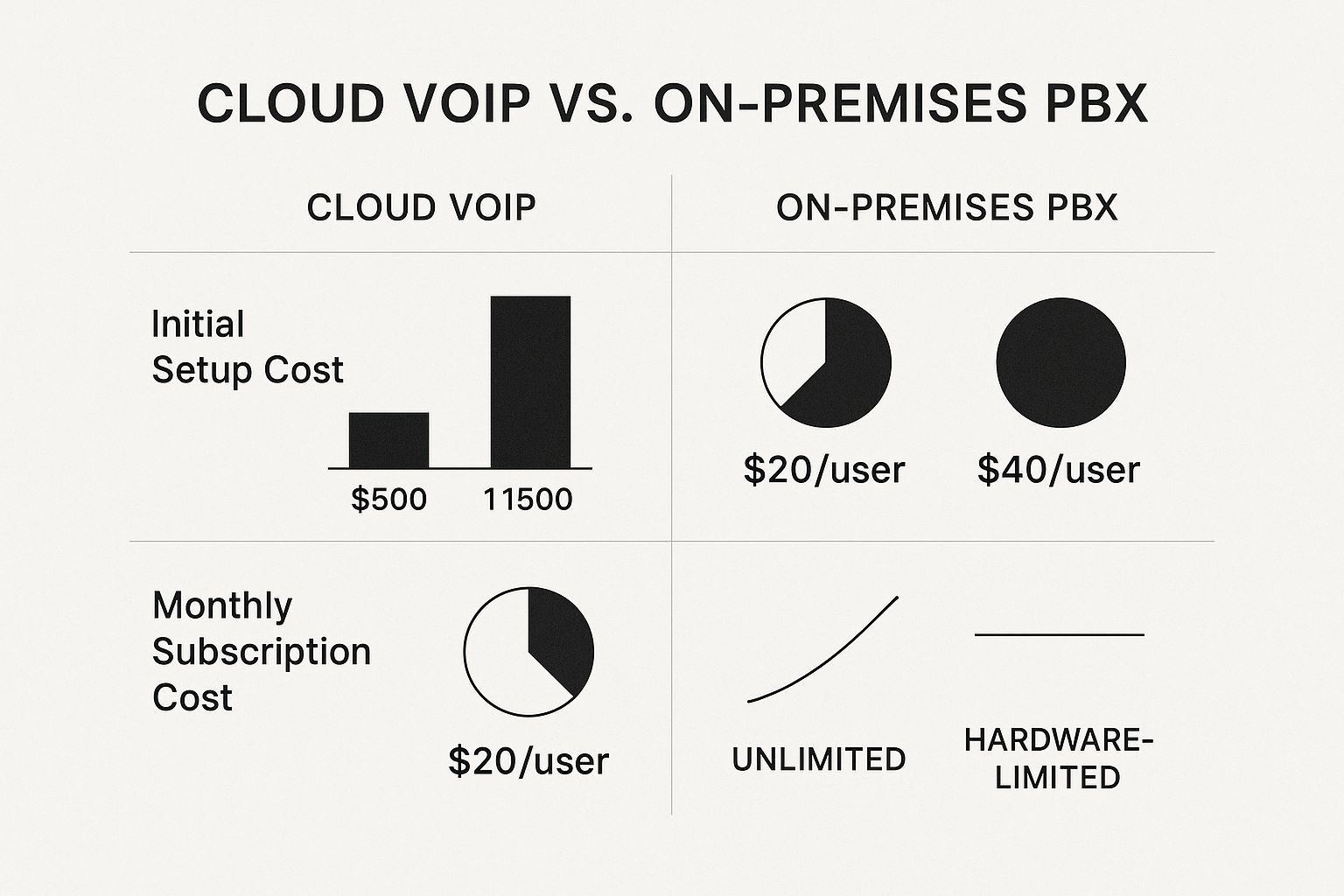
As you can see, the cloud model completely changes the financial equation. It lowers the barrier to entry with almost no setup costs and gives you predictable monthly fees that scale right alongside your business.
To make the comparison even clearer, let's break down the key factors side-by-side.
On-Premise vs Cloud Phone System Comparison
This table offers a direct look at how the two models stack up against each other in the areas that matter most to you as a small business owner.
| Factor | On-Premise System | Cloud-Based System (VoIP/UCaaS) |
|---|---|---|
| Initial Cost | High. Requires purchasing all server hardware, software licenses, and desk phones upfront. | Low to None. Minimal setup fees, with providers often including phones in the plan. |
| Ongoing Costs | Unpredictable. Includes maintenance, repairs, IT staff time, and potential hardware replacement. | Predictable. A simple, per-user monthly subscription fee covers everything. |
| Maintenance | Your Responsibility. Your internal team or a contractor must handle all updates, patches, and repairs. | Provider's Responsibility. The vendor manages all hardware, software, and security updates. |
| Scalability | Difficult & Expensive. Adding users often requires buying new hardware and complex configuration. | Easy & Fast. Add or remove users in minutes through a simple online portal. |
| Flexibility | Limited. Tied to the physical office location. Remote work requires complex, often clunky add-ons. | Highly Flexible. Users can connect from anywhere with an internet connection—office, home, or mobile. |
| Features | Limited. Advanced features often require expensive additional modules or software licenses. | Rich. Includes a full suite of advanced features like video conferencing and team messaging at no extra cost. |
Ultimately, the choice comes down to agility and focus. An on-premise system saddles you with the burden of becoming a phone company, while a cloud system lets you get back to business.
For most local businesses, whether you're in hospitality in Pacific Grove or running a professional services firm in Monterey, the cloud offers a much smarter path. It gives you the agility to adapt, whether you're hiring a new team member or gearing up for the busy season during the Salinas Rodeo.
Working with an expert who knows the local landscape makes the switch even easier. Exploring how a Monterey cloud IT partner can streamline this process ensures your technology is perfectly aligned with your business goals. The right decision will give you a powerful, reliable phone system that helps—not hurts—your daily operations.
Must-Have Features for a Modern Business Phone System

Modern business phone systems for small business are so much more than a way to make and take calls—they're genuine productivity hubs. When you start comparing options, it's easy to get bogged down in features. The trick is to focus on the real-world value each tool brings to your daily operations.
These aren't just flashy add-ons. They're practical tools designed to make your business run smoother, present a more polished image to customers, and save your team a ton of time.
The Automated Front Desk
First on the list is the Auto Attendant. You’ve definitely run into this: “Thank you for calling. Press 1 for Sales, Press 2 for Support…” It’s a simple feature, but it’s one of the fastest ways to make your small business sound like a much larger, well-established enterprise.
For you, this is incredibly valuable. It ensures every call gets answered promptly and professionally, 24/7, and immediately points customers to the right person. No more callers getting bounced around or landing in the wrong voicemail box—just fast, efficient service that builds confidence from the first ring.
Turning Your Mobile into a Business Line
These days, work doesn't just happen at a desk. That’s why a mobile app that extends your business phone line to your smartphone is an absolute must-have.
This isn’t just about convenience; it’s about professionalism and maintaining a healthy work-life balance for you and your team.
- Make and receive calls from your business number on your personal cell, so you never have to give out your private number to clients again.
- Your business caller ID is always displayed, maintaining a consistent, professional image no matter where you are.
- Access company contacts and voicemail on the go, keeping you fully connected.
A mobile app essentially puts your entire office phone in your pocket. It gives you the power to be responsive and professional without being chained to your desk—a game-changer for any busy business owner.
The shift toward these multi-featured communication systems has been dramatic. The adoption of VoIP systems by small and medium-sized businesses is expected to jump by around 15% between 2019 and 2025. This growth is fueled directly by access to powerful tools like auto attendants and mobile apps that were once out of reach.
Smart Call Management and Time-Savers
Beyond those core features, a few other tools work together to streamline your communications and give your team’s efficiency a real boost. Keep an eye out for these time-savers that deliver a tangible return on investment.
Voicemail-to-Email (or Visual Voicemail): Forget dialing in to check messages. This feature transcribes voicemails into text and sends them straight to your email inbox. You can quickly scan messages, prioritize callbacks, and save important info without ever picking up the phone.
Advanced Call Routing: This lets you create smart rules for how incoming calls are handled. You can set up "ring groups" to call multiple phones at once (like everyone in sales) or "sequential ringing" that tries team members one by one. It drastically reduces the chances of a customer call going unanswered.
Video Conferencing & Team Messaging: Many modern phone systems now include built-in video conferencing and internal chat. This unifies your communication into a single platform, making it easy to collaborate with your team, host client meetings, and cut down on what you spend on other software subscriptions.
Of course, ensuring these systems are properly managed and secured is just as important as the features themselves. This is where partnering with a specialist can make all the difference. To understand the full scope of benefits, you can learn more about why your small business might need managed IT services to keep your technology running smoothly.
So, What Does a New Business Phone System Really Cost?
When you start budgeting for a new phone system, it's easy to fixate on the sticker price. But to make a truly smart investment, you need to look at the whole picture—what we call the Total Cost of Ownership (TCO). This includes every expense, from the day you sign up through year three and beyond.
Our goal here is to give you transparent advice. Let's pull back the curtain on all the costs you can expect. We’ll cover the obvious ones and shine a light on the charges often buried in the fine print.
The Upfront and Obvious Costs
These are the numbers you'll see first on any quote, but they only tell part of the financial story.
- Hardware (Phones and Headsets): If you want physical desk phones, they can range from basic models around $80 to advanced video phones that run $300 or more. The good news? Many cloud providers roll the cost of phones into the monthly plan or offer them at a steep discount, which dramatically lowers your initial cash outlay.
- Monthly Per-User Fees: This is the heart of cloud-based pricing. You’ll pay a subscription fee for each person using the system, typically between $20 to $45 per user per month, depending on the features you need.
A quick word of advice: the lowest per-user fee isn't automatically the best deal. It might be smarter to choose a slightly higher-priced plan that bundles in features like video conferencing. This can actually save you money by letting you cancel other software subscriptions.
Uncovering the Hidden Costs
This is where a lot of businesses get caught off guard. These "hidden" costs can quickly inflate your budget if you aren't ready for them. I always advise that you ask a potential provider for a complete breakdown of every possible charge.
- Setup and Implementation Fees: Some providers charge a one-time fee to configure your system, program your auto attendant, and get your team onboarded. This can be a small amount or run up to several hundred dollars.
- Number Porting Charges: Porting is the process of moving your existing business phone number. Many providers do this for free to win your business, but some still charge a small fee.
- Taxes and Regulatory Fees: Just like your personal cell phone bill, business phone services are subject to federal, state, and local taxes and compliance fees. These can easily add 10-20% to your monthly bill, so be sure to factor them into your budget.
This level of financial planning is just as critical as any other part of your operations. You plan for physical security, but what about making sure your communications can survive an outage? Investing in the right technology is key, and our guide to small business backup and disaster recovery explains how to build that kind of resilience.
Comparing Long-Term Value
Finally, let's compare the two financial models. An old-school on-premise system demands a massive capital investment upfront—thousands of dollars for servers and hardware. On top of that, you’re on the hook for unpredictable costs for maintenance and repairs.
A modern, cloud-based system flips that script. It transforms a huge capital expense (CapEx) into a predictable, manageable operational expense (OpEx). You get all the power of an enterprise-grade phone system for a simple monthly fee. It’s a model that aligns perfectly with our mission: providing top-tier IT at a price that works for local SMBs like yours.
Alright, you've got the tech, features, and costs down. Now, let's turn that knowledge into a concrete plan for a successful upgrade.
Think of this as your pre-flight checklist before launching a new communications strategy. A few simple steps now will ensure you pick the right business phone system for your small business and have a smooth, headache-free transition. It all starts by looking inward.
Assess Your Current and Future Needs
Before you start looking at providers, you need a crystal-clear picture of what your business needs today and where it’s headed. Don't skip this part!
Start by asking these fundamental questions:
- How many people need a phone line? Get an exact headcount. This includes everyone from the front desk to your people working remotely or in the field.
- What are your must-have features? Looking back at the features we've covered, which ones are non-negotiable? Is an auto attendant a deal-breaker? Do you absolutely need a mobile app for your team?
- What does growth look like? Do you plan on hiring in the next year? The right system should scale with you effortlessly.
Choosing a phone system isn't just a technical decision; it's a strategic one. The right system supports your current operations while giving you the agility to adapt to future growth without costly overhauls.
Evaluate Providers on Support and Local Expertise
Once you have your needs mapped out, it's time to find the right partner. While plenty of big national companies offer VoIP services, there's a huge advantage to working with a local expert who truly understands the Salinas business community.
A local provider gets it. They know the regional challenges and opportunities, from agriculture to hospitality. More importantly, they offer hands-on support that’s invaluable during setup and training. When you need help, having someone you can call—or who can stop by—makes all the difference.
Choosing a local expert gives you more than just a vendor; you get an IT partner who is genuinely invested in your success. They ensure your new phone system is a true asset. This is where having dedicated Monterey business IT support becomes a game-changer, giving you peace of mind that help is a local call away. We're here to manage the entire process, ensuring your transition is seamless.
Adaptive Information Systems
380 Main St, Salinas CA 93901 | 831-644-0300 | hello@adaptiveis.net
Common Questions We Hear All the Time
Making a change to something as fundamental as your business phones is bound to bring up questions. As the go-to IT partner for businesses across Monterey County, we've heard them all.
Here are the straightforward answers to the questions we get asked most often about new business phone systems for small business.
Can I Keep My Current Business Phone Number?
Yes, absolutely. This is usually the first thing business owners ask, and the answer is a firm "yes."
In almost every case, you can bring your existing phone number with you. The process is called "number porting," and your new provider handles it from start to finish.
We take care of all the technical details behind the scenes, transferring your number from the old carrier to your new system. It’s a seamless transition for your customers—they’ll never know anything changed, except for the better, clearer service when they call you.
What Happens If My Internet Goes Down?
A very fair question. If your phone system relies on the internet, what happens when that connection gets shaky? Modern VoIP systems are built with this problem in mind and have smart fail-safes built right in.
You can set up simple, automatic rules for call forwarding. So, if your office internet in Seaside ever has a hiccup, calls can instantly and automatically be rerouted to another number—like your cell phone, a backup line, or a team member’s phone. It means you never miss a critical client call, even during a temporary outage.
Peace of mind comes from knowing your business stays open, even when the unexpected happens. Smart call routing is your insurance policy against a dropped connection, keeping you in business no matter what.
How Much Technical Skill Do I Need to Manage a Cloud Phone System?
Honestly? Very little. In fact, one of the biggest reasons you'll love a cloud-based phone system is how simple it is to manage.
The provider, like us at Adaptive, handles all the complicated stuff—the hardware, software updates, and security—in our own secure data centers.
For you, managing the system is as easy as logging into a web browser. From a simple online dashboard, you can do things that used to require a technician, like:
- Adding a new employee to the system.
- Updating your business hours or holiday greetings.
- Changing how your auto attendant routes calls.
You don't need to be an IT wizard. The entire system is designed to be intuitive, freeing you up to run your business, not your phone system. It’s a core part of our mission: giving you enterprise-level power without the enterprise-level headaches.
Ready to find a phone system that works as hard as you do? Adaptive Information Systems provides modern, reliable, and affordable VoIP solutions designed for local businesses in Salinas and across the Monterey Bay Area. Let us handle the technology so you can focus on your customers.
Explore our business communication solutions at https://adaptiveis.net.
Adaptive Information Systems
380 Main St, Salinas CA 93901 | 831-644-0300 | hello@adaptiveis.net