
As a small business owner in Monterey County, whether you're running a farm in Salinas or a restaurant on Cannery Row, you know that juggling daily operations is a monumental task. But overlooking legal and IT compliance can quietly dismantle everything you’ve worked so hard to build. You're facing a complex web of regulations, from California's specific data privacy laws to federal employment requirements, and it's constantly shifting. A single misstep can lead to crippling fines, disruptive audits, or a damaging loss of your customers' trust.
That's why we've put together this comprehensive small business compliance checklist. Think of it as direct advice from a local IT partner who wants to see you succeed—translating dense legal and technical jargon into a clear, actionable plan. Our mission at Adaptive is to provide enterprise-level IT at an affordable price, and that starts with ensuring your Monterey County business is not just growing, but growing on a solid and secure foundation.
This article provides a step-by-step roadmap to navigate the critical areas of compliance that matter most to businesses like yours. We will cover eight essential checkpoints:
- Federal and State Tax Obligations: Mastering your income and employment tax requirements.
- Labor Law Adherence: Ensuring your employment practices are fair and legal.
- Local Licenses and Permits: Staying current with city and county mandates.
- Sales Tax Management: Correctly collecting and remitting what you owe.
- Mandatory Business Insurance: Protecting your assets from unforeseen events.
- Data Protection and Privacy: Securing sensitive information under laws like the CCPA.
- Industry-Specific Regulations: Addressing rules for sectors like agriculture or hospitality.
- Corporate Governance: Maintaining proper records and formal structures for your business.
Let's walk through the essential checkpoints you need to address this year to protect your hard work and secure your future.
1. Federal Income Tax Compliance
For any small business, from a startup in Salinas to a hospitality group in Carmel-by-the-Sea, mastering your federal income tax obligations is the non-negotiable foundation of financial health. It’s the very first item on any comprehensive small business compliance checklist because it directly impacts your profitability and legal standing. This involves much more than just filing a return once a year; it requires you to have a systematic approach to tracking, saving, and paying what you owe to the Internal Revenue Service (IRS).
Proper federal tax compliance means you're accurately reporting all business income and claiming all eligible deductions. Neglecting this can lead to severe penalties, audits, and significant financial strain. For example, if you're a freelance graphic designer in Pacific Grove, you must diligently track every payment you receive and set aside funds for quarterly estimated tax payments. Similarly, a small manufacturing firm in the Salinas Valley has to correctly categorize equipment purchases for depreciation to maximize its deductions over time.
Why It's a Top Priority
Failing to meet federal tax requirements can derail your business faster than almost any other compliance misstep. The benefits of a proactive approach are clear:
- Avoids Penalties: Timely and accurate payments prevent costly underpayment penalties and interest charges from the IRS.
- Improves Financial Planning: Understanding your tax obligations helps you create a realistic budget and manage cash flow effectively.
- Maximizes Deductions: Proper record-keeping ensures you can legally lower your taxable income by claiming all legitimate business expenses, from home office costs to client meals.
Key Insight: Treat tax savings as a year-round activity, not a last-minute scramble. By integrating tax planning into your daily operations, you transform a burdensome obligation into a strategic financial tool.
The following infographic illustrates the fundamental workflow for maintaining federal income tax compliance throughout the year.
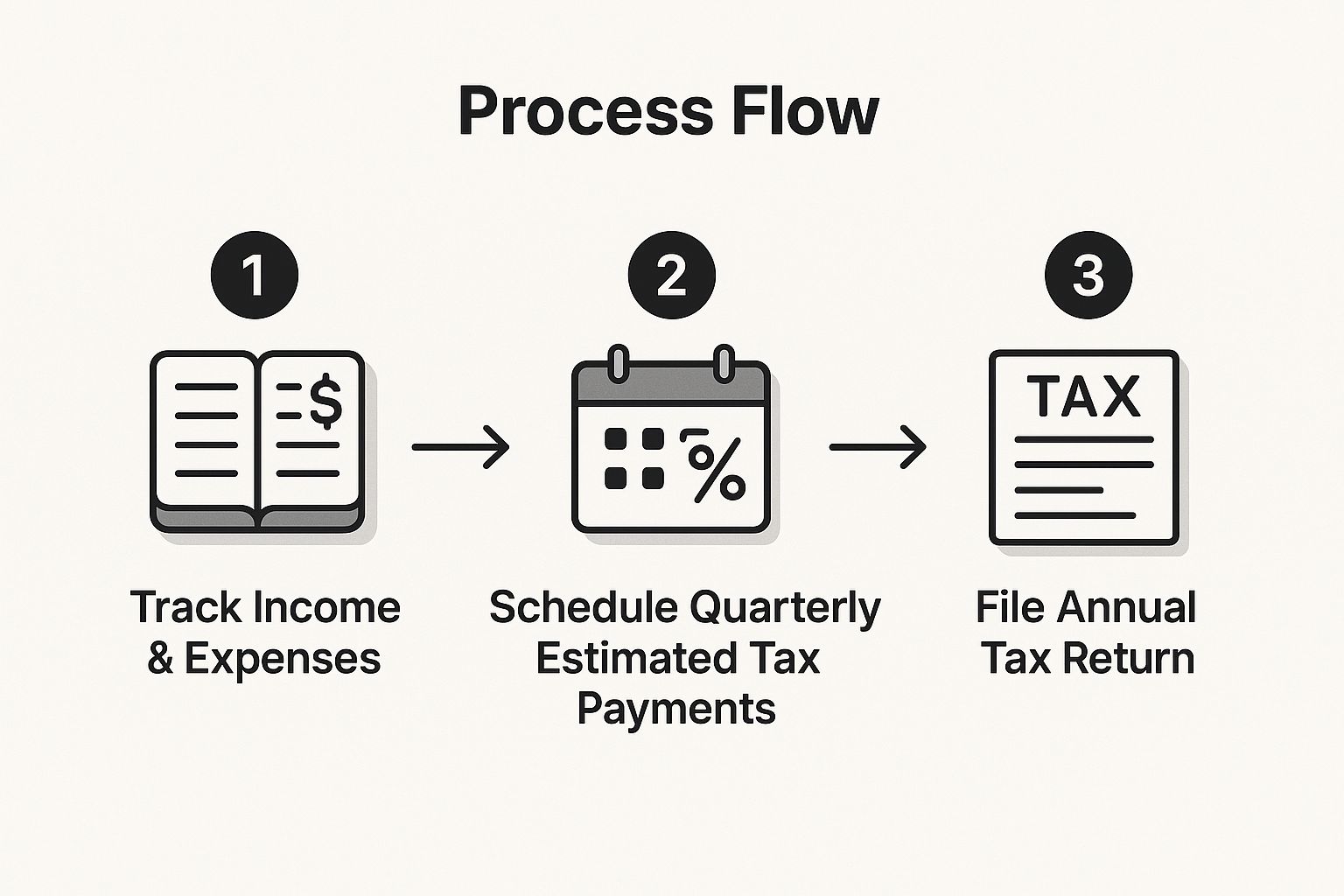
As the visual flow demonstrates, compliance is a continuous cycle, starting with diligent tracking and culminating in your final annual filing.
Actionable Steps for Implementation
To stay on the right side of the IRS, implement these practices:
- Automate Record-Keeping: Use accounting software like QuickBooks or Xero to automatically track your income and categorize expenses. This eliminates manual errors and saves you countless hours.
- Create a Tax Savings Account: Open a separate business savings account and regularly transfer 25-30% of your gross income into it. This ensures funds are available when your estimated tax payments are due.
- Know Your Deadlines: Mark your calendar for the IRS quarterly estimated tax deadlines: April 15, June 15, September 15, and January 15 of the following year.
- Retain Meticulous Records: Keep all receipts, bank statements, and invoices for at least seven years. Digital copies stored in the cloud are an excellent, affordable way to safeguard this documentation.
2. Employment Tax and Labor Law Compliance
Once your business grows beyond a solo operation, mastering employment tax and labor law compliance becomes your critical next step. For any Monterey business with a team, whether it's a restaurant in Carmel-by-the-Sea or an agricultural firm in Salinas, this area of the small business compliance checklist is fraught with complexity. It encompasses a wide range of your obligations, including federal and state payroll tax withholding, proper worker classification, wage and hour laws, and workplace safety standards mandated by OSHA and Cal/OSHA.

Getting this wrong can lead to steep fines, back-pay lawsuits, and damage to your reputation. For example, if you run a tech startup in Seaside, you must correctly distinguish between independent contractors who receive a 1099 and full-time employees who get a W-2 to avoid misclassification penalties. Likewise, a retail store in Pacific Grove must meticulously track hours and calculate overtime to comply with California’s strict wage laws.
Why It's a Top Priority
Neglecting labor laws and employment tax duties exposes your business to significant legal and financial risks. Staying compliant provides foundational stability and protects your greatest asset: your people.
- Mitigates Legal Risk: Correctly classifying your workers and adhering to wage laws helps prevent costly lawsuits and government investigations.
- Ensures Accurate Payroll: Proper withholding for Social Security, Medicare, and income taxes ensures your employees are paid correctly and your tax remittances are accurate.
- Fosters a Positive Workplace: Complying with safety standards and labor laws shows you're committed to your team's well-being, which improves morale and retention.
Key Insight: View labor compliance not as a bureaucratic hurdle, but as a framework for building a fair, safe, and sustainable business. Proactive management is always less expensive than reactive cleanup.
Actionable Steps for Implementation
To build a compliant and resilient workforce management system, follow these steps:
- Use a Payroll Service: Automate tax calculations, payments, and filings by using a reputable payroll service like Gusto or ADP. This is an affordable way to minimize errors and ensure deadlines are met.
- Review Worker Classifications: Annually, or whenever a role changes significantly, review the status of your workers (employee vs. contractor) with legal or HR counsel to ensure they are classified correctly under California's ABC test.
- Display Required Posters: Post all mandatory federal and state labor law notices in a location highly visible to all your employees, such as a break room. These posters are available from government agencies.
- Maintain Detailed Records: Keep meticulous records of all hours worked, wages paid, and overtime calculations for each employee for at least three to four years, as required by federal and state law.
- Stay Current on Local Ordinances: Be aware that minimum wage and paid sick leave laws can vary by city or county, so monitor local regulations in addition to state and federal mandates.
3. Business Licenses and Permits
Operating legally is about more than just paying taxes; it involves securing the proper legal authorizations to conduct business in your specific location and industry. For your company, from a small retail shop in Monterey to an agricultural tech firm in Salinas, navigating the web of required business licenses and permits is a critical component of a small business compliance checklist. These authorizations are your official permission slips from federal, state, and local governments to operate, and overlooking even one can lead to forced closures, fines, or legal action.
Obtaining the right permits is a non-negotiable step before you even open your doors. A home-based bakery in Marina, for instance, needs more than just a general business license; it likely requires a cottage food permit and a food handler's license from the Monterey County Health Department. Similarly, a construction company in Seaside can't break ground without a valid contractor's license and specific building permits for each project, ensuring they meet safety and zoning regulations.
Why It's a Top Priority
Failing to secure and maintain the correct licenses can bring your business to a grinding halt before it even gains momentum. The advantages of staying current are foundational:
- Ensures Legal Operation: Possessing the right licenses is the most basic requirement for legally conducting business and protects you from fines and shutdowns.
- Builds Customer Trust: Displaying your valid permits and professional licenses demonstrates credibility and shows customers you adhere to industry standards.
- Unlocks Business Opportunities: Many contracts, especially with government agencies or larger corporations, require proof of specific licenses and permits before you can even bid on a project.
Key Insight: Treat licensing not as a one-time task but as an ongoing responsibility. Regulations change, and permits expire, so proactive management is essential to keeping your business operations uninterrupted.
Actionable Steps for Implementation
To ensure you are fully licensed and compliant, follow these strategic steps:
- Conduct Thorough Research: Before you launch, use resources like the U.S. Small Business Administration (SBA) and the California Governor's Office of Business and Economic Development (GO-Biz) to identify all required federal, state, county, and city licenses for your specific industry and location.
- Create a Renewal Calendar: Licenses are not permanent. Set up calendar alerts and reminders 90 days before any permit expires. This gives you ample time to complete the renewal process without risking a lapse in compliance.
- Verify Jurisdictional Requirements: If you serve clients across different cities, like a consultant working in both Carmel-by-the-Sea and Pacific Grove, confirm if you need separate business licenses for each municipality you operate in.
- Keep Licenses Accessible: Store physical copies of all licenses and permits in a designated binder at your place of business. Also, maintain high-quality digital scans in a secure, low-cost cloud folder for easy access and backup.
4. Sales Tax Collection and Remittance
For your business in the Monterey Bay Area selling goods or taxable services, navigating sales tax is a critical component of state and local compliance. From a retail shop in Monterey to an online artisan in Marina, correctly handling your sales tax obligations is essential for legal operation and financial stability. This part of your small business compliance checklist involves registering for the right permits, accurately calculating and collecting tax, and remitting those funds to the correct government agencies on time.
Understanding and managing sales tax isn't just about adding a percentage at the checkout. It requires you to have a deep understanding of what is taxable, where it is taxable (nexus), and how to document everything properly. For instance, a Seaside e-commerce business selling handmade goods across the country must use software to calculate the correct tax rates for thousands of jurisdictions. A local restaurant in Carmel must also properly manage sales tax, including knowing how to handle tax-exempt sales to qualifying organizations.
Why It's a Top Priority
Mismanaging sales tax can lead to significant financial liabilities, including back taxes, steep penalties, and interest charges that can accumulate quickly. A proactive approach to your sales tax compliance provides several key advantages:
- Avoids Financial Penalties: Filing and paying on time prevents costly fines and audits from state agencies like the California Department of Tax and Fee Administration (CDTFA).
- Builds Customer Trust: Correctly charging sales tax demonstrates professionalism and transparency, assuring customers that you are a legitimate and compliant business.
- Protects Business Viability: Unpaid sales tax is a debt that can follow you, the business owner, personally, making it a high-stakes area of compliance.
Key Insight: Treat sales tax as money you are holding in trust for the government, not as business revenue. This mindset shift helps you prioritize timely and accurate remittance and prevents cash flow issues when tax payments are due.
Actionable Steps for Implementation
To ensure you are correctly managing your sales tax obligations, follow these concrete steps:
- Register Before Your First Sale: Before you sell any taxable item, register with the CDTFA to obtain your seller's permit. This is a legal prerequisite for collecting sales tax in California.
- Use Automation Software: If you sell online to customers in multiple states, use sales tax automation software like Avalara or TaxJar. These tools integrate with your e-commerce platform to calculate the correct rates, track nexus thresholds, and simplify filing—an affordable way to get enterprise-level functionality.
- Maintain Impeccable Records: Keep detailed records of all your sales, both taxable and non-taxable. For exempt sales, you must retain a valid, fully completed exemption certificate from the buyer.
- File on Time, Every Time: Mark your filing deadlines on your calendar. You must file a return for every reporting period, even if you had zero sales. This prevents penalties for non-filing.
5. Business Insurance Requirements
For any small business, whether it's a bustling cafe in Monterey or a tech startup in Marina, securing the right business insurance is a critical layer of your financial and legal protection. This goes far beyond a simple recommendation; it's a mandatory component of a robust small business compliance checklist. Insurance acts as your safety net, shielding your company from the potentially catastrophic costs of accidents, lawsuits, and unforeseen events.
Proper insurance compliance means you're holding legally required policies like workers' compensation and understanding which additional coverages are essential for your specific operations. For instance, a construction company in Seaside must secure workers' compensation and potentially bonding for its projects. In contrast, a marketing consultancy in Carmel must prioritize professional liability (E&O) insurance to cover claims related to its strategic advice. Neglecting this area exposes your business assets, and even your personal assets, to significant risk.
Why It's a Top Priority
Failing to secure adequate insurance can lead to devastating financial losses, regulatory penalties, and a complete loss of client trust. The advantages of being properly insured are substantial:
- Mitigates Financial Risk: Insurance protects your business from the crippling costs of liability claims, property damage, and employee injuries.
- Ensures Legal Compliance: It helps you meet state and federal requirements, particularly for workers' compensation and unemployment insurance, helping you avoid fines.
- Builds Credibility: Having the right insurance, like general or professional liability, signals to clients and partners that you are a responsible and stable business.
Key Insight: View insurance not as an expense, but as a strategic investment in your business’s longevity and resilience. The right policies allow you to operate with confidence, knowing you are protected from a variety of operational risks.
Actionable Steps for Implementation
To ensure your business is adequately protected, implement these best practices:
- Work with a Commercial Insurance Agent: Partner with an experienced agent who understands the specific risks faced by businesses in the Monterey Bay area, from agriculture to hospitality. They can help you identify necessary coverage and find competitive rates.
- Review Coverage Annually: As your business grows or changes, so do your risks. Conduct an annual review of your policies to ensure your coverage levels are still appropriate for your revenue, staff size, and services.
- Understand Policy Exclusions: Don't just look at what's covered; pay close attention to what is excluded. Ask your agent to explain any limitations so there are no surprises when you need to file a claim.
- Bundle Policies: Ask your insurance provider about a Business Owner's Policy (BOP), which often combines general liability, commercial property, and business interruption insurance at a lower cost than purchasing them separately.
6. Data Protection and Privacy Compliance
In today's digital world, safeguarding your customer and employee data isn't just good practice; it's a legal necessity. For businesses from a boutique hotel in Monterey to a growing agricultural tech firm in Salinas, understanding data protection and privacy is a critical part of your small business compliance checklist. This involves managing how you collect, store, process, and protect personal information, governed by a growing web of state, federal, and even international laws.

Failing to comply can result in steep fines, damage to your reputation, and loss of customer trust. For instance, if you have an e-commerce store in Seaside, you must provide California residents with clear opt-out mechanisms under the California Consumer Privacy Act (CCPA). Likewise, a small medical clinic in Marina must adhere to the stringent patient data handling rules of the Health Insurance Portability and Accountability Act (HIPAA). Navigating these rules is essential for your sustainable growth.
Why It's a Top Priority
Neglecting data privacy can expose your business to significant legal and financial risks, making it a crucial compliance area. A proactive approach delivers tangible benefits:
- Reduces Legal Liability: Adhering to laws like CCPA and HIPAA helps you avoid massive fines and potential lawsuits.
- Builds Customer Trust: Demonstrating a commitment to protecting personal information enhances your brand's reputation and fosters customer loyalty.
- Strengthens Cybersecurity: Implementing strong data protection measures naturally improves your overall defense against cyberattacks and data breaches.
Key Insight: Treat data privacy not as a one-time project, but as an ongoing business function. By embedding privacy principles into your operations from the start ("Privacy by Design"), you build a resilient and trustworthy organization.
Actionable Steps for Implementation
To ensure your business meets its data protection obligations, implement these core practices:
- Conduct a Data Inventory: Map out exactly what personal data you collect, where it's stored, how it's used, and who has access. This is the foundational step for any privacy program.
- Implement "Privacy by Design": When you develop new products or services, build privacy and security features in from the beginning, rather than adding them as an afterthought.
- Secure Data with Encryption: Use encryption for sensitive data both when it is stored (at rest) and when it is being transmitted (in transit). This is an enterprise-level tactic that is now affordable for you to implement.
- Train Your Team: Regularly educate all your employees on your privacy policies, data handling procedures, and how to spot phishing attempts. Your team is your first line of defense.
- Develop an Incident Response Plan: Know exactly what to do if a data breach occurs. This plan should outline steps for containment, investigation, and notification to comply with legal requirements.
For a deeper dive into the technical side of securing your digital assets, you can learn more about cybersecurity compliance essentials for 2025 and how to build a robust defense.
7. Industry-Specific Regulations
Beyond the universal rules of taxes and labor laws, your small business in the Monterey Bay Area likely has to navigate a complex web of industry-specific regulations. This is a critical component of any small business compliance checklist because these rules are tailored to your sector—like agriculture, education, or hospitality—and often carry significant penalties for non-compliance. These requirements are not optional; they are the baseline for operating legally and safely within your chosen field.
For example, a food truck operating in downtown Monterey has a different set of rules than a financial advisor in Carmel-by-the-Sea. You know the food truck must adhere to stringent Monterey County Health Department codes and maintain food safety certifications, while the financial advisor must maintain specific securities licenses and fulfill continuing education requirements. Likewise, an agricultural business in the Salinas Valley must comply with environmental regulations and worker safety standards unique to farming operations.
Why It's a Top Priority
Ignoring sector-specific mandates can lead to forced closures, license revocation, and steep fines that can cripple a small business. Staying current with these specialized rules is essential for your long-term viability.
- Ensures Operational Legitimacy: Complying with industry standards demonstrates credibility and professionalism to your customers, partners, and regulators.
- Mitigates Unique Risks: These regulations are designed to address specific dangers, from foodborne illness in hospitality to data breaches in finance, protecting both your business and your clients.
- Maintains Professional Standing: For licensed professionals, compliance is directly tied to your right to practice. Failing to meet requirements like continuing education can result in losing your certification.
Key Insight: View industry compliance not as a bureaucratic hurdle, but as a strategic framework for excellence. Adhering to these standards often aligns with best practices that improve your quality, safety, and customer trust.
Actionable Steps for Implementation
To effectively manage your industry-specific obligations, a proactive approach is necessary:
- Join Industry Associations: Organizations like the Monterey County Vintners & Growers Association or local hospitality groups provide invaluable, often low-cost resources, updates, and guidance on regulatory changes.
- Create a Compliance Calendar: Track all your renewal deadlines for licenses, permits, and certifications. Set reminders for required continuing education or mandatory safety training sessions.
- Conduct Regular Internal Audits: Don't wait for a regulator to find a problem. Periodically review your own processes against industry checklists to identify and correct any compliance gaps.
- Consult with Specialists: Establish relationships with attorneys or consultants who specialize in your industry. Their expertise is crucial for navigating complex or changing regulations.
8. Corporate Governance and Reporting
For your formal business entity, from an agricultural C-corp in Salinas to a hospitality LLC in Monterey, proper corporate governance is the structural backbone that preserves your legal integrity. This critical component of a small business compliance checklist involves the ongoing legal duties required to maintain your business's good standing with state authorities. It’s about more than just the initial formation; it’s about the consistent, documented actions that protect your limited liability status.
Effective corporate governance means you are adhering to the rules set by your business structure and the state. Neglecting these obligations can lead to severe consequences, including the "piercing of the corporate veil," which makes you personally liable for business debts. For example, a corporation in Marina must hold and document annual shareholder meetings, while an LLC in Seaside must keep its operating agreement updated and file its biennial Statement of Information with the California Secretary of State.
Why It's a Top Priority
Failing to maintain corporate formalities can invalidate the very legal protections you sought when you formed your business entity. The benefits of diligent governance are foundational:
- Preserves Limited Liability: Correctly following corporate procedures ensures a clear separation between your personal and business assets, protecting you from personal liability.
- Ensures Legal Good Standing: Timely filings and reports keep your business compliant with state requirements, preventing administrative dissolution or penalties.
- Improves Operational Clarity: Maintaining records like meeting minutes and updated operating agreements provides a clear history of major decisions, resolving potential disputes among owners.
Key Insight: View corporate governance not as bureaucratic red tape, but as essential maintenance for your business's legal shield. Consistent record-keeping and timely filings are your best defense against legal and financial risks.
As governance intersects with operational security, many businesses find value in external expertise. Learn more about how expert IT consulting in Monterey can support your compliance infrastructure and secure your critical business records.
Actionable Steps for Implementation
To ensure your business remains legally sound and protected, implement these practices:
- Calendar All Filing Deadlines: Immediately mark your calendar with reminders for state-mandated filings, such as California’s biennial Statement of Information or annual report deadlines in other states.
- Maintain a Corporate Records Binder: Keep a physical or digital binder with your formation documents, bylaws or operating agreement, meeting minutes, stock ledger, and resolutions. Document all major decisions.
- Understand Beneficial Ownership Information (BOI) Reporting: Comply with the federal Corporate Transparency Act by filing a BOI report with FinCEN, detailing who ultimately owns or controls your company. This is a new but mandatory requirement for most small businesses.
- Utilize a Registered Agent Service: Using a professional registered agent service is an affordable way to ensure you never miss a critical legal notice or state correspondence, especially if your business operates in multiple locations or you don’t maintain a consistent physical office address.
Small Business Compliance Checklist Comparison
| Compliance Area | Implementation Complexity 🔄 | Resource Requirements ⚡ | Expected Outcomes 📊 | Ideal Use Cases 💡 | Key Advantages ⭐ |
|---|---|---|---|---|---|
| Federal Income Tax Compliance | High – complex tax codes and frequent changes | Moderate to high – record-keeping, possible CPA | Accurate tax reporting, penalty avoidance | Small businesses, freelancers, corporations | Reduces taxable income, supports audit defense |
| Employment Tax and Labor Law | High – multi-jurisdictional and legal nuance | High – payroll systems, legal counsel, HR | Compliance with labor laws, avoids costly audits | Businesses with employees across states | Protects from misclassification lawsuits |
| Business Licenses and Permits | Moderate – varied by jurisdiction and industry | Moderate – application fees, renewal tracking | Legal authorization to operate, avoids fines | All businesses depending on industry/location | Ensures legal operations, builds customer trust |
| Sales Tax Collection and Remittance | High – complex multi-state rules and nexus | High – tax software, detailed sales tracking | Accurate collection/remittance, avoids penalties | Retailers, e-commerce, multi-state sellers | Streamlines multi-state compliance |
| Business Insurance Requirements | Moderate – coverage selection and renewals | Moderate to high – ongoing premiums and reviews | Risk mitigation, legal and financial protection | All businesses depending on risk and contracts | Protects against lawsuits and losses |
| Data Protection and Privacy | High – evolving regulations and technical needs | High – legal, IT security, training | Avoids fines, builds trust, reduces breach risk | Businesses handling personal/client data | Competitive advantage & regulatory compliance |
| Industry-Specific Regulations | High – specialized rules and certifications | High – continuous education, audits, consulting | Ensures safety, competency, and legal operation | Regulated sectors like healthcare, finance, food | Builds credibility and reduces liability |
| Corporate Governance and Reporting | Moderate to high – ongoing filings and records | Moderate – administrative services and legal help | Maintains legal status and limited liability | Corporations, LLCs, businesses in multiple states | Preserves legal protections and good standing |
Your Next Step: From Checklist to Compliant
Navigating the complexities of business regulations can feel like a monumental task, but you have now worked through a comprehensive small business compliance checklist. From federal taxes and local Salinas permits to the intricate web of data privacy laws like the CCPA, you’ve gained a clear roadmap. This isn't just about avoiding fines; it’s about building a resilient, trustworthy, and sustainable business right here in the Monterey Bay Area.
Think of this checklist not as a finish line, but as the foundation upon which your business can securely grow. Each item you address, from securing the right business insurance to implementing proper corporate governance, adds another layer of protection. It solidifies your reputation with customers, attracts and retains top talent, and positions you for long-term success, whether you're in the agricultural fields of the Salinas Valley or the bustling hospitality scene of Carmel-by-the-Sea.
Key Takeaways: From Theory to Action
Completing this checklist moves compliance from an abstract concept to a tangible, manageable process. The most critical takeaway for you is that compliance is not static. It’s a living, breathing aspect of your business that requires ongoing attention.
Here are the core principles to carry forward:
- Proactive vs. Reactive: The most successful businesses anticipate compliance needs rather than reacting to audits or, worse, data breaches. A proactive stance saves you money, time, and immense stress down the road.
- Documentation is Your Defense: If it isn’t written down, it didn’t happen. Meticulous records for employment, tax filings, and corporate meetings are your best defense in any dispute or audit. This is your business’s official story.
- Data is a Liability and an Asset: Handling customer and employee data carries immense responsibility. Treating data protection as a core business function, not just an IT task, protects you from severe financial and reputational damage.
- Local Knowledge is Power: While federal laws apply to everyone, your specific obligations for sales tax, business licenses, and industry-specific rules are dictated by your operations in Monterey County. Staying current with local ordinances is non-negotiable.
Building a Culture of Compliance
Your journey doesn't end with checking off the final box. The next, most crucial step is to weave these practices into the very fabric of your company culture. This transforms compliance from a burdensome list of rules into "the way we do things here."
How do you achieve this?
- Lead from the Top: As the business owner or manager, your commitment sets the tone. When you prioritize compliance, your team will follow suit.
- Train Your Team: Your employees are your first line of defense. Regular training on data security, privacy policies, and workplace safety is essential. An informed employee is a compliant one.
- Schedule Regular Reviews: Set a recurring calendar appointment, perhaps quarterly or semi-annually, to review your small business compliance checklist. Ask yourself: Has our business changed? Have new regulations been introduced? Are our policies still adequate?
- Leverage Professional Expertise: You don’t have to be an expert in everything. Partnering with legal, financial, and IT professionals is not an admission of weakness; it's a strategic strength. It frees you up to focus on what you do best: running and growing your business.
Mastering compliance is the ultimate act of protecting your hard work. It ensures that the business you’ve poured your heart into is built on solid ground, ready to weather any storm and seize every opportunity that comes its way in our vibrant Monterey Bay community.
Don't let IT and cybersecurity compliance become a barrier to your growth. For expert guidance in implementing robust security measures and navigating complex data regulations, trust the local experts at Adaptive Information Systems. We specialize in providing enterprise-level IT solutions tailored for the needs and budgets of businesses throughout the Monterey Bay Area.
Ready to transform your compliance checklist into a powerful business asset? Contact Adaptive Information Systems today for a no-obligation consultation and see how we can secure your success.
Adaptive Information Systems
380 Main St, Salinas CA 93901 | 831-644-0300 | hello@adaptiveis.net