

Here’s the thing about hackers: they love small businesses because they see them as easy targets. Cybercriminals are opportunistic, and they know that small companies often hold incredibly valuable data without the kind of fortress-like security that big corporations have. For them, it's a low-risk, high-reward job with a quick payday. If you’re running a business anywhere in Monterey County, from Salinas to Carmel, understanding this risk is your first line of defense.
Why Your Small Salinas Business Is A Prime Target
If you’re running a business anywhere in Monterey County, from a farm in Salinas to a hotel in Carmel, you've probably had this thought: "Are we really at risk? We're just a small company." It's a perfectly normal question, but it's rooted in a dangerous assumption. The belief that your size keeps you safe is one of the biggest—and most costly—myths in cybersecurity today.
However, recent insights show that 79% of SMBs have experienced a cyberattack, despite 26% believing they are too small to be targeted. What this actually means for you is that being small doesn’t make you invisible—it makes you vulnerable. Hackers know smaller businesses often lack the resources or security infrastructure to respond quickly or detect intrusions. They see you not just as a local shop, but as an unlocked door leading to a quick profit.
The Numbers Don't Lie
It’s easy to dismiss these warnings as a problem for big-city corporations, not a local Monterey business. But the data paints a very different, and much closer to home, picture.
Shockingly, 79% of small and mid-sized businesses (SMBs) have experienced a cyberattack, even though 26% of their owners believe their company is too small to be targeted.
What this really means for you is that being small doesn’t offer protection—it creates vulnerability. Hackers operate like predators looking for the easiest meal, and they’ve learned that smaller companies often lack dedicated IT staff, advanced security tools, or even basic protections needed to spot an intrusion or respond quickly. You and your team are busy running your business, which is exactly what criminals are counting on. We dive deeper into this in our article debunking common IT security myths that could put your business at risk.
The good news is that you don't have to be an easy target. Building a strong defense starts with foundational steps that make a massive difference. Start with basic protections: enable multi-factor authentication (MFA), keep software updated, and consider outsourced cybersecurity from a managed IT provider like Adaptive Information Systems. A great first step is to learn more about our Managed IT Services.
Want to see where your company stands? Let us perform a free cybersecurity risk check—no strings attached.
Adaptive Information Systems
380 Main St, Salinas CA 93901 | 831-644-0300 | hello@adaptiveis.net
The Hacker's Playbook For Targeting SMBs
To understand why hackers seem to love small businesses, it helps to start thinking like one. Picture a burglar walking down a quiet street in Monterey, methodically checking every single door handle. They aren't looking for a fortress with armed guards; they're searching for the one door someone forgot to lock. If you don't have the right protections in place, that unlocked door is your business.
Hackers run a business model built on volume and efficiency. Their entire strategy revolves around finding and exploiting the path of least resistance. Hitting one large, well-defended corporation is incredibly difficult and time-consuming. In stark contrast, targeting hundreds of smaller, less-prepared businesses is a much more profitable and repeatable game.
This simple flowchart shows the direct line from a hacker's motivation straight to your business's front door.
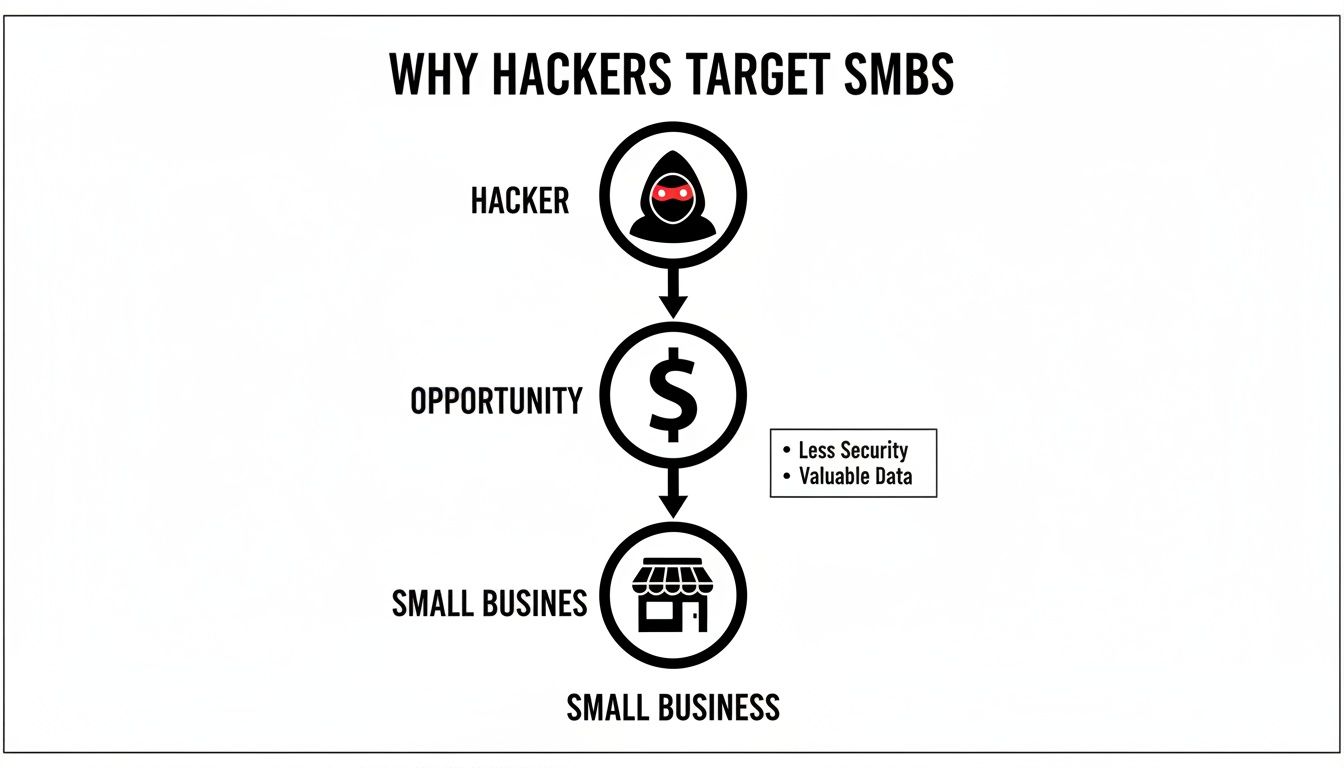
The visualization makes it crystal clear: hackers see your small business as a direct path to a payday. They aren't targeting you personally; they're targeting the vulnerabilities they know are common in companies your size.
Exploiting Limited IT Budgets
One of the biggest vulnerabilities hackers count on is your budget. As a small business owner, you're constantly juggling priorities. Investing in advanced cybersecurity software or hiring a full-time IT expert might feel like a luxury you just can't afford, especially when weighed against payroll, inventory, or marketing.
Cybercriminals know this. They know that without a dedicated IT budget, your business is probably running on older hardware, using unpatched software, or missing critical security tools like a business-grade firewall. For them, a limited budget is a wide-open invitation.
Imagine a ransomware attack paralyzing a Salinas farm's shipping system right in the middle of peak harvest season. The cost of just a few days of downtime could easily blow past the annual cost of a solid security plan. Hackers are betting that you haven't made that investment, making you a prime target for attacks designed to bring your operations to a grinding halt. You can learn more about how to get ahead of these threats by reading our guide on how to prevent ransomware attacks.
The Absence Of A Security Expert
Even if you have some security measures in place, who's actually managing them? In most small businesses, IT responsibilities fall to the owner, an office manager, or an employee who is simply "good with computers." You and your team are already wearing multiple hats just to keep the lights on.
This lack of dedicated expertise is a critical gap that hackers are masters at exploiting. They know you likely don't have someone whose sole job is to monitor network traffic for suspicious activity, train staff on spotting phishing emails, or stay up-to-date on the latest threats. This creates a dangerous knowledge gap they can drive a truck through.
A cybercriminal’s business model depends on this reality. The startling statistic that 43% of all cyberattacks targeted small businesses highlights their focus on this segment. Recent data shows 79% of small businesses were hit by an attack in the last five years, yet 64% still believe they are too small to be a target. This gap between perception and reality is where hackers thrive, as many businesses skip basic defenses like firewalls or email filtering.
Gaps In Employee Security Training
Your employees are your greatest asset, but without the right training, they can also become your biggest security risk. Hackers understand that the easiest way into a network isn't through some complex technical wizardry but through a simple human error.
To understand how hackers turn common business vulnerabilities into opportunities, take a look at this table. It breaks down the typical weak spots they look for and the specific tactics they use to exploit them.
Common SMB Vulnerabilities And Hacker Tactics
| Common SMB Vulnerability | How Hackers Exploit It |
|---|---|
| Outdated Software & Systems | Running old versions of Windows or key applications leaves known security holes unpatched. Hackers use automated tools to scan for and attack these specific openings. |
| Weak or Reused Passwords | Employees using simple passwords (like "Spring2024!") or the same one for multiple services makes it easy for attackers to guess or use stolen credentials to gain access. |
| No Multi-Factor Authentication (MFA) | Without MFA, a stolen password is all a hacker needs to get into your email, bank accounts, or cloud services. It's like leaving the key under the doormat. |
| Untrained Employees | A busy employee who doesn't know how to spot a phishing email is the perfect target. Hackers send fake invoices or urgent requests to trick them into clicking a bad link. |
| Lack of a Firewall | A missing or misconfigured firewall leaves your network ports exposed to the internet, allowing attackers to probe for weaknesses and launch direct attacks. |
As you can see, hackers don't need to be geniuses; they just need to be persistent. They craft convincing phishing emails designed to trick a busy employee into clicking a malicious link or giving up their login credentials. An email that looks like a legitimate invoice from a vendor or an urgent request from a bank can be all it takes to compromise your entire system. This is a tactic they use over and over again simply because it works.
Without regular, ongoing security awareness training, your team is left to fend for themselves against seasoned criminals. The key takeaway is that hackers build their entire strategy on these predictable vulnerabilities—budget, expertise, and training—which are common challenges for almost every small business.
Common Cyberattacks Facing Monterey County Businesses
Now that you understand why small businesses are such an appealing target, let's pull back the curtain on how hackers actually get in. Cybercriminals aren't using impossibly complex methods you see in spy movies. Far from it. They rely on a handful of proven, repeatable tactics that prey on common human behaviors and predictable security gaps.
Understanding their playbook is the first step in building your own defense. Think of it like a shopkeeper in Seaside learning how to spot a counterfeit bill—once you know what to look for, the fakes become much easier to see. Let's break down the most common attacks you're likely to face as a Monterey County business owner.

Phishing: The Most Common Entry Point
If a hacker’s toolkit has a Swiss Army knife, phishing is it. It's the most widespread and effective type of attack they have, responsible for the vast majority of initial breaches. A phishing attack is really just a digital con game. A criminal sends an email or text message that looks like it's from a legitimate source—a bank, a vendor, or even a trusted colleague.
The goal is simple: trick you or an employee into doing something that benefits the attacker. That could mean clicking a malicious link, downloading an infected attachment, or giving up sensitive info like passwords or financial details. Think of it as a wolf in sheep's clothing arriving directly in your inbox.
Local Scenario: Imagine your bookkeeper gets an email that looks like it's from a major agricultural supplier you work with in the Salinas Valley. The email urgently claims their banking information has changed and provides new wire instructions for an outstanding invoice. In the rush of a busy day, the payment is sent. But the money doesn't go to your supplier—it goes straight into a criminal's account.
Ransomware: The Digital Hostage Situation
Ransomware is one of the most feared attacks out there, and for very good reason. It's a type of malicious software (malware) that, once it gets onto your network, encrypts all your critical files. We're talking customer data, financial records, operational documents—everything—making it all completely inaccessible.
The attackers then demand a ransom, usually in cryptocurrency, in exchange for the decryption key that will unlock your files. For a small business, this is a devastating scenario. It’s the digital equivalent of a burglar changing the locks on your building and demanding a huge payment to let you back inside.
Losing access to your systems for even a single day can halt your entire operation, torpedo your reputation, and lead to massive financial losses that go far beyond the ransom itself.
Business Email Compromise (BEC): The Impersonation Scam
Business Email Compromise (BEC) is a much more sophisticated and targeted version of phishing. Instead of blasting out thousands of generic emails, attackers do their homework. They might research your company, identify key people like the CEO or CFO, and then use that intel to impersonate them convincingly.
In a typical BEC scam, a hacker either gains access to an executive's real email account or creates a nearly identical one (e.g., jane.doe@adaptiveis.net vs. jane.doe@adaptive-is.net). They then email someone in your finance department, instructing them to make an urgent wire transfer for a confidential acquisition or a new vendor payment.
Because the request appears to come from a trusted authority figure, the employee often complies without a second thought. This is a quiet, devastating attack that bypasses technical defenses by exploiting the most human of vulnerabilities: trust and the pressure of workplace hierarchies.
Malware: The Unwanted Guest
While ransomware is one type of malware, the term actually covers a whole range of malicious software designed to disrupt your business or steal your data. Malware can be hidden in email attachments, disguised as legitimate software downloads, or even embedded in compromised websites you might visit.
Common types of malware include:
- Spyware: This nasty software secretly monitors your computer activity, capturing keystrokes, passwords, and other sensitive information.
- Trojans: These disguise themselves as useful programs but carry a hidden malicious payload that activates once they're installed on your system.
- Adware: This one inundates your device with unwanted pop-up ads, which can sometimes be a gateway to more dangerous infections.
These attacks often happen silently in the background, siphoning off data for weeks or months before they’re ever discovered. Knowing these threats is crucial, as many of them are preventable. For a closer look, you can explore our guide on the top 10 cybersecurity threats your business should have on its radar. By recognizing these tactics, you can better equip your team to spot the warning signs and protect your company's future.
The True Cost Of A Cyberattack On Your Business
A security breach isn't just a technical glitch; it's a potential business-ending event. When cybercriminals hit, the damage goes way beyond the initial ransom payment or stolen data. The real costs are deep, painful, and can linger for years, sending ripples through every part of your operation.
For a small business, underestimating these consequences is a gamble you just can't afford to take.
Imagine the chaos if your small hotel in Pacific Grove suddenly had its booking system frozen solid during the height of tourist season. Every reservation would vanish, online bookings would grind to a halt, and your front desk would be completely paralyzed. The immediate financial gut punch is staggering, but it’s only the beginning of the nightmare.
The Financial Fallout Beyond The Ransom
The first cost that comes to mind is usually the ransom itself, but that's often just the tip of the iceberg. The financial bleeding continues long after the attack is over, draining your resources in ways you might not expect.
These hidden costs can quickly spiral, turning a single incident into a long-term financial crisis.
- Operational Downtime: Every single hour your systems are offline is an hour you aren't serving customers, closing deals, or bringing in revenue. For a local financial advisor in Monterey, this means no access to client portfolios, no ability to execute trades, and a complete halt to the business.
- Recovery and Remediation: Getting back on your feet is an expensive, uphill battle. It means bringing in IT experts to investigate the breach, scrub your systems, restore data from backups (if they even work), and securely rebuild your network. Those emergency services come at a premium.
- Regulatory Fines and Legal Fees: If you handle sensitive client information—like financial records or personal data—a breach can trigger serious legal heat. You could be looking at hefty fines for not complying with data protection laws, not to mention the cost of defending yourself against lawsuits from angry customers.
The Damage You Can't Put A Price On
While the dollars and cents are scary enough, some of the most devastating impacts of a cyberattack are the ones you can't easily measure. These intangible losses can permanently cripple the business you’ve poured your life into building.
The true cost of a breach is often measured in lost trust. When customers feel their data isn't safe with you, they will take their business elsewhere—and they often won't come back.
This erosion of trust is catastrophic. A local business thrives on its reputation within the community. Once that reputation is tarnished by a security incident, rebuilding it is an exhausting, uphill battle. News travels fast, and the perception that your business is unsafe is incredibly difficult to shake.
Reputational Harm And Loss Of Customer Confidence
Think about the long-term stain on your brand. A data breach sends a clear signal to your customers, partners, and suppliers that your company might not be a safe place to do business. This can lead to a mass exodus of clients and make it incredibly difficult to attract new ones.
The hard truth is this: the investment in proactive cybersecurity is just a tiny fraction of the devastating cost of recovery. Protecting your business from an attack isn’t just another expense; it’s one of the smartest, most critical decisions you can make for your future. It's about making sure one unlocked digital door doesn't lead to the collapse of everything you've built.
Your First Steps To Building A Stronger Cyber Defense
Feeling overwhelmed? You’re not alone. When you start digging into cybersecurity risks, it’s easy to feel like building a solid defense is an impossible task for a small business. But security is a journey, not a destination, and you can take practical, powerful first steps today without breaking the bank.
The key is to focus on foundational, high-impact actions that shut the most common doors hackers use. You don’t need a massive budget or a dedicated security team to make a real difference. A few basic protections can dramatically reduce your risk and make your business a much harder target.
Start With The Essentials
Think of your digital security like securing your physical storefront in Monterey. You start by putting strong locks on the doors and windows before you even think about installing a complex alarm system. The same principle applies here.
Before you do anything else, nail down these three non-negotiable actions:
Enable Multi-Factor Authentication (MFA): This is the single most effective security measure you can take, period. MFA is like needing two unique keys to unlock your front door instead of just one. Even if a hacker steals your password, they can't get in without that second key (usually a code sent to your phone). Turn it on for everything: email, banking, accounting software, and cloud storage.
Keep All Software Updated: Those constant update notifications aren't just for adding new features; they contain critical security patches that fix the very vulnerabilities hackers are looking for. Running outdated software is the digital equivalent of leaving a window wide open for criminals to climb through. Make it a policy to install updates as soon as they’re available.
Implement Employee Security Training: Your team is your first and last line of defense. Regular, simple training can teach them how to spot phishing emails, use strong passwords, and avoid common online scams. An aware employee is a human firewall, and often a more effective one than any piece of software alone.
These steps aren't complicated or expensive, but they are incredibly powerful in disrupting a hacker's playbook. If you're looking for a solid foundation, our guide on Cyber Security 101 can walk you through more of these core concepts.
Understand The Gaps You Are Facing
Many small business owners try to handle security themselves, but it's a complex and fast-moving field. Research shows exactly why hackers love small businesses so much: 74% handle security in-house or with help from untrained acquaintances, and 49% admit they have significant skill gaps. For local businesses like Salinas farms or Monterey schools, this often results in exposed networks and weak defenses.
On top of that, digital isn't the only risk. To achieve absolute certainty that sensitive data on old devices is permanently erased, implementing secure hard drive shredding is a crucial first step in building a stronger cyber defense. Overlooking physical data disposal can leave a surprising amount of sensitive information exposed.
Partner With A Professional For Real Peace Of Mind
This is where bringing in a professional becomes your most powerful next step. You're an expert in your field, whether that's hospitality or agriculture; you shouldn't have to become a cybersecurity expert, too.
What this actually means for you is that being small doesn’t make you invisible—it makes you vulnerable. Hackers know smaller businesses often lack the resources or security infrastructure to respond quickly or detect intrusions.
An outsourced cybersecurity provider acts as your dedicated IT department, giving you access to enterprise-level tools and expertise at a fraction of the cost of hiring someone in-house. A managed IT provider like Adaptive Information Systems can handle the monitoring, updates, and threat detection so you can focus on running your business. It's the most effective way to close that security gap and get genuine peace of mind.
Want to see where your company stands? Let us perform a free cybersecurity risk check—no strings attached.
Adaptive Information Systems
380 Main St, Salinas CA 93901 | 831-644-0300 | hello@adaptiveis.net
How a Local IT Partner Creates Peace of Mind
You're an expert in your field. Whether that means growing the finest produce in the Salinas Valley or managing a beloved shop on the Monterey wharf, your energy belongs to your business—not to becoming a cybersecurity specialist. You shouldn't have to. The constant pressure to defend against ever-changing digital threats can feel like a second full-time job you never signed up for.
This is where having the right local partner changes the entire game. At Adaptive Information Systems, our mission is built on a simple promise: delivering enterprise-level IT at an affordable price for local SMBs. We believe powerful, proactive security isn't a luxury reserved for massive corporations. It should be an accessible tool that helps our community’s businesses thrive safely.

Your Proactive, Outsourced IT Department
Partnering with a managed IT provider isn't just about buying software; it's about gaining a dedicated team. Think of us as your proactive, in-house IT department, constantly working behind the scenes to keep you safe. Instead of reacting to problems after they happen, our job is to stop them from happening in the first place.
We handle the complex, time-consuming tasks so you can get back to what you do best.
- 24/7 Threat Monitoring: Cybercriminals don’t work a 9-to-5 schedule, and neither does our monitoring. We watch over your network around the clock, catching and neutralizing suspicious activity before it can escalate into a full-blown crisis.
- System Patching and Updates: We manage all your software updates and security patches, making sure the digital windows and doors that hackers look for are always locked. This consistent maintenance is a simple but absolutely critical layer of defense.
- Expert Guidance and Support: Have a question about a fishy email? Need advice on new technology? Our team is right here to give you clear, straightforward answers and act as your trusted technology advisor.
Turning Vulnerability Into Strength
The central reason why hackers love small businesses is the assumption that you're on your own. They’re betting on you being too busy, under-resourced, and lacking the expert knowledge to mount a serious defense. Bringing in a local IT expert completely flips that script.
The core takeaway is simple: being a small business doesn't mean you have to be vulnerable. With the right local partner, you can build a defense that makes hackers move on to an easier target.
A managed services partnership is about more than just security; it’s about operational stability and growth. For comprehensive protection and operational stability, consider how managed IT services for small business in California can transform your company. It lets you confidently adopt new technologies, knowing your foundation is secure. You can find more details in our complete guide to the benefits of Managed IT Services.
Take the First Step Toward Peace of Mind
You’ve worked too hard building your business to leave its future to chance. Protecting it doesn’t have to be complicated or overwhelming. It all starts with a simple conversation. You can finally stop worrying about the "what ifs" and gain the confidence that comes from knowing you have a professional team watching your back.
It’s time to make your business a hard target.
Want to see where your company stands? Let us perform a free cybersecurity risk check—no strings attached.
Adaptive Information Systems
380 Main St, Salinas CA 93901 | 831-644-0300 | hello@adaptiveis.net
Your Questions, Answered
We talk with local business owners every day, and a lot of the same questions and worries about cybersecurity come up. Let's get right to it with some clear, straightforward answers to help you protect the company you’ve worked so hard to build.
Are We Really a Target? We’re Just a Small Company in Monterey
This is the number one question we hear, and it’s rooted in a dangerous myth. The short answer is yes, you are absolutely a target. Recent data shows that a staggering 79% of SMBs have faced a cyberattack, even though 26% of owners still believe they’re too small to be noticed.
Here’s what that really means for your business: being small doesn't make you invisible—it makes you an easier meal. Hackers know smaller companies often don't have the security budget or dedicated IT staff to fend off an attack. They see you as a quicker, simpler payday than a fortified global corporation.
Is Cybersecurity Too Expensive for a Small Business Budget?
Not at all. Effective cybersecurity doesn't have to break the bank. While big, complex enterprise tools can be costly, some of the most powerful defenses are actually foundational and highly affordable. Simple moves like turning on multi-factor authentication and training your staff on how to spot phishing emails cost next to nothing but deliver a massive return on security.
Partnering with a local IT provider is another smart way to manage costs. It gives you access to expert-level protection and advanced tools for a predictable monthly fee—a tiny fraction of what it would cost to hire a full-time IT specialist or clean up after a data breach.
What Is the Single Most Important Step We Can Take Right Now?
If you do only one thing today, enable multi-factor authentication (MFA) on every single one of your critical accounts. That means your email, online banking portals, and any cloud software that holds customer or financial data. Think of MFA as adding a heavy-duty deadbolt to your digital front door. Even if a thief steals your password (the key), they still can't get inside without that second verification step from your phone.
This one simple action is the fastest, most effective thing you can do to immediately slash your risk from the most common types of attacks. It's a game-changer.
How Can We Protect Ourselves Without Being IT Experts?
You don’t have to become a cybersecurity guru to be secure. The smartest approach for a business owner who isn’t a tech expert is to nail the basics and then partner with a professional for the heavy lifting.
Start with these fundamental, high-impact steps:
- Turn on multi-factor authentication (MFA) for all your important accounts.
- Keep your software and systems updated. Those updates often contain critical patches for security holes.
- Consider outsourcing your cybersecurity to a Managed IT Services provider like us here at Adaptive Information Systems.
A managed IT partner becomes your dedicated security team, handling all the complex technical work behind the scenes. That leaves you free to focus on running your business with real peace of mind.
Want to see where your company stands? Let us perform a free cybersecurity risk check—no strings attached.
Adaptive Information Systems
380 Main St, Salinas CA 93901 | 831-644-0300 | hello@adaptiveis.net