
Imagine this: a wildfire forces evacuations during the height of Monterey Car Week, or a critical server crashes right in the middle of harvest season. For a Salinas business like yours, these aren't just hypotheticals; they're real-world risks. Business continuity solutions are the proactive plans and technologies that keep your operations running when—not if—a disruption happens.
This is about more than just IT. It’s the complete operational safety net protecting your team, your hard-earned reputation, and your revenue stream.

Keeping Your Salinas Business Resilient
For any business in Monterey County, from Salinas to Carmel, disruptions are an unfortunate fact of life. Whether it's a PG&E power outage, a supply chain issue hitting local agriculture, or a cyberattack trying to lock down your systems, downtime is a direct threat to your bottom line.
Could your business truly survive being offline for a day? What about a week?
Many small and mid-sized business (SMB) owners feel like this kind of resilience is a luxury reserved for massive corporations. At Adaptive Information Systems, we see things differently. We believe robust protection is a fundamental need for every local business, and our mission is to make enterprise-level IT accessible and affordable for you.
What Is a Business Continuity Solution?
Think of a business continuity solution as your company’s "what-if" playbook. It’s a comprehensive strategy designed to ensure your most critical functions can keep going during and after a crisis. This isn't just about data backups; it’s a holistic approach that covers your people, your processes, and your technology.
A strong continuity plan answers the critical questions before you’re forced to ask them: How will your team work if the office is inaccessible? How will you communicate with customers during an outage? How quickly can you restore essential services and data to avoid financial loss?
This proactive planning is what separates businesses that stumble during a crisis from those that stand strong. It’s about building a foundation of resilience so you can confidently face whatever comes your way.
Why Every SMB Needs a Plan
The stark reality is that a significant disruption can be devastating. Studies show that a shocking 40% of small businesses never reopen following a major disaster. The cost of downtime isn't just measured in lost sales, either. It hits you in other ways, too.
- Damaged Reputation: In tight-knit communities like ours, trust is everything. Being the business that goes dark during a crisis can have long-lasting effects on your brand.
- Lost Customer Loyalty: If customers can't reach you or access your services, they will quickly find a competitor who can help them. It's that simple.
- Operational Chaos: Without a clear plan, your team is left scrambling. This leads to confusion, stress, and inefficiency right when you can least afford it.
By investing in a business continuity solution, you aren't just buying an IT service. You're securing the future of your company, protecting your employees' livelihoods, and guaranteeing that you can continue serving the community you worked so hard to build.
Understanding Business Continuity and Disaster Recovery
Let’s clear up some common confusion. People often use "business continuity" and "disaster recovery" as if they mean the same thing, but they're two very different—though closely related—concepts. Getting the distinction right is the first step toward building a business that can weather any storm.
Think of it this way: business continuity is your complete game plan for a crisis. It’s the entire playbook detailing how every part of your business will keep functioning during a major disruption—your people, your processes, and your customer service. It’s the big-picture strategy for operational survival.
Disaster recovery (DR), on the other hand, is a critical chapter within that playbook. It focuses almost exclusively on getting your IT infrastructure and data back online after something goes wrong. If business continuity is about keeping the entire business running, disaster recovery is about getting the lights back on in your server room (or your cloud environment).
Proactive Strategy Versus Reactive Scramble
Here's the key takeaway: business continuity is all about being proactive. You aren't waiting for a fire, flood, or cyberattack to happen before you figure out what to do. You’re creating a calm, logical, and tested plan to follow when things inevitably go sideways. Without one, you’re left scrambling, making high-stakes decisions under immense pressure.
A solid continuity plan has a few straightforward goals:
- Protect Your People: First and foremost, ensure your team is safe. Give them clear instructions on how to keep working securely, whether that's from home or a temporary office.
- Maintain Critical Processes: Keep your core operations—like processing orders, running payroll, or serving clients—online to prevent a complete and costly shutdown.
- Secure Your Profits and Reputation: Minimize the financial bleeding and maintain customer trust by showing you’re a reliable partner, even when things get tough.
This proactive mindset is gaining serious traction. The Business Continuity Management (BCM) market was recently valued at around USD 754 million and is expected to explode to over USD 2.2 billion by 2033. This growth is fueled by a rising awareness of just how fragile operations can be.
The Stark Reality of Being Unprepared
The difference between having a plan and winging it becomes painfully obvious during a real incident. These numbers paint a pretty clear picture of what’s at stake.
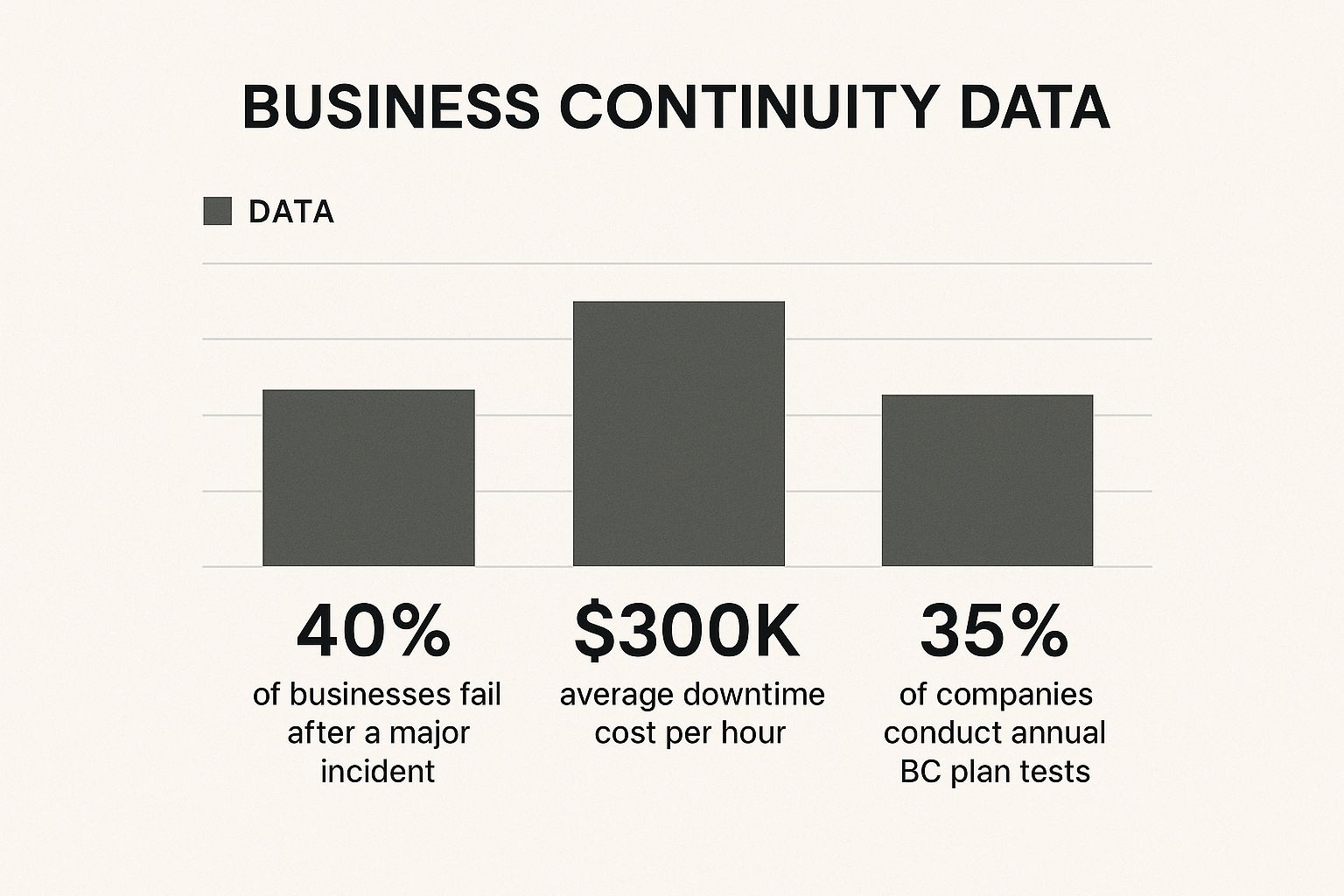
The data tells a scary story: the cost of failure is astronomical, yet most businesses aren't even testing their plans. To really see how this plays out in the real world, let’s compare the two scenarios.
Business Operations During a Crisis With vs Without a Plan
Take a look at how a typical crisis unfolds for a prepared business versus an unprepared one. The difference is night and day.
| Metric | Business WITH Continuity Plan | Business WITHOUT Continuity Plan |
|---|---|---|
| Initial Response | Coordinated execution of pre-defined roles and recovery steps. | Disorganized scramble with unclear leadership and priorities. |
| Downtime Duration | Minimized. Critical systems are restored within hours or even minutes. | Extended. Recovery could take days or weeks, if it happens at all. |
| Customer Impact | Proactive communication maintains trust; service interruptions are minimal. | Customers are left in the dark, leading to frustration and churn. |
| Financial Loss | Contained and predictable, with minimal impact on long-term revenue. | Significant and potentially catastrophic, threatening business viability. |
| Reputation | Strengthened. The business is seen as reliable and resilient. | Severely damaged, potentially leading to a permanent loss of trust. |
As you can see, one path leads to a managed recovery, while the other leads straight to chaos. The outcomes couldn't be more different.
For a closer look at the IT side of this, check out our guide on how backup and disaster recovery services benefit small businesses. It’s a foundational piece of the larger business continuity puzzle you can’t afford to ignore.
The Essential Components of Your Continuity Plan

A powerful business continuity plan is so much more than just backing up your data. It’s a complete operational strategy designed to keep every critical part of your business—from your tech to your team—running, no matter what happens.
Think of it less like a single tool and more like a comprehensive toolkit. Each component has a specific job to do, and together, they make your company incredibly resilient.
At Adaptive IS, we help you assemble this toolkit affordably, making sure you have the right pieces in place long before an emergency ever strikes. Let's break down the essential building blocks of the business continuity solutions that will protect your SMB.
The goal isn't to create a massive, complicated document that just gathers dust on a shelf. It's about building a living, breathing strategy that covers your people, technology, and facilities—one that your whole team understands and can put into action at a moment's notice.
The Business Impact Analysis
The first and most important piece of any continuity plan is the Business Impact Analysis (BIA). Before you can protect your business, you have to know exactly what makes it tick. The BIA is how we diagnose and identify your most critical functions and the resources that keep them going.
During a BIA, we’ll work with you to answer some key questions:
- Which business processes are absolutely essential for bringing in revenue?
- What’s the maximum amount of downtime each process can handle before it causes serious damage? (This gives us your Recovery Time Objective, or RTO).
- What specific technology, people, and suppliers do these critical processes rely on?
The answers form the foundation of your entire continuity strategy. It tells you exactly where to focus your time and money to protect what truly matters, ensuring you aren't overspending on things that aren't mission-critical.
Recovery and Continuity Strategies
Once you know your critical functions, the next step is building the strategies to keep them running during a disruption. This goes way beyond just your IT. A complete plan addresses recovery across three core areas.
-
Technology Recovery: This is where data backups and IT infrastructure shine. It involves having robust systems ready to restore your servers, applications, and critical data in a hurry. You can learn more in our guide on data backup and recovery for Salinas and Monterey businesses.
-
People and Process Continuity: What happens if your team can't get to the office? A modern plan must include strategies for remote work, giving employees secure access to the systems they need from anywhere. It also means documenting key processes so others can step in if a primary team member is out.
-
Facility and Supply Chain Continuity: This part of the plan deals with your physical location and outside dependencies. It could mean identifying an alternative work site or ensuring you have backup suppliers for essential materials—a common concern we see with our local agriculture and hospitality clients.
A Clear Communication Plan
When a crisis hits, confusion is your worst enemy. An effective communication plan is what ensures everyone—from your employees to your customers—knows exactly what's going on and what they need to do.
A communication plan isn't an afterthought; it's the operational glue that holds your response together. It ensures clear, consistent messaging that builds confidence and minimizes panic, both internally and externally.
Your plan should clearly outline:
- Who is in charge of communication? Designate one person as the point of contact to avoid mixed signals.
- How will you contact employees? Plan to use multiple channels like text alerts, a phone tree, and personal email.
- What will you tell customers? Prepare templates ahead of time for website banners, social media posts, and customer emails to provide quick, honest updates.
By putting these essential components together, you create a holistic defense system. It’s a practical strategy that ensures your business continuity solutions are robust, actionable, and perfectly aligned with the real-world needs of your organization.
Why Proactive Planning Is a Competitive Advantage
In a tight-knit community like ours, where a business in Carmel might serve customers from Pacific Grove and beyond, reputation is everything. When disaster strikes—whether it's a wildfire, a power grid failure, or a cyberattack—the real cost of downtime goes far beyond lost sales. It’s about the promises you keep to your customers and the trust you’ve spent years building.
Viewing business continuity solutions as just another IT expense is a common but costly mistake. Savvy business owners see it for what it truly is: a core strategy for sustainable growth and a powerful competitive advantage. Being the one business that stays open when others can't is a message that resonates deeply with the community.
Protect Your Brand and Customer Loyalty
Imagine a major storm hits the Monterey Peninsula, knocking out power and communications. While your competitors are scrambling with unanswered phones, your business keeps humming. Your team can still access customer data, process orders, and communicate because you had a plan for this exact scenario.
This is how you turn a potential crisis into a brand-building opportunity.
- Maintain Customer Trust: When you continue to provide service in the face of disruption, you prove your reliability. Customers always remember the businesses that were there for them during tough times.
- Prevent Customer Churn: Downtime gives customers a perfect reason to look elsewhere. A solid continuity plan ensures they have no reason to leave.
- Enhance Your Reputation: Word-of-mouth is incredibly powerful. Being known as the dependable company that weathers any storm solidifies your position as a local leader.
Meet Regulatory Compliance with Confidence
For many local industries, from financial services firms on Alvarado Street to healthcare clinics, compliance isn't optional. Regulations like HIPAA have strict requirements for data protection and availability. A failure to meet them can trigger massive fines and legal headaches you just don't need.
A well-designed business continuity plan is your documented proof of due diligence. It shows auditors and regulators that you have taken serious, proactive steps to protect sensitive information and maintain operational integrity, no matter what happens.
This isn’t just about dodging penalties; it's about operating with integrity. It sends a clear signal to your clients and partners that you take your responsibilities seriously, building an invaluable layer of trust.
Achieve Sustainable Growth and Viability
Resilience is the bedrock of long-term growth. Businesses that are constantly reacting to emergencies can never truly get ahead. They’re stuck putting out fires instead of focusing on what really matters: innovation, customer service, and expansion.
This proactive mindset is catching on. The market for Business Continuity Management Solutions was recently valued at USD 3.28 billion and is projected to hit USD 6.92 billion by 2033. This surge proves that organizations everywhere are waking up to the fact that resilience is essential for survival. You can read more about the growing BCM market and the role of cloud technology on verifiedmarketreports.com.
A critical piece of modern resilience is strong cybersecurity. You can dive deeper into this topic by reading our small business guide to network security.
By investing in a proactive continuity plan, you break free from the "what-if" cycle of anxiety. You create a stable operational environment where you can focus on what you do best—serving your customers and growing your business. In an unpredictable world, that's the ultimate competitive edge.
Choosing the Right Business Continuity Partner in Monterey County
Picking an IT partner to build out your business continuity plan is one of the most important decisions you'll make for your company’s future. You’re not just buying another service; you're trusting a partner with your operational lifeline. It's vital to find a team that understands your business, your goals, and the unique challenges we all face operating right here in Monterey County.
Your partner should feel like an extension of your own team—a seasoned expert who is genuinely invested in your success. They need to provide more than just technology. They need to deliver confidence and peace of mind.

Prioritize Local Expertise Over National Call Centers
For businesses in our area, a partner who understands the local landscape is non-negotiable. A national, one-size-fits-all provider won't grasp the specific risks facing a Salinas-based agricultural firm during harvest season or a hospitality business in Carmel during a major event. You need a partner who gets it.
A local provider just brings more to the table:
- Faster, On-Site Support: When a true emergency hits, you don't want to be stuck in a queue for a remote call center. You need local technicians who can be there in person, ready to help.
- Understanding of Regional Risks: From wildfires to specific supply chain vulnerabilities, a local partner builds plans based on real-world regional threats, not generic templates.
- Commitment to the Community: Local providers are your neighbors. Their reputation is built on serving businesses like yours, creating a level of accountability you just won't find with a faceless corporation.
Choosing a partner is a major step. For more guidance on what to look for, you can explore our detailed breakdown of how to select from the various IT service providers available to you.
Key Questions to Ask Any Potential Partner
To properly vet a provider and make sure they’re the right fit, you need to ask the right questions. Their answers will tell you everything about their technical skill, strategic approach, and whether they're committed to being a true partner.
Go into your conversations armed with this checklist:
-
How do you test the recovery plan regularly? The only way to know if a plan works is to test it. A good partner will insist on at least annual testing and give you detailed reports on what they find.
-
Do you offer 24/7 local support? Disasters don’t stick to a 9-to-5 schedule. You have to know you can reach a knowledgeable, local person who can act immediately, day or night.
-
What is your approach to proactive monitoring? The best business continuity solutions stop issues before they cause downtime. Your partner should be using advanced tools to monitor your systems around the clock, not just reacting when something breaks.
-
How will you customize the plan for our specific business and budget? Steer clear of any provider pushing a rigid, pre-packaged deal. A true partner starts by understanding your operations and budget to build a plan that delivers maximum value without fluff.
A business continuity plan should never be a "set it and forget it" document. It must be a living strategy that evolves with your business. Your IT partner’s role is to ensure it remains effective, tested, and ready for action at all times. This proactive management is the core of real resilience.
Making Enterprise-Level Resilience Affordable for Your SMB
A lot of small business owners hear "business continuity" and immediately see dollar signs. There's this lingering myth that serious operational protection is a luxury reserved for giant corporations with bottomless IT budgets. We’re here to set the record straight: that’s just not true anymore.
Thanks to smarter strategies and modern cloud technology, true resilience is more accessible—and affordable—than ever. You don’t need an enterprise-sized bank account to get enterprise-level protection. The key is to be strategic, not just to spend more.
At Adaptive IS, our entire approach is built on this very idea. We don't push expensive, one-size-fits-all packages. Instead, we act as your dedicated IT consultant, working with you to create a customized plan that fits your specific operational needs and, just as importantly, your budget.
Your Path to Affordable Resilience
Achieving powerful resilience on an SMB budget isn't about cutting corners; it's about making smart, targeted investments. We focus on strategies that deliver the biggest bang for your buck, ensuring every dollar works hard to protect what matters most.
Often, this starts by getting more out of the technology you already own. We can frequently build a strong continuity foundation using your existing infrastructure, only adding the specific tools needed to fill critical gaps. It’s a much more efficient and cost-effective way to get started.
Another key strategy is phased implementation.
- We kick things off with a Business Impact Analysis (BIA) to pinpoint your most essential functions—the ones that would cause the most damage if they went down.
- From there, we focus on protecting those high-priority operations first.
- This gives you immediate, meaningful protection where it counts, allowing you to build out the rest of your plan over time as your budget allows.
This methodical approach keeps you from feeling overwhelmed financially while delivering tangible security right from the start.
Smart Investments for Maximum Impact
Protecting your business isn't just about hardware and software; it's also about people and processes. Today, the smartest investments in business continuity solutions focus on two key areas: strengthening your human defenses and using intelligent technology to spot threats faster.
Industry data confirms this trend. Even with tight budgets, around 69% of IT decision-makers are planning to boost their cybersecurity spending. They're wisely putting their resources where they matter most, with 44% allocating funds to employee education and 41% investing in AI-enabled security tools. As you can find out by exploring more about these business continuity statistics, these areas are central to modern, robust BCM strategies.
Building a resilient business is a journey, not a one-time purchase. It starts with a smart, affordable plan that grows with you. By focusing on targeted investments and practical strategies, you can achieve a level of protection that gives you true peace of mind.
For local companies, this kind of strategic IT support is a game-changer. It levels the playing field, allowing you to compete with confidence. If you're looking for a partner to help you navigate this, our team provides dedicated Salinas business IT support designed to make your technology a powerful asset. By combining the right technology with expert guidance, we make sure your business is ready for anything.
Common Questions About Business Continuity
As a local IT partner, we get a lot of questions from business owners thinking about making the jump to a formal continuity plan. We get it—you have more than enough on your plate without adding another project. That’s why we believe in giving direct, clear answers.
Here are a few of the most common questions we hear about business continuity solutions.
How Long Does It Take to Create a Plan?
This is a great question, and the answer is almost always "faster than you think." For most small and mid-sized businesses, we can get the initial Business Impact Analysis (BIA) done and have your core recovery strategy mapped out in just a few weeks. The exact timeline really depends on how complex your operations are.
Our approach is all about phased implementation. We don’t try to boil the ocean. Instead, we start by protecting your most critical functions first, giving you immediate value and peace of mind without a huge upfront commitment.
Isn't a Continuity Plan Just Fancy Data Backups?
Not at all, and this is probably the most important distinction to make. Data backup is a vital part of business continuity, but it's only one piece of a much larger puzzle.
Think of it this way:
Backups are like having all your ingredients safely stored in the pantry. A full business continuity plan, however, is the complete recipe book and the emergency generator that keeps the kitchen running, no matter what happens outside. It’s the roadmap for recovering your entire operation—your people, your applications, and your processes—so you can keep serving customers.
It’s the difference between saving your information and saving your business.
How Often Should We Test Our Plan?
A plan is only useful if you know for a fact that it works. We strongly recommend testing your continuity plan at least once a year, or anytime you make a big change to your IT systems, key staff, or core business processes.
Regular testing isn't about finding fault; it's about building confidence. Think of these tests as a fire drill for your business operations. They ensure the plan is still effective, expose any gaps that have appeared over time, and make certain your team knows exactly what to do when it counts. This practice is what turns a document on a shelf into a living, reliable strategy.
Ready to build a business that can weather any storm? The team at Adaptive Information Systems is here to make enterprise-level protection simple and affordable for your Monterey County business. Let's build your plan together.
Adaptive Information Systems
380 Main St, Salinas CA 93901 | 831-644-0300 | hello@adaptiveis.net